Clinical Knowledge › Internal medicine › Endocrinology › Calcium and bone disorders
Primary hyperparathyroidism
Primary hyperparathyroidism (PHPT) is autonomous overproduction of parathyroid hormone (PTH) by one or more parathyroid glands, giving a raised or high-normal calcium with a PTH that is raised or inappropriately normal. It is the commonest cause of hypercalcaemia in outpatients, peaks in postmenopausal women and is usually found on a routine blood test. About 85% of cases are a single adenoma; multigland hyperplasia suggests a hereditary syndrome such as MEN1, and carcinoma is rare. Classic consequences are kidney stones, osteoporosis (especially at the forearm), fragility fractures, thirst, polyuria, fatigue, low mood and, when calcium is very high, confusion and dehydration. Familial hypocalciuric hypercalcaemia must be excluded with a urine calcium:creatinine clearance ratio. Parathyroidectomy is the only cure and is recommended for anyone with symptoms or end-organ disease, calcium more than 0.25 mmol/L above normal, or age under 50, and can be offered to all fit patients. Cinacalcet and bisphosphonates or denosumab help those who cannot have surgery.
Patient case, mechanism, investigations, management, flashcards and exam-style questions.Open the lesson →
Key facts
- Diagnosis: raised albumin-adjusted calcium with a raised or inappropriately normal PTH; check vitamin D and urine calcium
- Single adenoma in about 85%, multigland hyperplasia 10–15% (think MEN1, MEN2A, lithium), carcinoma under 1% (very high calcium and PTH, palpable neck mass)
- Exclude familial hypocalciuric hypercalcaemia (FHH): calcium:creatinine clearance ratio below 0.01 suggests FHH, which needs no surgery
- Exclude secondary causes of a raised PTH: vitamin D deficiency, CKD, thiazides and lithium
- Fifth International Workshop (2022) surgical criteria: calcium more than 0.25 mmol/L (1 mg/dL) above normal, T-score −2.5 or less or vertebral fracture, eGFR below 60, stones or nephrocalcinosis, hypercalciuria, or age under 50
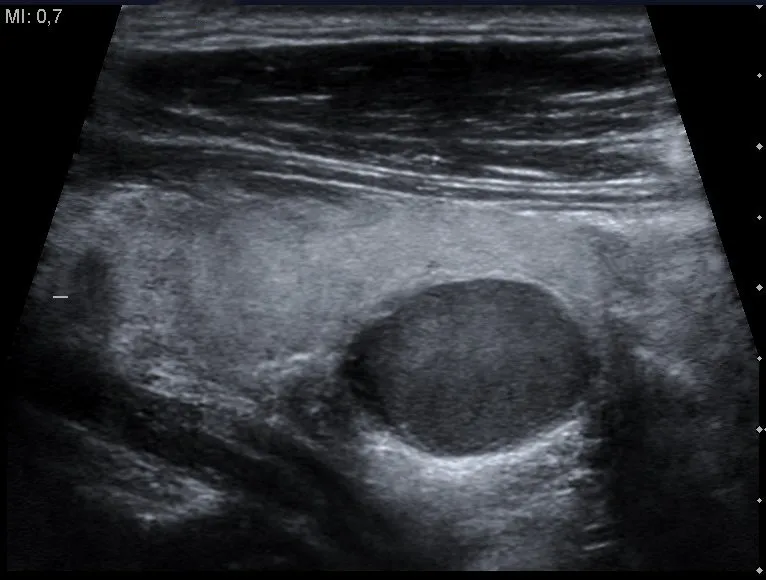
- Localise only after the biochemical diagnosis: neck ultrasound and sestamibi, or 4D-CT or 18F-fluorocholine PET/CT, to plan focused surgery
- Intraoperative PTH falling by more than 50% 10 minutes after excision predicts cure
- Cinacalcet lowers calcium but not bone loss; bisphosphonates or denosumab protect bone in patients who do not have surgery
Differential diagnosis
| Condition | Clues | Key test |
|---|---|---|
| Familial hypocalciuric hypercalcaemia | Lifelong mild hypercalcaemia, family history, no complications | Calcium:creatinine clearance ratio below 0.01; CASR genetic testing |
| Hypercalcaemia of malignancy | Rapid onset, weight loss, very high calcium, known cancer | PTH suppressed; PTHrP raised |
| Secondary hyperparathyroidism (vitamin D deficiency) | Normal or low calcium, low phosphate, bone pain | Low 25-hydroxyvitamin D; PTH falls after repletion |
| Tertiary hyperparathyroidism | Long-standing CKD or after kidney transplant | High calcium and PTH with CKD history |
| Lithium-associated hyperparathyroidism | Bipolar disorder on long-term lithium | Drug history; often multigland |
| Thiazide-associated hypercalcaemia | Mild hypercalcaemia on a thiazide | Repeat calcium and PTH 3 months after stopping the thiazide if safe |
| Granulomatous disease or vitamin D excess | Sarcoidosis, TB, lymphoma or high-dose supplements | PTH suppressed; high 1,25-dihydroxyvitamin D |
Exam pearls
Guideline
Fifth International Workshop on Primary Hyperparathyroidism guidelines (2022), NICE NG132 Hyperparathyroidism (primary): diagnosis, assessment and initial management (2019) and AAES guidelines for definitive management (2016)
References
- Bilezikian JP, Khan AA, Silverberg SJ, et al.. Evaluation and management of primary hyperparathyroidism: summary statement and guidelines from the Fifth International Workshop. J Bone Miner Res 2022.
- National Institute for Health and Care Excellence (NICE). Hyperparathyroidism (primary): diagnosis, assessment and initial management (NG132). NICE, London 2019.
- Wilhelm SM, Wang TS, Ruan DT, et al.. The American Association of Endocrine Surgeons guidelines for definitive management of primary hyperparathyroidism. JAMA Surg 2016.
- Insogna KL.. Primary hyperparathyroidism. N Engl J Med 2018.
- Walker MD, Silverberg SJ.. Primary hyperparathyroidism. Nat Rev Endocrinol 2018.
- Thakker RV, Newey PJ, Walls GV, et al.. Clinical practice guidelines for multiple endocrine neoplasia type 1 (MEN1). J Clin Endocrinol Metab 2012.
Related topics
By Dr Khalid Seidi (B.Sc., M.D.) · MedEd World Clinical Knowledge library. Original teaching content checked against current guidelines (November 2026); confirm the latest local guidance before clinical use. Not a substitute for clinical judgement.