Clinical Knowledge › Internal medicine › Endocrinology › Calcium and bone disorders
Paget disease of bone
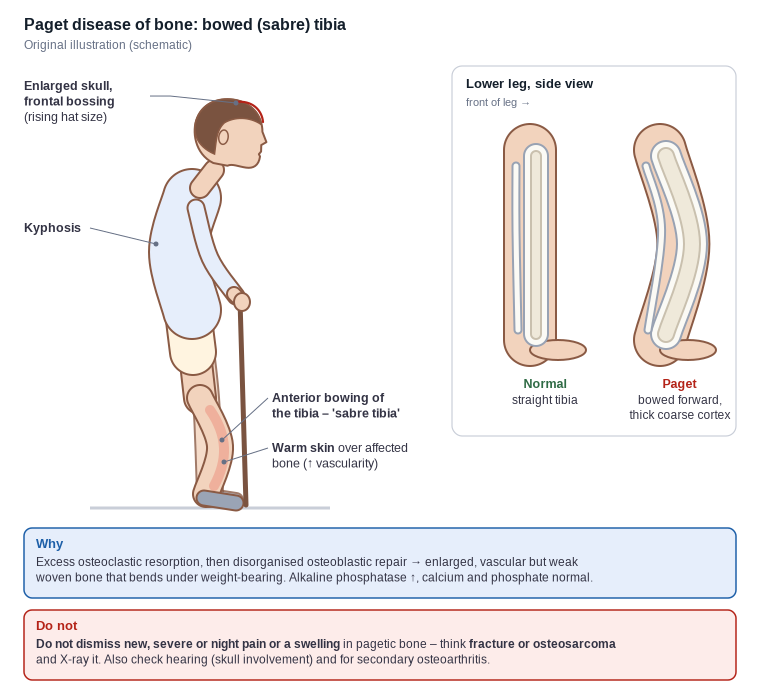
Paget disease of bone is a focal disorder of bone remodelling in which overactive, abnormal osteoclasts resorb bone and osteoblasts respond by laying down disorganised woven bone. The affected bone becomes enlarged, more vascular, deformed and weaker than normal. It is the second commonest metabolic bone disease after osteoporosis, is rare before 55 years, and is most common in people of British ancestry, although its prevalence and severity have fallen over recent decades. Mutations in SQSTM1 (p62) are found in many familial and some sporadic cases. Most people have no symptoms and are found by an isolated raised alkaline phosphatase or an incidental X-ray. Others present with bone pain, bowing of the legs, an enlarging skull, deafness, fractures, secondary osteoarthritis or nerve compression; osteosarcoma is a rare but important late complication. Diagnosis rests on typical X-ray changes plus a raised total alkaline phosphatase with normal calcium, phosphate and liver tests, and a radionuclide bone scan defines the extent. A single infusion of zoledronic acid is the most effective treatment for bone pain from active disease; treatment is aimed at symptoms rather than at normalising alkaline phosphatase.
Patient case, mechanism, investigations, management, flashcards and exam-style questions.Open the lesson →
Key facts
- Focal, disorganised bone remodelling: large multinucleated osteoclasts drive resorption, followed by chaotic woven bone formation
- Classic biochemistry: raised total alkaline phosphatase (ALP) with normal calcium, phosphate, GGT and bilirubin
- Commonest sites: pelvis, lumbar spine, femur, skull and tibia; usually polyostotic, and new bones rarely become affected after diagnosis
- SQSTM1 (p62) mutations are found in about 40% of familial and about 10% of sporadic cases; inheritance is autosomal dominant with incomplete penetrance
- X-ray: cortical thickening, coarse trabeculae and bone expansion; lytic 'blade of grass' front in long bones and osteoporosis circumscripta in the skull
- Radionuclide bone scan (technetium-99m bisphosphonate) shows intense uptake in all affected bones and defines extent at diagnosis
- Zoledronic acid 5 mg IV once gives the best and longest pain response; check vitamin D and calcium first to avoid hypocalcaemia
- New or worsening pain and swelling in pagetic bone suggests fracture or osteosarcoma (under 1% of patients) and needs urgent imaging
Differential diagnosis
| Condition | Clues | Key test |
|---|---|---|
| Osteoblastic bone metastases (prostate, breast) | Older man with back pain, weight loss; bone not enlarged; cortex not thickened | PSA, CT; bone scan pattern; biopsy |
| Osteomalacia | Diffuse bone pain, proximal myopathy, low or normal calcium and low phosphate | 25-OH vitamin D, PTH, phosphate; Looser zones on X-ray |
| Primary hyperparathyroidism | Raised calcium with high or inappropriately normal PTH; ALP only mildly raised | Calcium, PTH, urinary calcium |
| Liver disease (cholestasis) | Raised ALP with raised GGT and bilirubin | GGT, liver ultrasound; bone-specific ALP |
| Fibrous dysplasia | Younger patient, ground-glass lesions, may have café-au-lait spots | X-ray or CT appearance; GNAS testing; biopsy |
| Multiple myeloma | Lytic lesions, anaemia, raised calcium; ALP usually normal | Serum free light chains, electrophoresis, whole-body low-dose CT |
| Osteosarcoma in pagetic bone | New severe pain, swelling, pathological fracture in known Paget disease | MRI and CT of the lesion; biopsy |
Exam pearls
Guideline
Paget's Association (UK) international clinical guideline for Paget's disease of bone (2019, endorsed by ECTS, IOF, ASBMR, BRS and BGS) and Endocrine Society clinical practice guideline (2014)
References
- Ralston SH, Corral-Gudino L, Cooper C, et al.. Diagnosis and Management of Paget's Disease of Bone in Adults: A Clinical Guideline. J Bone Miner Res 2019.
- Singer FR, Bone HG, Hosking DJ, et al.. Paget's disease of bone: an Endocrine Society clinical practice guideline. J Clin Endocrinol Metab 2014.
- Reid IR, Miller P, Lyles K, et al.. Comparison of a single infusion of zoledronic acid with risedronate for Paget's disease. N Engl J Med 2005.
- Langston AL, Campbell MK, Fraser WD, et al.. Randomized trial of intensive bisphosphonate treatment versus symptomatic management in Paget's disease of bone. J Bone Miner Res 2010.
- Tan A, Goodman K, Walker A, et al.. Long-term randomized trial of intensive versus symptomatic management in Paget's disease of bone: the PRISM-EZ study. J Bone Miner Res 2017.
- Phillips J, Subedi D, Lewis SC, et al.. Randomised trial of genetic testing and targeted intervention to prevent the development and progression of Paget's disease of bone. Ann Rheum Dis 2024.
Related topics
By Dr Khalid Seidi (B.Sc., M.D.) · MedEd World Clinical Knowledge library. Original teaching content checked against current guidelines (November 2026); confirm the latest local guidance before clinical use. Not a substitute for clinical judgement.