Clinical Knowledge › Internal medicine › Endocrinology › Calcium and bone disorders
Osteoporosis
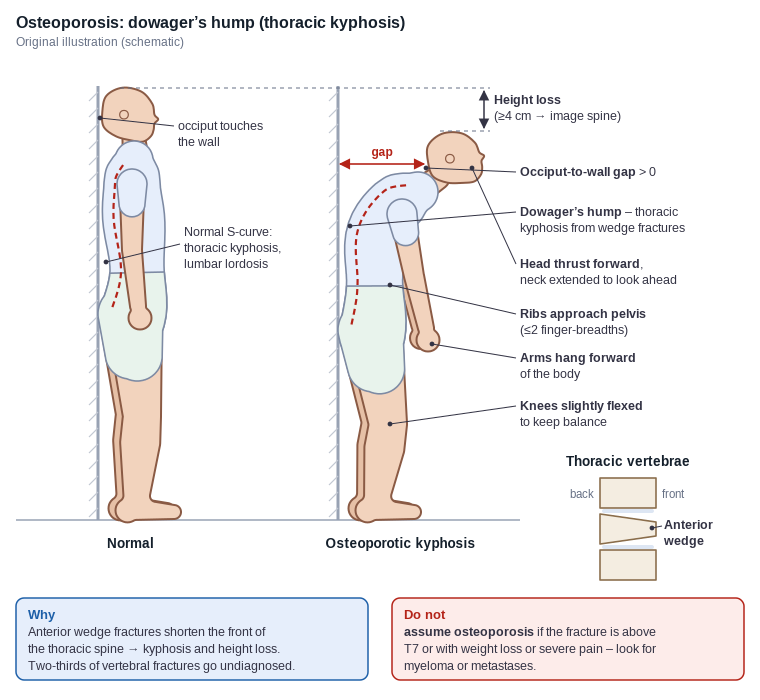
Osteoporosis is a skeletal disease of low bone mass and deteriorated bone microarchitecture that makes bones fragile and prone to fracture after minimal trauma. The WHO densitometric definition is a T-score of −2.5 or less at the lumbar spine, femoral neck or total hip on DXA; a fragility fracture of the hip or spine establishes the diagnosis clinically. It affects about one in three women and one in five men over 50, mainly through postmenopausal oestrogen loss, ageing, glucocorticoids and other secondary causes. It is silent until a fracture of the wrist, vertebra or hip, which causes pain, height loss, disability and, after hip fracture, high mortality. Assessment combines clinical risk factors, FRAX fracture probability and DXA, with blood tests for secondary causes. Management includes falls prevention, exercise, adequate calcium and vitamin D, and drug treatment: oral or IV bisphosphonates first line for most people, denosumab, HRT in younger postmenopausal women, and anabolic drugs (teriparatide, abaloparatide, romosozumab) first for those at very high risk.
Patient case, mechanism, investigations, management, flashcards and exam-style questions.Open the lesson →
Key facts
- WHO definition: T-score −2.5 or less (osteopenia −1.0 to −2.5); severe or established osteoporosis = T-score −2.5 or less plus a fragility fracture
- A low-trauma hip or vertebral fracture justifies treatment even without DXA, depending on age and context
- FRAX estimates 10-year probability of hip and major osteoporotic fracture; NOGG uses age-dependent intervention thresholds
- NOGG 2024: very high risk = FRAX probability more than 60% above the intervention threshold, or a recent vertebral fracture, 2 or more vertebral fractures, T-score −3.5 or less, or high-dose glucocorticoids
- First-line for most: alendronate 70 mg weekly or risedronate 35 mg weekly, or IV zoledronate 5 mg yearly (teaching doses; check local formulary)
- Very high risk: consider anabolic therapy first (teriparatide, abaloparatide or romosozumab), always followed by an antiresorptive
- Never stop denosumab without follow-on treatment: rebound bone loss causes multiple vertebral fractures
- Rare serious adverse effects of antiresorptives: osteonecrosis of the jaw and atypical femoral fractures; reassess bisphosphonates after 5 years oral or 3 years IV
Differential diagnosis
| Condition | Clues | Key test |
|---|---|---|
| Osteomalacia | Bone pain, proximal myopathy, little sun exposure | Low phosphate, high ALP and PTH, low 25-OH D |
| Multiple myeloma | Vertebral collapse, anaemia, high ESR, renal impairment | Serum protein electrophoresis, free light chains |
| Bone metastases | Vertebral fracture above T7, night pain, cancer history, weight loss | MRI spine; isotope scan or PET |
| Primary hyperparathyroidism | High calcium, stones, low radius BMD | Calcium and PTH |
| Hyperthyroidism or excess levothyroxine | Weight loss, tremor, suppressed TSH | TSH and free T4 |
| Cushing syndrome or glucocorticoid use | Central obesity, striae, myopathy | Drug history; overnight dexamethasone suppression test |
| Male hypogonadism | Low libido, erectile dysfunction, loss of body hair | Morning testosterone, LH, FSH |
| Coeliac disease | Young person with low BMD, iron deficiency, diarrhoea | Tissue transglutaminase IgA |
Exam pearls
Guideline
NOGG 2024 UK clinical guideline for the prevention and treatment of osteoporosis (published 2025), Endocrine Society postmenopausal osteoporosis guideline (2019, updated 2020) and AACE/ACE postmenopausal osteoporosis guideline (2020)
References
- Gregson CL, Armstrong DJ, Avgerinou C, et al.. The 2024 UK clinical guideline for the prevention and treatment of osteoporosis. Arch Osteoporos 2025.
- Eastell R, Rosen CJ, Black DM, et al.. Pharmacological management of osteoporosis in postmenopausal women: an Endocrine Society clinical practice guideline. J Clin Endocrinol Metab 2019.
- Camacho PM, Petak SM, Binkley N, et al.. American Association of Clinical Endocrinologists/American College of Endocrinology clinical practice guidelines for the diagnosis and treatment of postmenopausal osteoporosis - 2020 update. Endocr Pract 2020.
- Saag KG, Petersen J, Brandi ML, et al.. Romosozumab or alendronate for fracture prevention in women with osteoporosis. N Engl J Med 2017.
- Kendler DL, Marin F, Zerbini CAF, et al.. Effects of teriparatide and risedronate on new fractures in post-menopausal women with severe osteoporosis (VERO): a multicentre, double-blind, double-dummy, randomised controlled trial. Lancet 2018.
- Cummings SR, San Martin J, McClung MR, et al.. Denosumab for prevention of fractures in postmenopausal women with osteoporosis. N Engl J Med 2009.
Related topics
By Dr Khalid Seidi (B.Sc., M.D.) · MedEd World Clinical Knowledge library. Original teaching content checked against current guidelines (November 2026); confirm the latest local guidance before clinical use. Not a substitute for clinical judgement.