Clinical Knowledge › Ear, nose and throat › Head and neck cancer
Laryngeal cancer
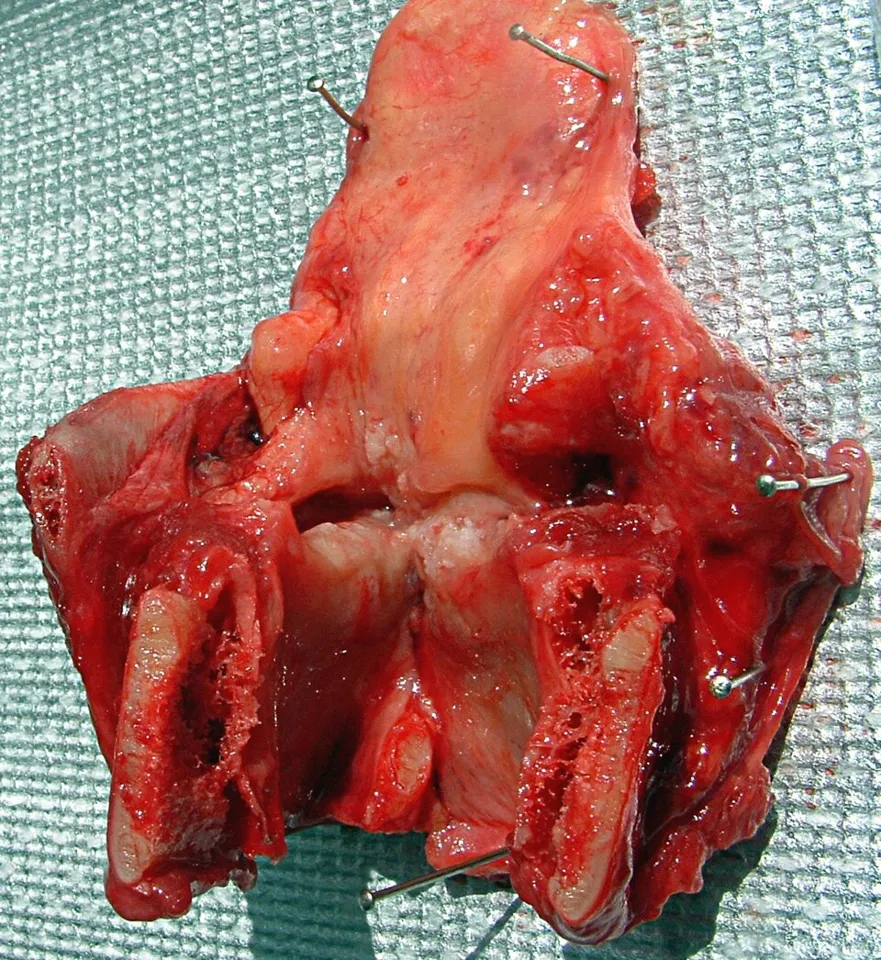
Laryngeal cancer is almost always squamous cell carcinoma and is strongly linked to smoking, with alcohol adding risk. The larynx is divided into supraglottis, glottis and subglottis, and this subdivision explains behaviour: glottic cancers (about 60%) cause hoarseness early and rarely spread to nodes because the vocal folds have sparse lymphatics, so most are cured; supraglottic cancers present later with dysphagia, referred otalgia or a neck lump and spread early, often to both sides of the neck. Persistent hoarseness for more than 3 weeks, especially in a smoker, needs urgent laryngoscopy. Diagnosis rests on flexible nasendoscopy, biopsy under general anaesthesia and CT of the neck and chest; vocal fold fixation means at least T3. T1–T2 tumours are treated with transoral laser surgery or radiotherapy, with cure rates of 80–95%. Advanced tumours are treated with larynx-preserving chemoradiotherapy with cisplatin, or with total laryngectomy when there is cartilage destruction or a poorly functioning larynx; voice is restored with a tracheo-oesophageal valve.
Patient case, mechanism, investigations, management, flashcards and exam-style questions.Open the lesson →
Key facts
- Over 95% of laryngeal cancers are squamous cell carcinoma; smoking is the dominant cause
- Glottic tumours (about 60%) present early with hoarseness and rarely metastasise (sparse vocal fold lymphatics)
- Supraglottic tumours (about 35%) present later and spread early, often bilaterally, to levels II–IV
- Subglottic tumours are rare, present with stridor and spread to paratracheal (level VI) nodes
- Vocal fold fixation = T3; invasion through the outer cortex of the thyroid cartilage = T4a
- T1 glottic cancer: radiotherapy or transoral laser microsurgery cure about 90% or more
- RTOG 91-11: concurrent cisplatin chemoradiotherapy gave the highest larynx preservation, without improving overall survival over other strategies
- After total laryngectomy the patient breathes only through the neck stoma: give oxygen and ventilate via the stoma
Differential diagnosis
| Condition | Clues | Key test |
|---|---|---|
| Vocal fold nodules or polyp | Voice user, bilateral nodules or unilateral polyp, normal mobility | Laryngoscopy with stroboscopy |
| Laryngopharyngeal reflux or chronic laryngitis | Fluctuating hoarseness, throat clearing, diffuse oedema | Laryngoscopy; trial of treatment only if no suspicious lesion |
| Recurrent laryngeal nerve palsy | Breathy voice, immobile fold but smooth mucosa | CT skull base to mediastinum |
| Recurrent respiratory papillomatosis | Exophytic warty lesions, HPV 6/11, young adult or child | Biopsy at microlaryngoscopy |
| Laryngeal leukoplakia with dysplasia | White plaque on vocal fold in smoker | Excision biopsy for grading |
| Tuberculous or fungal laryngitis | Ulcerated larynx with pulmonary TB or immunosuppression | Biopsy with stains and cultures |
| Hypopharyngeal cancer | Dysphagia and otalgia, piriform sinus mass | Nasendoscopy and CT; biopsy at panendoscopy |
Exam pearls
Guideline
UK National Multidisciplinary Guidelines for laryngeal cancer (2016), ASCO larynx-preservation guideline update (2018), EHNS-ESMO-ESTRO head and neck SCC guideline (2020), NICE NG36 (2016, updated 2018) and NG12 suspected cancer
References
- Jones TM, De M, Foran B, et al.. Laryngeal cancer: United Kingdom National Multidisciplinary guidelines. J Laryngol Otol 2016.
- Forastiere AA, Ismaila N, Lewin JS, et al.. Use of larynx-preservation strategies in the treatment of laryngeal cancer: ASCO clinical practice guideline update. J Clin Oncol 2018.
- Forastiere AA, Goepfert H, Maor M, et al.. Concurrent chemotherapy and radiotherapy for organ preservation in advanced laryngeal cancer. N Engl J Med 2003.
- Department of Veterans Affairs Laryngeal Cancer Study Group; Wolf GT, Fisher SG, Hong WK, et al.. Induction chemotherapy plus radiation compared with surgery plus radiation in patients with advanced laryngeal cancer. N Engl J Med 1991.
- National Institute for Health and Care Excellence. Cancer of the upper aerodigestive tract: assessment and management in people aged 16 and over (NG36). NICE, London 2016.
- National Institute for Health and Care Excellence. Suspected cancer: recognition and referral (NG12). NICE, London 2015.
Related topics
By Dr Khalid Seidi (B.Sc., M.D.) · MedEd World Clinical Knowledge library. Original teaching content checked against current guidelines (November 2026); confirm the latest local guidance before clinical use. Not a substitute for clinical judgement.