Clinical Knowledge › Ear, nose and throat › Head and neck cancer
Neck metastasis from an unknown primary
Neck metastasis from an unknown primary means carcinoma, usually squamous cell carcinoma, in cervical lymph nodes when no primary tumour is found after full clinical examination, endoscopy and imaging. It accounts for about 2–5% of head and neck cancers. Most hidden primaries lie in the tonsils or tongue base, and the share caused by HPV has risen, so most now have p16-positive disease. The level of the node points to the likely source: levels II–III suggest the oropharynx, level V and EBV-positive nodes the nasopharynx, parotid nodes skin cancer, and supraclavicular nodes the lung or gastrointestinal tract. Work-up starts with ultrasound-guided fine-needle aspiration or core biopsy (not open biopsy), p16, HPV and EBV testing, then PET-CT before examination under anaesthesia with targeted biopsies, tonsillectomy and tongue base mucosectomy, which find the primary in many patients. Treatment is neck dissection with adjuvant radiotherapy, or primary chemoradiotherapy covering the neck and likely mucosal sites. Prognosis is relatively good, especially for p16-positive disease.
Patient case, mechanism, investigations, management, flashcards and exam-style questions.Open the lesson →
Key facts
- Definition: nodal metastatic carcinoma with no primary after clinical examination, nasendoscopy, cross-sectional imaging and PET-CT
- About 2–5% of head and neck cancers; most are SCC, and most are now HPV-related (p16-positive)
- Most occult primaries are found in the palatine tonsil or tongue base (lingual tonsil)
- Node level predicts the source: II–III oropharynx or larynx; V or EBV-positive nasopharynx; IV/supraclavicular below the clavicle; parotid or periauricular skin
- Ultrasound-guided FNA or core biopsy first; open excision biopsy risks seeding and complicates later surgery
- PET-CT should be performed before panendoscopy and biopsies to avoid false positives
- Tonsillectomy plus transoral tongue base mucosectomy identifies the primary in a high proportion of p16-positive cases
- AJCC 8: p16-positive nodes with no primary are staged as T0 HPV-associated oropharyngeal cancer; EBV-positive as T0 nasopharyngeal
Differential diagnosis
| Condition | Clues | Key test |
|---|---|---|
| Lymphoma | Rubbery nodes, multiple regions, B symptoms | Core or excision biopsy with flow cytometry |
| Metastatic papillary thyroid carcinoma | Young adult, level III–IV or VI, cystic or calcified node | Thyroglobulin in FNA washout; thyroid ultrasound |
| Metastatic cutaneous SCC or melanoma | Parotid or periauricular node; previous scalp or face lesion | Skin examination; histology with melanocytic markers |
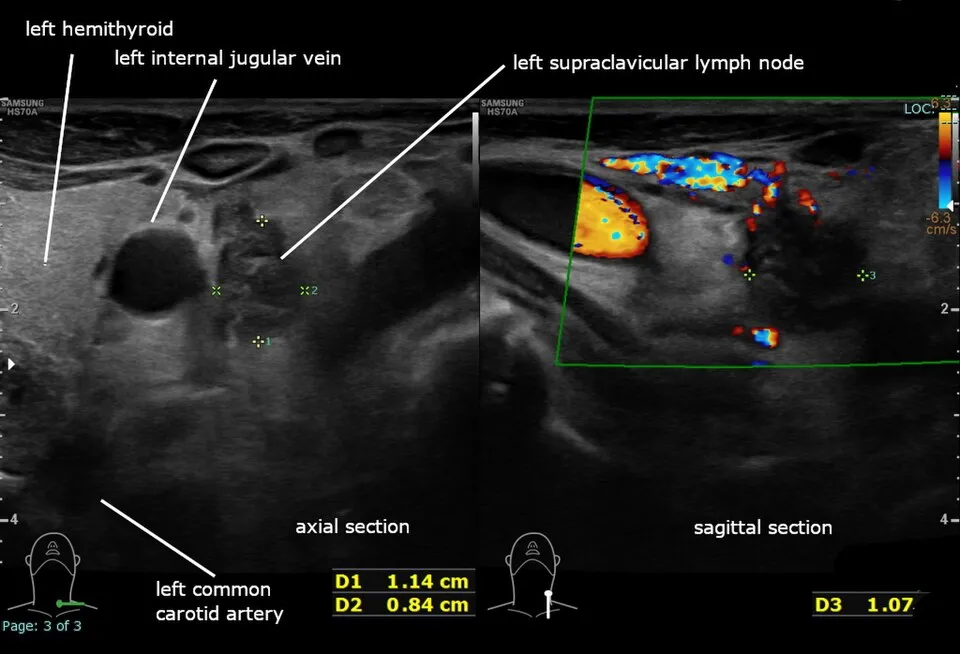
| Infraclavicular metastasis (Virchow node) | Left supraclavicular node, weight loss, GI or lung symptoms | CT chest, abdomen and pelvis; endoscopy |
| Branchial cyst | Young patient, smooth cystic level II mass | FNA with p16; over 40 treat as possible metastasis |
| Tuberculous lymphadenitis | Matted nodes, sinus, endemic exposure | FNA with mycobacterial PCR and culture |
| Salivary gland tumour | Parotid or submandibular gland mass | Ultrasound with FNA or core biopsy |
Exam pearls
Guideline
ASCO guideline on squamous cell carcinoma of unknown primary in the head and neck (2020), UK National Multidisciplinary Guidelines (2016), NICE NG36 (2016, updated 2018) and AJCC 8th edition
References
- Maghami E, Ismaila N, Alvarez A, et al.. Diagnosis and management of squamous cell carcinoma of unknown primary in the head and neck: ASCO guideline. J Clin Oncol 2020.
- Mackenzie K, Watson M, Jankowska P, et al.. Investigation and management of the unknown primary with metastatic neck disease: United Kingdom National Multidisciplinary Guidelines. J Laryngol Otol 2016.
- Lewis-Jones H, Colley S, Gibson D. Imaging in head and neck cancer: United Kingdom National Multidisciplinary Guidelines. J Laryngol Otol 2016.
- National Institute for Health and Care Excellence. Cancer of the upper aerodigestive tract: assessment and management in people aged 16 and over (NG36). NICE, London 2016.
- Machiels JP, René Leemans C, Golusinski W, et al.. Squamous cell carcinoma of the oral cavity, larynx, oropharynx and hypopharynx: EHNS-ESMO-ESTRO Clinical Practice Guidelines for diagnosis, treatment and follow-up. Ann Oncol 2020.
- Amin MB, Edge SB, Greene FL, et al., eds.. AJCC Cancer Staging Manual (head and neck chapters). Springer 2017.
Related topics
By Dr Khalid Seidi (B.Sc., M.D.) · MedEd World Clinical Knowledge library. Original teaching content checked against current guidelines (November 2026); confirm the latest local guidance before clinical use. Not a substitute for clinical judgement.