Clinical Knowledge › Ear, nose and throat › Head and neck cancer
Oral cavity cancer
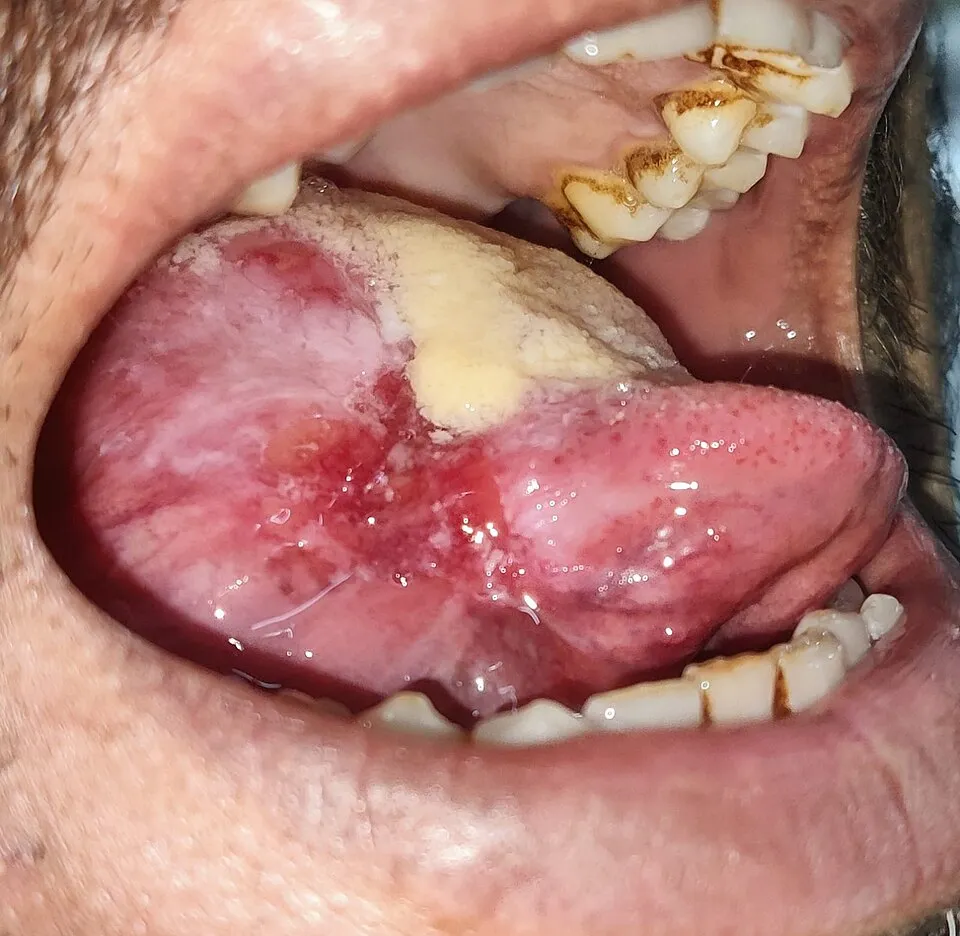
Oral cavity cancer is squamous cell carcinoma of the lips, anterior two-thirds of the tongue, floor of mouth, buccal mucosa, gums, retromolar trigone and hard palate. It is one of the commonest cancers in South Asia, where betel quid, areca nut and smokeless tobacco cause gingivobuccal tumours; elsewhere smoking and alcohol cause most cases, usually on the lateral tongue or floor of mouth. Many cancers arise from potentially malignant disorders: leukoplakia, erythroplakia (the highest risk), oral submucous fibrosis and proliferative verrucous leukoplakia. Any ulcer, lump or red or white patch persisting beyond 3 weeks needs urgent referral and biopsy. Staging combines clinical examination, MRI or CT and chest imaging; in AJCC 8th edition the T stage depends on size and depth of invasion. Surgery is the mainstay: resection with clear margins, neck dissection or sentinel node biopsy, and free-flap reconstruction, followed by radiotherapy or chemoradiotherapy for adverse features. Elective neck dissection improves survival in early node-negative disease.
Patient case, mechanism, investigations, management, flashcards and exam-style questions.Open the lesson →
Key facts
- Over 90% are squamous cell carcinomas; lateral tongue and floor of mouth are the commonest sites in Western countries
- In South Asia, betel quid and smokeless tobacco cause buccal and gingivobuccal cancers, often with oral submucous fibrosis
- Erythroplakia carries the highest malignant risk of the potentially malignant disorders; most leukoplakias never become cancer
- Red flag: an oral ulcer, lump or red/white patch lasting more than 3 weeks needs urgent referral
- AJCC 8th edition T stage uses tumour size plus depth of invasion (DOI 5 and 10 mm thresholds)
- Surgery is first-line; radiotherapy alone is rarely primary treatment for oral cavity cancer
- Elective neck dissection improves survival over watch-and-wait in early node-negative oral cancer (D'Cruz, NEJM 2015)
- Positive margins or extranodal extension call for postoperative chemoradiotherapy with cisplatin
Differential diagnosis
| Condition | Clues | Key test |
|---|---|---|
| Traumatic ulcer | Sharp tooth or denture next to the ulcer; heals within 2–3 weeks of removing cause | Review after removing cause; biopsy if persistent |
| Recurrent aphthous ulcers | Young, recurrent, painful, small, heal in 1–2 weeks | Clinical; screen for coeliac disease and anaemia if severe |
| Oral lichen planus | Bilateral lacy white striae on buccal mucosa, erosive forms | Biopsy if atypical or ulcerated |
| Candidiasis (pseudomembranous or hyperplastic) | Wipe-off plaques; chronic hyperplastic form in smokers | Swab; biopsy if persists after antifungal |
| Syphilitic chancre or gumma | Painless indurated ulcer, high-risk sexual history | Treponemal serology, dark-field or PCR |
| Tuberculous ulcer | Undermined painful ulcer on tongue, pulmonary TB | Biopsy with mycobacterial testing; chest radiograph |
| Minor salivary gland tumour | Smooth submucosal swelling of hard palate | Biopsy; MRI |
Exam pearls
Guideline
UK National Multidisciplinary Guidelines for oral cavity and lip cancer (2016), NICE NG36 (2016, updated 2018), NICE NG12 suspected cancer, EHNS-ESMO-ESTRO head and neck SCC guideline (2020) and AJCC 8th edition staging
References
- Kerawala C, Roques T, Jeannon JP, Bisase B. Oral cavity and lip cancer: United Kingdom National Multidisciplinary Guidelines. J Laryngol Otol 2016.
- National Institute for Health and Care Excellence. Cancer of the upper aerodigestive tract: assessment and management in people aged 16 and over (NG36). NICE, London 2016.
- National Institute for Health and Care Excellence. Suspected cancer: recognition and referral (NG12). NICE, London 2015.
- Machiels JP, René Leemans C, Golusinski W, et al.. Squamous cell carcinoma of the oral cavity, larynx, oropharynx and hypopharynx: EHNS-ESMO-ESTRO Clinical Practice Guidelines for diagnosis, treatment and follow-up. Ann Oncol 2020.
- D'Cruz AK, Vaish R, Kapre N, et al.. Elective versus therapeutic neck dissection in node-negative oral cancer. N Engl J Med 2015.
- Amin MB, Edge SB, Greene FL, et al., eds.. AJCC Cancer Staging Manual (head and neck chapters). Springer 2017.
Related topics
By Dr Khalid Seidi (B.Sc., M.D.) · MedEd World Clinical Knowledge library. Original teaching content checked against current guidelines (November 2026); confirm the latest local guidance before clinical use. Not a substitute for clinical judgement.