Clinical Knowledge › Internal medicine › Gastroenterology and hepatology › Clinical problems
Lower gastrointestinal bleeding
Lower gastrointestinal bleeding (LGIB) is bleeding from the colon, rectum or anus, usually presenting as fresh red blood or maroon stools (haematochezia). It is mainly a disease of older adults, many of whom take antiplatelet drugs or anticoagulants. Diverticular bleeding is the commonest cause in most series, followed by haemorrhoids, ischaemic colitis, angioectasia, post-polypectomy bleeding, colitis and colorectal cancer. About four in five bleeds stop on their own. Management starts with resuscitation and a shock index (heart rate divided by systolic pressure): a brisk upper gastrointestinal source must be excluded when the patient is unstable. Stable patients are risk-stratified with the Oakland score, and those scoring 8 or less can usually be investigated as outpatients. Unstable patients need CT angiography and, if it shows extravasation, catheter embolisation. Most admitted patients have a non-urgent colonoscopy, a restrictive transfusion policy and careful decisions about antithrombotic drugs.
Patient case, mechanism, investigations, management, flashcards and exam-style questions.Open the lesson →
Key facts
- LGIB arises distal to the ileocaecal valve; bleeding between the ampulla and the ileocaecal valve is called small bowel (mid-gut) bleeding
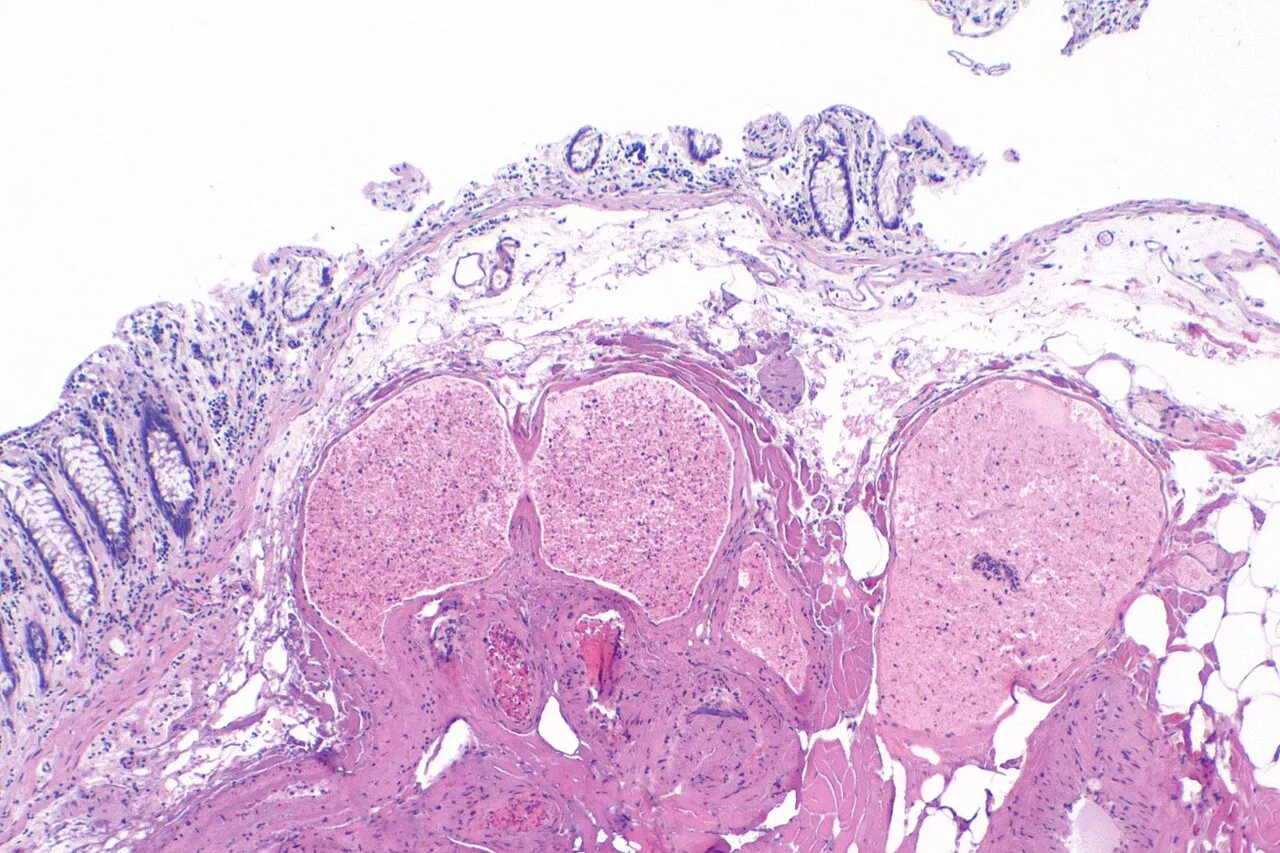
- Diverticular bleeding is the commonest cause in adults; it is painless, arterial and usually stops spontaneously
- Shock index above 1 marks an unstable bleed; up to about 1 in 6 such patients has an upper gastrointestinal source
- Oakland score 8 or less (BSG 2019) identifies stable patients who can be discharged for outpatient investigation
- Unstable or ongoing bleeding: CT angiography first, then catheter embolisation if contrast extravasation is seen
- ACG 2023: urgent colonoscopy within 24 hours does not reduce rebleeding or mortality compared with non-urgent inpatient colonoscopy
- Restrictive transfusion: threshold haemoglobin 70 g/L (80 g/L with cardiovascular disease) in stable patients
- Stop NSAIDs and primary-prevention aspirin after a bleed; continue secondary-prevention aspirin and restart anticoagulation once bleeding stops
Differential diagnosis
| Condition | Clues | Key test |
|---|---|---|
| Brisk upper gastrointestinal bleed | Haemodynamic instability, raised urea out of proportion to creatinine, peptic ulcer risk | Upper endoscopy (after CTA if unstable) |
| Diverticular bleeding | Sudden painless large-volume red or maroon blood in an older adult | CT angiography if active; colonoscopy |
| Ischaemic colitis | Crampy left-sided pain then bloody diarrhoea in an older vasculopath | CT with contrast; colonoscopy with biopsy |
| Haemorrhoids or anal fissure | Bright red blood on paper or dripping into the pan; pain with fissure | Inspection, rectal examination, proctoscopy |
| Colorectal cancer | Change in bowel habit, weight loss, iron deficiency anaemia | Colonoscopy with biopsy |
| Inflammatory bowel disease or infective colitis | Bloody diarrhoea, urgency, fever | Stool culture, C. difficile test, faecal calprotectin, flexible sigmoidoscopy |
| Angioectasia | Recurrent painless bleeding or anaemia in an older patient with chronic kidney disease or aortic stenosis | Colonoscopy; capsule endoscopy for small bowel lesions |
| Meckel diverticulum | Painless rectal bleeding in a child or young adult | Technetium-99m pertechnetate scan |
Exam pearls
Guideline
ACG guideline for acute lower gastrointestinal bleeding (2023) and BSG acute LGIB guideline (2019)
References
- Sengupta N, Feuerstein JD, Jairath V, Shergill AK, Strate LL, Wong RJ, Wan D.. Management of Patients With Acute Lower Gastrointestinal Bleeding: An Updated ACG Guideline. Am J Gastroenterol 2023.
- Oakland K, Chadwick G, East JE, et al.. Diagnosis and management of acute lower gastrointestinal bleeding: guidelines from the British Society of Gastroenterology. Gut 2019.
- Oakland K, Jairath V, Uberoi R, et al.. Derivation and validation of a novel risk score for safe discharge after acute lower gastrointestinal bleeding: a modelling study. Lancet Gastroenterol Hepatol 2017.
- Laine L, Barkun AN, Saltzman JR, Martel M, Leontiadis GI.. ACG Clinical Guideline: Upper Gastrointestinal and Ulcer Bleeding. Am J Gastroenterol 2021.
- Gerson LB, Fidler JL, Cave DR, Leighton JA.. ACG Clinical Guideline: Diagnosis and Management of Small Bowel Bleeding. Am J Gastroenterol 2015.
- HALT-IT Trial Collaborators.. Effects of a high-dose 24-h infusion of tranexamic acid on death and thromboembolic events in patients with acute gastrointestinal bleeding (HALT-IT): an international randomised, double-blind, placebo-controlled trial. Lancet 2020.
Related topics
By Dr Khalid Seidi (B.Sc., M.D.) · MedEd World Clinical Knowledge library. Original teaching content checked against current guidelines (November 2026); confirm the latest local guidance before clinical use. Not a substitute for clinical judgement.