Clinical Knowledge › Internal medicine › Haematology and oncology › Oncological emergencies
Malignant spinal cord compression
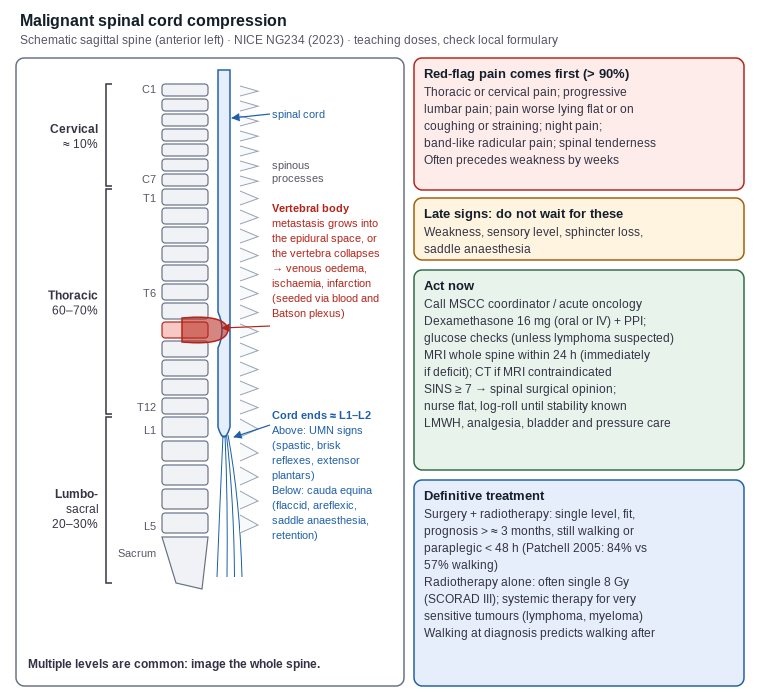
Malignant (metastatic) spinal cord compression (MSCC) is compression of the spinal cord or cauda equina by cancer, usually a vertebral metastasis that collapses or extends into the epidural space. It affects about 3–5% of people with cancer, most often from breast, prostate, lung, kidney, myeloma and lymphoma. Back pain is the earliest symptom in over 90% and typically precedes weakness by weeks: thoracic or progressive pain, pain worse on lying flat, coughing or straining, band-like radicular pain and night pain are warning features. Waiting for a sensory level or sphincter loss means waiting too long, because ability to walk at diagnosis is the strongest predictor of walking afterwards. NICE NG234 (2023) recommends contacting the acute oncology/MSCC coordinator immediately, MRI of the whole spine within 24 hours for suspected compression, dexamethasone 16 mg as soon as compression is suspected (unless lymphoma is likely and untreated), assessment of spinal stability, and definitive treatment with surgery and/or radiotherapy, ideally before neurological loss progresses.
Patient case, mechanism, investigations, management, flashcards and exam-style questions.Open the lesson →
Key facts
- MSCC occurs in about 3–5% of people with cancer; it is the first presentation of cancer in about 20%
- Thoracic spine is involved in about 60–70%, lumbosacral in 20–30% and cervical in about 10%; multiple levels are common, so image the whole spine
- Back pain precedes neurological signs in more than 90%, often by weeks; red flags include thoracic pain, pain lying flat, night pain, band-like radicular pain and pain on coughing or straining
- Late signs: leg weakness, sensory level, sphincter dysfunction, saddle anaesthesia; upper motor neurone signs above L1, lower motor neurone (cauda equina) signs below
- MRI whole spine within 24 hours if MSCC suspected (immediately if neurological deficits); CT if MRI contraindicated
- Dexamethasone 16 mg orally or IV daily as soon as MSCC is suspected, with a proton pump inhibitor and glucose monitoring (teaching dose; check local formulary)
- Surgical decompression plus radiotherapy improves walking in selected patients with a single level of compression, good performance status and prognosis over about 3 months (Patchell 2005)
- Single-fraction 8 Gy radiotherapy is a reasonable option for many patients unsuitable for surgery (SCORAD III)
Differential diagnosis
| Condition | Clues | Key test |
|---|---|---|
| Mechanical back pain or osteoporotic vertebral fracture | No cancer history, pain eased by rest, no neurological signs | MRI: benign fracture signal, no epidural mass |
| Spinal epidural abscess | Fever, injecting drug use or bacteraemia, raised CRP | MRI with contrast, blood cultures |
| Lumbar disc prolapse with cauda equina syndrome | Younger patient, sudden onset after strain, sciatica | MRI lumbar spine |
| Leptomeningeal metastases | Multiple cranial nerve palsies and radicular symptoms | Contrast MRI brain and spine, CSF cytology |
| Radiation myelopathy | Months after spinal radiotherapy, no mass | MRI cord signal change, history |
| Paraneoplastic myelopathy or Guillain–Barré syndrome | Progressive weakness without back pain or mass | MRI normal; CSF and antibody tests; nerve conduction |
| Hypercalcaemia of malignancy | Weakness and confusion with bone metastases | Corrected calcium |
Exam pearls
Guideline
NICE NG234 Spinal metastases and metastatic spinal cord compression (2023, replacing CG75 2008); ESMO bone health in cancer guideline (2020); Spine Oncology Study Group SINS (2010) and NOMS framework
References
- National Institute for Health and Care Excellence. Spinal metastases and metastatic spinal cord compression (NG234). NICE 2023.
- Patchell RA, Tibbs PA, Regine WF, et al.. Direct decompressive surgical resection in the treatment of spinal cord compression caused by metastatic cancer: a randomised trial. Lancet 2005.
- Hoskin PJ, Hopkins K, Misra V, et al.. Effect of single-fraction vs multifraction radiotherapy on ambulatory status among patients with spinal canal compression from metastatic cancer: the SCORAD randomized clinical trial. JAMA 2019.
- Fisher CG, DiPaola CP, Ryken TC, et al.. A novel classification system for spinal instability in neoplastic disease: an evidence-based approach and expert consensus from the Spine Oncology Study Group. Spine 2010.
- Bilsky MH, Laufer I, Fourney DR, et al.. Reliability analysis of the epidural spinal cord compression scale. J Neurosurg Spine 2010.
- Laufer I, Rubin DG, Lis E, et al.. The NOMS framework: approach to the treatment of spinal metastatic tumors. Oncologist 2013.
Related topics
By Dr Khalid Seidi (B.Sc., M.D.) · MedEd World Clinical Knowledge library. Original teaching content checked against current guidelines (November 2026); confirm the latest local guidance before clinical use. Not a substitute for clinical judgement.