Clinical Knowledge › Internal medicine › Pulmonology › Lung neoplasms
Non-small cell lung cancer
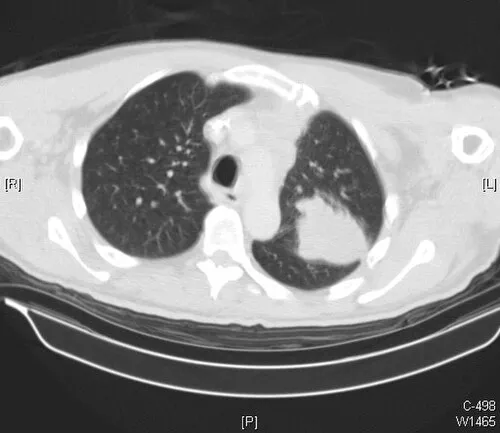
Non-small cell lung cancer (NSCLC) accounts for about 85% of lung cancers and includes adenocarcinoma, squamous cell carcinoma and large cell carcinoma. Management is driven by stage (TNM ninth edition), histology, molecular profile, PD-L1 expression, fitness and patient preference, and is planned by a multidisciplinary team. Early-stage disease is treated with curative intent by anatomical resection, with segmentectomy now an option for small peripheral tumours, or stereotactic radiotherapy for patients unfit for surgery. Perioperative chemo-immunotherapy, and adjuvant osimertinib or alectinib for EGFR-mutant or ALK-positive tumours, have improved outcomes in resectable stage II–III disease. Unresectable stage III disease receives concurrent chemoradiotherapy followed by durvalumab, or osimertinib if EGFR-mutant. Advanced disease is treated with targeted drugs when a driver alteration is found, and otherwise with immune checkpoint inhibitors alone or with platinum chemotherapy. Survival in stage IV has improved markedly, but most patients still present late.
Patient case, mechanism, investigations, management, flashcards and exam-style questions.Open the lesson →
Key facts
- Adenocarcinoma is the commonest subtype; squamous carcinoma is central and most strongly linked to smoking
- Test non-squamous NSCLC for EGFR, ALK, ROS1, BRAF V600E, KRAS G12C, MET exon 14, RET, NTRK and HER2, and all NSCLC for PD-L1
- Stage I–II in fit patients: lobectomy with systematic nodal dissection; segmentectomy is acceptable for peripheral tumours 2 cm or smaller (JCOG0802)
- Medically inoperable stage I: stereotactic ablative radiotherapy (SABR)
- Resectable stage II–III: perioperative chemo-immunotherapy (for example nivolumab or pembrolizumab with platinum doublet) improves event-free survival
- Adjuvant osimertinib for 3 years after resection of EGFR-mutant stage IB–IIIA disease (ADAURA); adjuvant alectinib for ALK-positive disease (ALINA)
- Unresectable stage III: concurrent chemoradiotherapy then durvalumab for 12 months (PACIFIC), or osimertinib if EGFR-mutant (LAURA)
- Stage IV without a driver: pembrolizumab alone if PD-L1 is 50% or more, or chemo-immunotherapy; with a driver: matched targeted therapy first-line
Differential diagnosis
| Condition | Clues | Key test |
|---|---|---|
| Small cell lung cancer | Central mass, bulky nodes, rapid growth, SIADH or Lambert–Eaton | Biopsy: small cells with neuroendocrine markers, high Ki-67 |
| Pulmonary metastasis from extrathoracic primary | Multiple peripheral nodules, known cancer | Immunohistochemistry (TTF-1 negative, organ-specific markers) |
| Malignant pleural mesothelioma | Asbestos exposure, pleural thickening and effusion | Pleural biopsy with calretinin and BAP1 loss |
| Carcinoid tumour | Younger patient, endobronchial lesion, recurrent pneumonia or wheeze | Bronchoscopic biopsy; low Ki-67; somatostatin receptor imaging |
| Tuberculosis or fungal infection | Cavitating mass, endemic exposure | Culture, NAAT, histology with special stains |
| Organising pneumonia | Migratory consolidation | Biopsy; response to corticosteroids |
Exam pearls
Guideline
ESMO metastatic NSCLC living guidelines (2023, with updates), NCCN NSCLC guidelines (2026) and NICE NG122 (2019, updated 2024)
References
- Hendriks LE, Kerr KM, Menis J, et al.. Oncogene-addicted metastatic non-small-cell lung cancer: ESMO Clinical Practice Guideline for diagnosis, treatment and follow-up. Ann Oncol 2023.
- Hendriks LE, Kerr KM, Menis J, et al.. Non-oncogene-addicted metastatic non-small-cell lung cancer: ESMO Clinical Practice Guideline for diagnosis, treatment and follow-up. Ann Oncol 2023.
- National Institute for Health and Care Excellence (NICE). Lung cancer: diagnosis and management (NICE guideline NG122). 2019.
- Rami-Porta R, Nishimura KK, Giroux DJ, et al.. The International Association for the Study of Lung Cancer Lung Cancer Staging Project: proposals for revision of the TNM stage groups in the forthcoming (ninth) edition of the TNM classification for lung cancer. J Thorac Oncol 2024.
- Antonia SJ, Villegas A, Daniel D, et al.. Durvalumab after chemoradiotherapy in stage III non-small-cell lung cancer. N Engl J Med 2017.
- Forde PM, Spicer J, Lu S, et al.. Neoadjuvant nivolumab plus chemotherapy in resectable lung cancer. N Engl J Med 2022.
Related topics
By Dr Khalid Seidi (B.Sc., M.D.) · MedEd World Clinical Knowledge library. Original teaching content checked against current guidelines (November 2026); confirm the latest local guidance before clinical use. Not a substitute for clinical judgement.