Clinical Knowledge › Internal medicine › Pulmonology › Lung neoplasms
Paraneoplastic syndromes of lung cancer
Paraneoplastic syndromes are effects of a cancer that occur at a distance from the tumour and its metastases, caused by hormones, peptides or cytokines secreted by tumour cells or by antibodies raised against tumour antigens that cross-react with normal tissue. Lung cancer is the commonest cause, and about one patient in ten develops at least one syndrome. Small cell lung cancer, a neuroendocrine tumour, typically produces antidiuretic hormone (SIADH), ectopic ACTH and antibody-mediated neurological syndromes such as Lambert–Eaton myasthenic syndrome and anti-Hu encephalomyelitis. Squamous cell carcinoma classically causes hypercalcaemia through parathyroid hormone-related protein, while adenocarcinoma is linked with hypertrophic pulmonary osteoarthropathy and cancer-associated thrombosis. A syndrome may appear months before the tumour is visible, so recognising it can lead to an earlier diagnosis. Treatment of the cancer is the most effective therapy, combined with specific measures such as fluid restriction, bisphosphonates or immunotherapy.
Patient case, mechanism, investigations, management, flashcards and exam-style questions.Open the lesson →
Key facts
- Paraneoplastic syndromes are remote effects of cancer mediated by tumour secretions or cross-reacting antibodies, not by invasion or metastasis
- Small cell lung cancer: SIADH, ectopic ACTH (Cushing syndrome), Lambert–Eaton myasthenic syndrome, anti-Hu sensory neuronopathy and encephalomyelitis
- Squamous cell carcinoma: hypercalcaemia from parathyroid hormone-related protein (PTHrP) with suppressed PTH
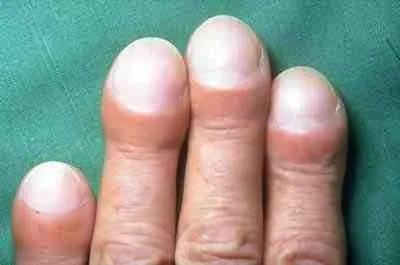
- Adenocarcinoma: hypertrophic pulmonary osteoarthropathy (clubbing plus painful periostitis) and Trousseau migratory thrombophlebitis
- SIADH: hypotonic hyponatraemia, inappropriately concentrated urine (above 100 mOsm/kg), urine sodium above 30 mmol/L, euvolaemia, normal thyroid and adrenal function
- Correct chronic hyponatraemia by no more than 10 mmol/L in the first 24 hours to avoid osmotic demyelination
- Lambert–Eaton: P/Q-type voltage-gated calcium channel antibodies, proximal leg weakness, areflexia, dry mouth and post-exercise facilitation
- A paraneoplastic syndrome may precede the cancer; a negative first search needs repeat screening (often every 4–6 months for about 2 years)
Differential diagnosis
| Condition | Clues | Key test |
|---|---|---|
| Hypercalcaemia from bone metastases | Known widespread lytic bone disease, bone pain | Bone scan or PET-CT; PTH suppressed and PTHrP often normal |
| Primary hyperparathyroidism | Long-standing mild hypercalcaemia, renal stones, no weight loss | Raised or inappropriately normal PTH |
| Drug-induced or other causes of SIADH | Recent SSRI, carbamazepine, cyclophosphamide or thiazide; pneumonia; CNS disease | Medicine review, chest imaging, thyroid and cortisol tests |
| Myasthenia gravis | Ocular and bulbar weakness, fatigue worse with exercise, normal reflexes | Acetylcholine receptor antibodies; decrement on repetitive stimulation |
| Chemotherapy-induced peripheral neuropathy | Symmetric stocking-glove sensory loss after platinum or taxane | Timeline of exposure; nerve conduction studies |
| Brain or leptomeningeal metastases | Headache, focal signs, cranial nerve palsies | MRI brain with contrast; CSF cytology |
| Cushing disease (pituitary) | Slower onset, typical cushingoid habitus, milder hypokalaemia | ACTH moderately raised, suppresses on high-dose dexamethasone; pituitary MRI and inferior petrosal sinus sampling |
| Immune checkpoint inhibitor toxicity | New neurological or endocrine syndrome after starting immunotherapy | Timing; antibody panel; endocrine tests |
Exam pearls
Guideline
Updated diagnostic criteria for paraneoplastic neurological syndromes (Graus et al., 2021), Endocrine Society hypercalcaemia of malignancy guideline (2023) and the European clinical practice guideline on hyponatraemia (2014)
References
- Kanaji N, Watanabe N, Kita N, et al.. Paraneoplastic syndromes associated with lung cancer. World J Clin Oncol 2014.
- Pelosof LC, Gerber DE.. Paraneoplastic syndromes: an approach to diagnosis and treatment. Mayo Clin Proc 2010.
- Graus F, Vogrig A, Muñiz-Castrillo S, et al.. Updated diagnostic criteria for paraneoplastic neurologic syndromes. Neurol Neuroimmunol Neuroinflamm 2021.
- Spasovski G, Vanholder R, Allolio B, et al.. Clinical practice guideline on diagnosis and treatment of hyponatraemia. Eur J Endocrinol 2014.
- Verbalis JG, Goldsmith SR, Greenberg A, et al.. Diagnosis, evaluation, and treatment of hyponatremia: expert panel recommendations. Am J Med 2013.
- El-Hajj Fuleihan G, Clines GA, Hu MI, et al.. Treatment of hypercalcemia of malignancy in adults: an Endocrine Society clinical practice guideline. J Clin Endocrinol Metab 2023.
Related topics
By Dr Khalid Seidi (B.Sc., M.D.) · MedEd World Clinical Knowledge library. Original teaching content checked against current guidelines (November 2026); confirm the latest local guidance before clinical use. Not a substitute for clinical judgement.