Clinical Knowledge › Internal medicine › Pulmonology › Lung neoplasms
Pancoast tumour
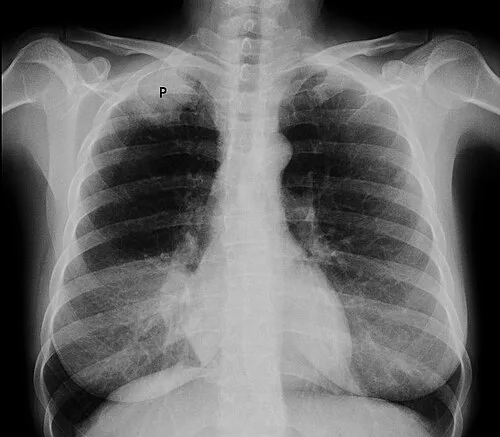
A Pancoast (superior sulcus) tumour is a lung cancer, almost always non-small cell, that arises at the apex of the lung and invades the structures of the thoracic inlet: the first ribs, the lower roots of the brachial plexus (C8 and T1), the sympathetic chain and stellate ganglion, the subclavian vessels and the vertebrae. It makes up under 5% of lung cancers. The typical patient is a smoker with severe shoulder pain radiating down the inner arm to the ring and little fingers, followed by weakness and wasting of the small hand muscles and an ipsilateral Horner syndrome (ptosis, miosis, anhidrosis). Because cough and haemoptysis are uncommon early, it is often mistaken for shoulder or cervical spine disease, and the apical mass is easily missed on chest X-ray. CT, MRI of the thoracic inlet, PET-CT and mediastinal staging define resectability. For T3–T4 N0–N1 disease the standard is induction concurrent chemoradiotherapy followed by en bloc resection, which gives 5-year survival of about 45–55%. Unresectable or N2 disease is treated with definitive chemoradiotherapy and consolidation immunotherapy; palliative radiotherapy controls pain well.
Patient case, mechanism, investigations, management, flashcards and exam-style questions.Open the lesson →
Key facts
- Superior sulcus tumours are apical NSCLCs invading the thoracic inlet; they account for under 5% of lung cancers
- Pancoast syndrome: shoulder and medial arm pain (C8–T1), weakness and wasting of intrinsic hand muscles, and ipsilateral Horner syndrome
- Horner syndrome = ptosis, miosis and anhidrosis from invasion of the sympathetic chain or stellate ganglion
- Commonly misdiagnosed as frozen shoulder, cervical radiculopathy or thoracic outlet syndrome; look carefully at the lung apices on chest X-ray
- MRI of the thoracic inlet best shows brachial plexus, subclavian vessel and vertebral invasion; PET-CT and EBUS or mediastinoscopy stage the mediastinum
- Invasion of T1 root or ribs is T3; invasion of C8 or higher roots, subclavian vessels or vertebral bodies is T4 (TNM 9th edition)
- Resectable T3–T4 N0–N1: induction chemoradiotherapy (about 45 Gy with platinum doublet) then en bloc resection; 5-year survival about 44% in SWOG 9416 and 54% after complete resection
- N2 disease or unresectable tumour: definitive chemoradiotherapy then durvalumab (or osimertinib if EGFR-mutant); radiotherapy and neuropathic analgesia for pain
Differential diagnosis
| Condition | Clues | Key test |
|---|---|---|
| Cervical radiculopathy (C8) | Neck pain, no Horner syndrome, normal chest imaging | MRI cervical spine |
| Frozen shoulder or rotator cuff disease | Restricted shoulder movement, no neurological signs | Clinical examination, shoulder ultrasound; chest X-ray if red flags |
| Thoracic outlet syndrome | Young patient, positional symptoms, cervical rib | Provocative tests, imaging of thoracic inlet |
| Ulnar nerve entrapment | Sensory loss sparing the medial forearm, elbow tenderness | Nerve conduction studies |
| Apical tuberculosis or fungal infection | Fever, sweats, cavitation, endemic exposure | Sputum AFB, culture, biopsy |
| Carotid dissection | Acute Horner syndrome with neck pain or headache | CT or MR angiography of neck |
| Metastasis, lymphoma or mesothelioma at the apex | Known primary or systemic features | Biopsy |
Exam pearls
Guideline
NCCN Guidelines for non-small cell lung cancer (2026); ACCP Diagnosis and Management of Lung Cancer, 3rd ed: special treatment issues including superior sulcus tumours (2013); NICE NG122 lung cancer (2019, updated 2024); IASLC 9th edition TNM classification (in use from 2025)
References
- National Comprehensive Cancer Network. NCCN Clinical Practice Guidelines in Oncology: Non-Small Cell Lung Cancer. 2026.
- Kozower BD, Larner JM, Detterbeck FC, Jones DR. Special treatment issues in non-small cell lung cancer: diagnosis and management of lung cancer, 3rd ed: American College of Chest Physicians evidence-based clinical practice guidelines. Chest 2013.
- National Institute for Health and Care Excellence (NICE). Lung cancer: diagnosis and management (NICE guideline NG122). 2019.
- Rami-Porta R, Nishimura KK, Giroux DJ, et al.. The International Association for the Study of Lung Cancer Lung Cancer Staging Project: proposals for revision of the TNM stage groups in the forthcoming (ninth) edition of the TNM classification for lung cancer. J Thorac Oncol 2024.
- Rusch VW, Giroux DJ, Kraut MJ, et al.. Induction chemoradiation and surgical resection for superior sulcus non-small-cell lung carcinomas: long-term results of Southwest Oncology Group Trial 9416 (Intergroup Trial 0160). J Clin Oncol 2007.
- Kunitoh H, Kato H, Tsuboi M, et al.. Phase II trial of preoperative chemoradiotherapy followed by surgical resection in patients with superior sulcus non-small-cell lung cancers: report of Japan Clinical Oncology Group trial 9806. J Clin Oncol 2008.
Related topics
By Dr Khalid Seidi (B.Sc., M.D.) · MedEd World Clinical Knowledge library. Original teaching content checked against current guidelines (November 2026); confirm the latest local guidance before clinical use. Not a substitute for clinical judgement.