Clinical Knowledge › Internal medicine › Pulmonology › Lung neoplasms
Small cell lung cancer
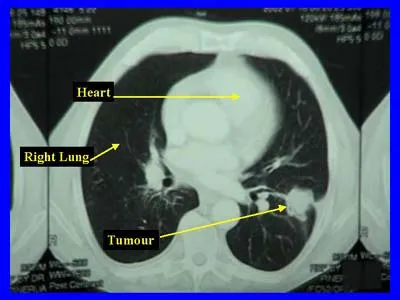
Small cell lung cancer (SCLC) is a high-grade neuroendocrine carcinoma that makes up about 13–15% of lung cancers and occurs almost exclusively in heavy smokers. Near-universal loss of TP53 and RB1 drives very rapid growth and early spread, so about two thirds of patients have extensive-stage disease at diagnosis. Typical presentations are a central mass with bulky mediastinal nodes, superior vena cava obstruction, and paraneoplastic syndromes such as SIADH, ectopic ACTH secretion and Lambert–Eaton myasthenic syndrome. SCLC is very sensitive to platinum–etoposide chemotherapy and radiotherapy at first, but relapse is the rule. Limited-stage disease is treated with concurrent chemoradiotherapy, now followed by durvalumab consolidation, with brain MRI surveillance or prophylactic cranial irradiation. Extensive-stage disease is treated with platinum–etoposide plus atezolizumab or durvalumab, then maintenance immunotherapy. At relapse, the DLL3-directed T-cell engager tarlatamab improved survival over chemotherapy. Overall prognosis remains poor.
Patient case, mechanism, investigations, management, flashcards and exam-style questions.Open the lesson →
Key facts
- SCLC is about 13–15% of lung cancers and is strongly linked to heavy smoking
- Biallelic loss of TP53 and RB1 is almost universal; high proliferation (Ki-67 often above 70%) explains rapid growth
- About two thirds present with extensive-stage disease; TNM ninth edition is recommended, alongside the limited/extensive distinction
- Paraneoplastic syndromes: SIADH (hyponatraemia), ectopic ACTH (hypokalaemic alkalosis), Lambert–Eaton syndrome and anti-Hu neurological syndromes
- Limited stage: concurrent platinum–etoposide with thoracic radiotherapy (for example 45 Gy in 30 twice-daily fractions), then durvalumab (ADRIATIC)
- Stage I node-negative disease: lobectomy with nodal staging, then adjuvant chemotherapy
- Extensive stage: carboplatin–etoposide with atezolizumab (IMpower133) or durvalumab (CASPIAN), then maintenance immunotherapy
- Relapse: tarlatamab (DLL3 bispecific T-cell engager) improved overall survival over chemotherapy in DeLLphi-304
Differential diagnosis
| Condition | Clues | Key test |
|---|---|---|
| Squamous cell carcinoma | Central mass in a smoker, but slower growth and PTHrP hypercalcaemia | Biopsy: p40 positive, neuroendocrine markers negative |
| Large cell neuroendocrine carcinoma | High-grade neuroendocrine tumour with larger cells and nucleoli | Histology and immunohistochemistry; often needs resection specimen |
| Lymphoma | Bulky mediastinal nodes, B symptoms, younger patient | Core or excision node biopsy with flow cytometry |
| Typical or atypical carcinoid | Neuroendocrine tumour, younger, endobronchial, indolent | Low mitotic count and Ki-67; organoid pattern |
| Metastatic Merkel cell or other small round blue cell tumours | Skin primary or extrathoracic mass | CK20 (Merkel), TTF-1 negative; clinical context |
| Sarcoidosis | Mediastinal nodes without a mass | EBUS-TBNA showing non-caseating granulomas |
Exam pearls
Guideline
ESMO small-cell lung cancer guideline (2021), NCCN SCLC guidelines (2026) and NICE NG122 (2019, updated 2024)
References
- Dingemans AC, Früh M, Ardizzoni A, et al.. Small-cell lung cancer: ESMO Clinical Practice Guidelines for diagnosis, treatment and follow-up. Ann Oncol 2021.
- Rudin CM, Brambilla E, Faivre-Finn C, Sage J.. Small-cell lung cancer. Nat Rev Dis Primers 2021.
- Horn L, Mansfield AS, Szczęsna A, et al.. First-line atezolizumab plus chemotherapy in extensive-stage small-cell lung cancer. N Engl J Med 2018.
- Paz-Ares L, Dvorkin M, Chen Y, et al.. Durvalumab plus platinum-etoposide versus platinum-etoposide in first-line treatment of extensive-stage small-cell lung cancer (CASPIAN): a randomised, controlled, open-label, phase 3 trial. Lancet 2019.
- Cheng Y, Spigel DR, Cho BC, et al.. Durvalumab after chemoradiotherapy in limited-stage small-cell lung cancer. N Engl J Med 2024.
- Turrisi AT, Kim K, Blum R, et al.. Twice-daily compared with once-daily thoracic radiotherapy in limited small-cell lung cancer treated concurrently with cisplatin and etoposide. N Engl J Med 1999.
Related topics
By Dr Khalid Seidi (B.Sc., M.D.) · MedEd World Clinical Knowledge library. Original teaching content checked against current guidelines (November 2026); confirm the latest local guidance before clinical use. Not a substitute for clinical judgement.