Clinical Knowledge › Internal medicine › Pulmonology › Lung neoplasms
Pulmonary carcinoid tumours
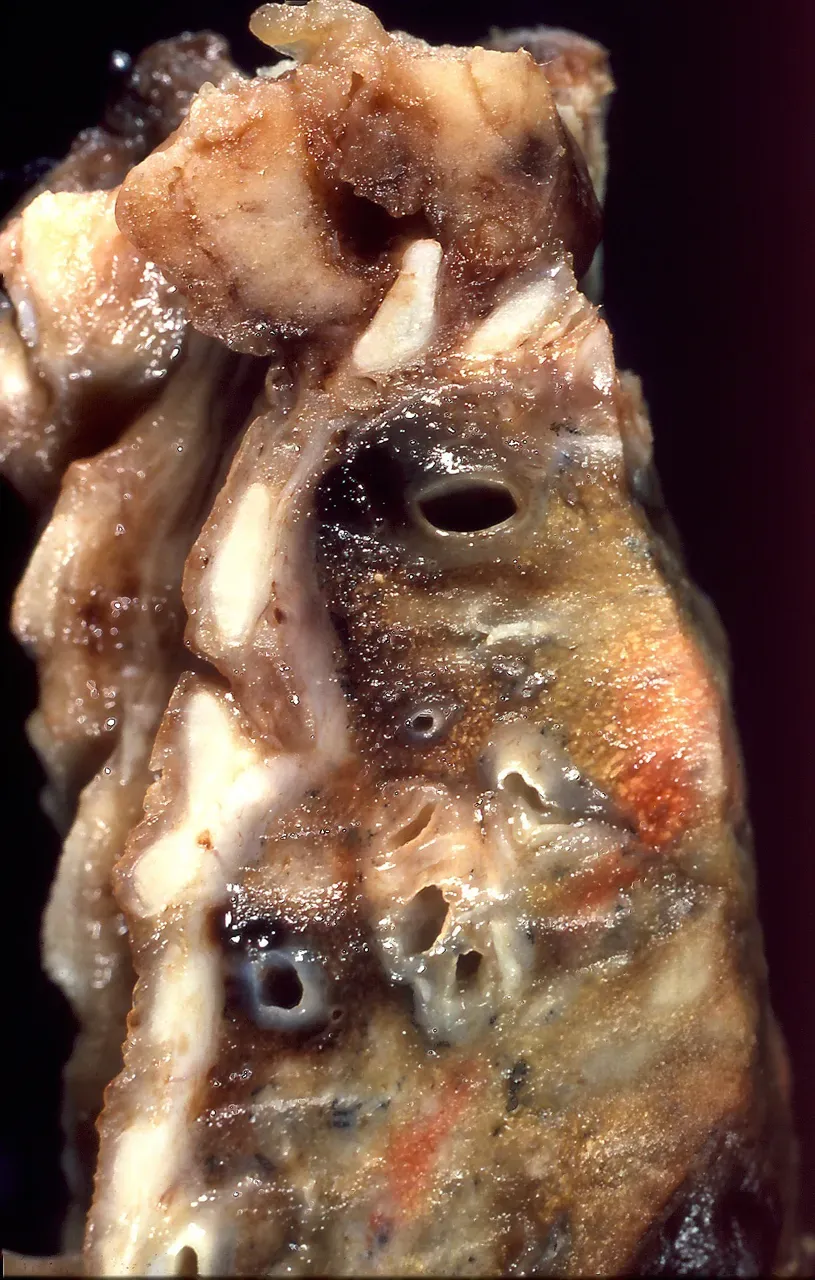
Pulmonary carcinoids are well-differentiated neuroendocrine tumours of the lung, arising from bronchial neuroendocrine (Kulchitsky) cells. The WHO 2021 classification separates typical carcinoids (fewer than 2 mitoses per 2 mm² and no necrosis) from atypical carcinoids (2–10 mitoses per 2 mm² and/or punctate necrosis); both differ fundamentally from the high-grade neuroendocrine carcinomas, small cell and large cell carcinoma. Carcinoids make up 1–2% of lung cancers, occur at a younger age than other lung cancers and are only loosely linked to smoking. Most are central and endobronchial, causing cough, unilateral wheeze, haemoptysis and recurrent pneumonia or collapse beyond the obstruction; peripheral tumours are often found incidentally. Hormonal syndromes (ectopic ACTH, carcinoid syndrome) are uncommon. Bronchoscopy shows a smooth, vascular, cherry-red mass. Diagnosis rests on histology with neuroendocrine markers and Ki-67, staged with CT and somatostatin receptor PET. Anatomical surgical resection with nodal dissection is curative for most. Advanced disease is treated with somatostatin analogues, everolimus, peptide receptor radionuclide therapy or chemotherapy. Typical carcinoids have an excellent prognosis; atypical ones recur more often.
Patient case, mechanism, investigations, management, flashcards and exam-style questions.Open the lesson →
Key facts
- Lung carcinoids are well-differentiated NETs: typical (under 2 mitoses/2 mm², no necrosis) and atypical (2–10 mitoses/2 mm² and/or necrosis)
- They account for 1–2% of lung cancers; patients are often younger (40s–50s) and many are never-smokers; MEN1 is an association
- About two-thirds to three-quarters are central: cough, haemoptysis, fixed unilateral wheeze and recurrent pneumonia or lobar collapse
- Bronchoscopy: smooth, pink-red, vascular polypoid mass with intact mucosa; biopsies can bleed
- Histology: chromogranin A, synaptophysin and INSM1 positive; Ki-67 helps grade and separate from neuroendocrine carcinoma
- Staging: contrast CT plus somatostatin receptor PET (68Ga-DOTATATE); FDG PET for atypical or SSTR-negative tumours
- Treatment of localised disease: anatomical resection (lobectomy, segmentectomy or sleeve resection) with systematic nodal dissection; avoid pneumonectomy
- Advanced disease: somatostatin analogues, everolimus (RADIANT-4), PRRT, temozolomide or oxaliplatin-based chemotherapy; typical carcinoid 5-year survival about 90%
Differential diagnosis
| Condition | Clues | Key test |
|---|---|---|
| Asthma | Wheeze is diffuse, variable and responds to bronchodilators | Spirometry with reversibility; CT if wheeze is fixed and localised |
| Foreign body aspiration | Sudden onset, choking episode, children or older adults | CT and bronchoscopy |
| Small cell lung cancer | Heavy smoker, bulky central mass, rapid course | Histology: high mitoses, Ki-67 often over 50%, necrosis |
| Large cell neuroendocrine carcinoma | Smoker, peripheral mass, high mitotic count | Histology: over 10 mitoses/2 mm², extensive necrosis |
| Hamartoma | Peripheral nodule with popcorn calcification and fat | CT density (fat), stability |
| Bronchiectasis | Chronic productive cough, multiple lobes | HRCT |
| Lung adenocarcinoma | Spiculated peripheral mass, smoker | Biopsy, TTF-1, molecular testing |
Exam pearls
Guideline
ENETS 2025 guidance paper for lung and thymic carcinoids (J Neuroendocrinol, 2026); ESMO Clinical Practice Guidelines for lung and thymic carcinoids (2021); WHO Classification of Thoracic Tumours, 5th edition (2021); IASLC 9th edition TNM (from 2025)
References
- Baudin E, Durand A, Buikhuisen W, et al.. European Society of Neuroendocrine Tumors (ENETS) 2025 guidance paper for lung and thymic carcinoids. J Neuroendocrinol 2026.
- Baudin E, Caplin M, Garcia-Carbonero R, et al.. Lung and thymic carcinoids: ESMO Clinical Practice Guidelines for diagnosis, treatment and follow-up. Ann Oncol 2021.
- WHO Classification of Tumours Editorial Board. Thoracic Tumours. WHO Classification of Tumours. 2021.
- Yao JC, Fazio N, Singh S, et al.. Everolimus for the treatment of advanced, non-functional neuroendocrine tumours of the lung or gastrointestinal tract (RADIANT-4): a randomised, placebo-controlled, phase 3 study. Lancet 2016.
- Ferolla P, Brizzi MP, Meyer T, et al.. Efficacy and safety of long-acting pasireotide or everolimus alone or in combination in patients with advanced carcinoids of the lung and thymus (LUNA): an open-label, multicentre, randomised, phase 2 trial. Lancet Oncol 2017.
- Baudin E, Capdevila J, Hörsch D, et al.. Treatment of advanced BP-NETS with lanreotide autogel/depot vs placebo: the phase III SPINET study. Endocr Relat Cancer 2024.
Related topics
By Dr Khalid Seidi (B.Sc., M.D.) · MedEd World Clinical Knowledge library. Original teaching content checked against current guidelines (November 2026); confirm the latest local guidance before clinical use. Not a substitute for clinical judgement.