Clinical Knowledge › Paediatrics › Basics of paediatrics
Normal growth and growth charts
Growth is the most sensitive single marker of a child's health. It occurs in three overlapping phases: infancy, driven mainly by nutrition; childhood, driven by growth hormone and thyroid hormone; and puberty, when sex steroids add a growth spurt. Growth is assessed by accurate serial measurement of weight, supine length (under 2 years) or standing height, and head circumference, plotted on charts built from healthy children. The WHO Child Growth Standards (0–5 years) describe how breastfed children grow in optimal conditions; the UK-WHO charts combine them with UK data, and the US uses WHO charts under 2 years and CDC charts afterwards. Centiles, z-scores and centile spaces allow comparison with peers, and mid-parental height gives each child a genetic target. Normal variants such as familial short stature and constitutional delay must be distinguished from pathological growth failure, signalled by height below the 0.4th centile, falling height velocity, weight crossing centiles downwards (faltering growth) or growth far below the parental target.
Patient case, mechanism, investigations, management, flashcards and exam-style questions.Open the lesson →
Key facts
- Birth weight about 3.5 kg; doubles by about 5 months, triples by 1 year; most babies regain birth weight by 2–3 weeks
- Length rises about 25 cm in the first year (about 50 to 75 cm) and roughly doubles birth length by 4 years
- Height velocity (approximate): 25 cm/year in infancy, 10–12 cm in the second year, 5–7 cm/year in mid-childhood, peak pubertal velocity about 8 cm/year in girls and 9–10 cm/year in boys
- Measure supine length under 2 years and standing height with a stadiometer from 2 years; correct age for prematurity until 1 year (32–36 weeks) or 2 years (under 32 weeks)
- UK-WHO centile lines (0.4th to 99.6th) are two-thirds of a standard deviation apart; a height below the 0.4th centile needs assessment
- Mid-parental height: average parental height plus 7 cm for boys or minus 7 cm for girls (some use 6.5 cm); most children fall within about 8.5–10 cm of it
- NICE NG75 faltering growth: weight falling 1 or more centile spaces (birth weight below 9th), 2 or more (9th–91st) or 3 or more (above 91st), or current weight below the 2nd centile
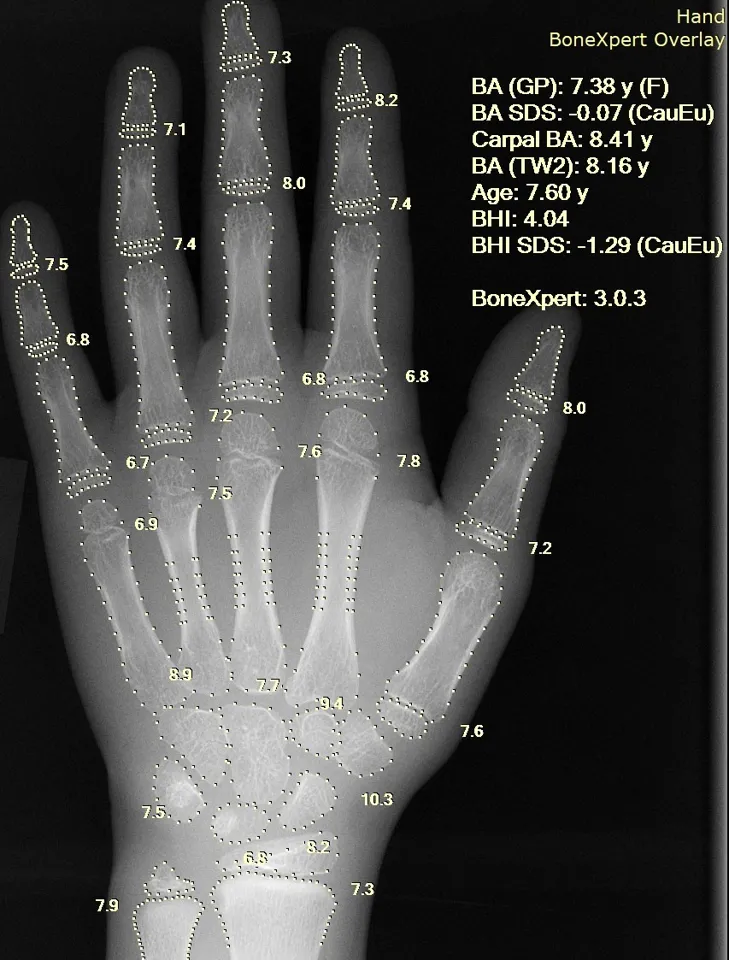
- Bone age (left hand and wrist X-ray) is delayed in constitutional delay, GH deficiency and hypothyroidism, and advanced in precocious puberty, obesity and CAH
Differential diagnosis
| Condition | Clues | Key test |
|---|---|---|
| Familial short stature | Short but growing parallel to centiles, consistent with short parents | Mid-parental height; normal height velocity and bone age |
| Constitutional delay of growth and puberty | Short, late puberty, parent was a late developer | Bone age delayed; normal velocity for bone age |
| Growth hormone deficiency | Falling height centile, chubby appearance, low velocity | IGF-1, GH stimulation tests, pituitary MRI |
| Hypothyroidism | Slowing growth, weight relatively preserved, fatigue, constipation | TSH and free T4 |
| Turner syndrome | Any girl with unexplained short stature | Karyotype |
| Coeliac disease or IBD | Falling weight before height; gastrointestinal symptoms | Coeliac serology, calprotectin, inflammatory markers |
| Psychosocial deprivation or neglect | Faltering growth with catch-up when cared for elsewhere | Social history, observed feeding, safeguarding assessment |
| Measurement or plotting error | Single outlying point | Repeat measurement with correct technique and age |
Exam pearls
Guideline
WHO Child Growth Standards (2006) and WHO growth reference 5–19 years (2007), RCPCH UK-WHO growth charts (0–4 years 2009; 2–18 years 2012), and NICE NG75 Faltering growth (2017)
References
- WHO Multicentre Growth Reference Study Group. WHO Child Growth Standards based on length/height, weight and age. Acta Paediatr Suppl 2006.
- de Onis M, Onyango AW, Borghi E, et al.. Development of a WHO growth reference for school-aged children and adolescents. Bull World Health Organ 2007.
- Wright CM, Williams AF, Elliman D, et al.. Using the new UK-WHO growth charts. BMJ 2010.
- National Institute for Health and Care Excellence. Faltering growth: recognition and management of faltering growth in children (NG75). NICE guideline 2017.
- Royal College of Paediatrics and Child Health. UK-WHO growth charts: 0–4 years and 2–18 years, with guidance for health professionals. RCPCH 2012.
- Hampl SE, Hassink SG, Skinner AC, et al.. Executive summary: clinical practice guideline for the evaluation and treatment of children and adolescents with obesity. Pediatrics 2023.
Related topics
By Dr Khalid Seidi (B.Sc., M.D.) · MedEd World Clinical Knowledge library. Original teaching content checked against current guidelines (November 2026); confirm the latest local guidance before clinical use. Not a substitute for clinical judgement.