Clinical Knowledge › Paediatrics › Basics of paediatrics
Paediatric vital signs and early warning scores
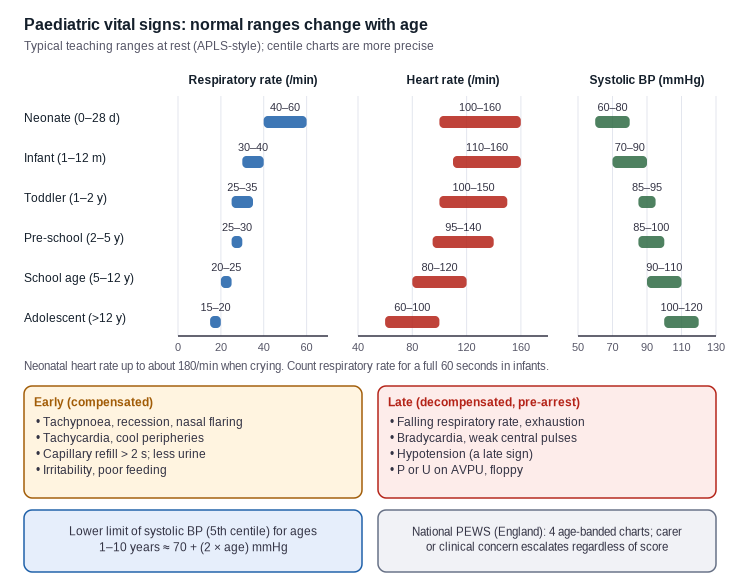
Normal heart rate, respiratory rate and blood pressure change continuously from birth to adolescence, so a value that is normal for a toddler may signal danger in a teenager. Children compensate for illness by raising heart and respiratory rates and constricting peripheral vessels, keeping blood pressure normal until they are close to collapse; tachypnoea, tachycardia, prolonged capillary refill and altered behaviour are therefore the important early signs and hypotension is late. Accurate measurement needs the right equipment (correct cuff size, age-appropriate thermometer), counting breaths for a full minute in infants, and interpretation against age-specific ranges. Paediatric early warning scores (PEWS) combine observations into a score that triggers escalation; England's national PEWS (four age-banded charts) adds a structured question for parent or carer concern and clinical intuition. PEWS supports, never replaces, clinical judgement. In suspected infection, NICE traffic-light criteria, NICE sepsis guidance and the 2024 Phoenix criteria build on the same vital signs.
Patient case, mechanism, investigations, management, flashcards and exam-style questions.Open the lesson →
Key facts
- Typical teaching ranges: infant heart rate 110–160/min and respiratory rate 30–40/min; school-age child heart rate 80–120/min and respiratory rate 20–25/min
- Lower limit of systolic blood pressure (5th centile) for ages 1–10 years is about 70 + (2 × age in years) mmHg; hypotension is a late, pre-arrest sign
- Capillary refill time over 2 seconds is abnormal; 3 seconds or more in a febrile child is an amber feature in NICE NG143
- Count respiratory rate for a full 60 seconds in infants because breathing is irregular
- Fever is 38°C or above; any fever in an infant under 3 months is a red (high-risk) feature
- England's national PEWS uses four age-banded charts (0–11 months, 1–4 years, 5–12 years, 13 years and over) with scored observations plus carer and clinical concern
- The EPOCH cluster randomised trial (2018) found BedsidePEWS did not reduce mortality but reduced significant clinical deterioration events
- Phoenix sepsis criteria (2024): suspected infection plus Phoenix Sepsis Score of 2 or more; septic shock if at least 1 cardiovascular point
Differential diagnosis
| Condition | Clues | Key test |
|---|---|---|
| Tachycardia from fever, pain or anxiety | Settles with antipyresis, analgesia or comfort; normal perfusion | Repeat observations after treatment; heart rate rises about 10/min per °C |
| Compensated shock | Persistent tachycardia, cool peripheries, prolonged capillary refill, normal blood pressure | Lactate, response to 10 mL/kg bolus |
| Respiratory distress | Tachypnoea with recession, nasal flaring, grunting | SpO2, blood gas if severe, chest X-ray |
| Metabolic acidosis (DKA, sepsis) | Deep sighing (Kussmaul) breathing without lung signs | Capillary glucose, ketones, blood gas |
| Supraventricular tachycardia | Heart rate above about 220/min in infants or 180/min in children, fixed, narrow complex | 12-lead ECG |
| Raised intracranial pressure | Bradycardia, hypertension and irregular breathing (Cushing triad, late) | Neurological examination, pupils, CT or MRI |
| Hypothermia or pre-arrest bradycardia | Heart rate under 60/min with poor perfusion | Start CPR; treat hypoxia first |
Exam pearls
Guideline
NHS England national Paediatric Early Warning Score (PEWS) observation and escalation charts (2023), NICE NG143 Fever in under 5s (2019), NICE NG254 Suspected sepsis in under 16s (2025) and the International Consensus (Phoenix) Criteria for Pediatric Sepsis (2024)
References
- Fleming S, Thompson M, Stevens R, et al.. Normal ranges of heart rate and respiratory rate in children from birth to 18 years of age: a systematic review of observational studies. Lancet 2011.
- Parshuram CS, Dryden-Palmer K, Farrell C, et al.. Effect of a pediatric early warning system on all-cause mortality in hospitalized pediatric patients: the EPOCH randomized clinical trial. JAMA 2018.
- NHS England, Royal College of Paediatrics and Child Health, Royal College of Nursing. National Paediatric Early Warning Score (PEWS) observation and escalation charts (System-wide Paediatric Observations Tracking programme). NHS England 2023.
- National Institute for Health and Care Excellence. Fever in under 5s: assessment and initial management (NG143). NICE guideline 2019.
- National Institute for Health and Care Excellence. Suspected sepsis in under 16s: recognition, diagnosis and early management (NG254). NICE guideline 2025.
- Schlapbach LJ, Watson RS, Sorce LR, et al.. International consensus criteria for pediatric sepsis and septic shock. JAMA 2024.
Related topics
By Dr Khalid Seidi (B.Sc., M.D.) · MedEd World Clinical Knowledge library. Original teaching content checked against current guidelines (November 2026); confirm the latest local guidance before clinical use. Not a substitute for clinical judgement.