Clinical Knowledge › Paediatrics › Basics of paediatrics
Paediatric drug dosing and prescribing
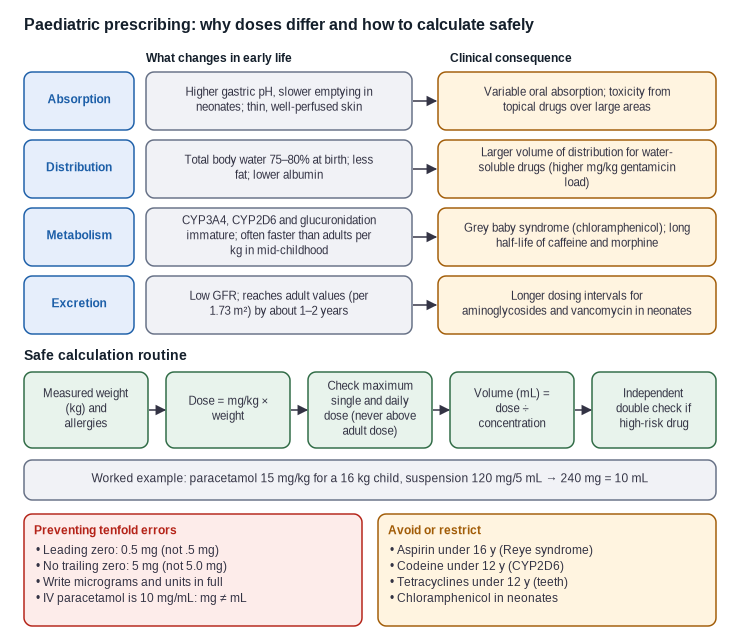
Children are not small adults: absorption, distribution, metabolism and excretion of drugs change rapidly from the preterm neonate to the adolescent, so doses are calculated by weight (mg/kg), body surface area or age band, and checked against a maximum that should not exceed the adult dose. Neonates have a larger volume of distribution for water-soluble drugs, immature liver enzymes and low glomerular filtration, which explains classic toxicities such as grey baby syndrome with chloramphenicol. Many medicines are used outside their licence because trials in children are few; this is acceptable when supported by evidence and a paediatric formulary such as the BNF for Children. Prescribing errors are about three times more likely to cause potential harm in children than adults, mostly from tenfold dosing mistakes, so accurate weight, clear units, leading zeros, double-checking and electronic prescribing matter. Some drugs are avoided or restricted in childhood, including aspirin (Reye syndrome), codeine under 12 years, and tetracyclines under 12 years.
Patient case, mechanism, investigations, management, flashcards and exam-style questions.Open the lesson →
Key facts
- Dose by measured weight (mg/kg) for most drugs, never exceeding the adult dose; body surface area for chemotherapy; age bands for some common medicines
- Neonates: higher total body water (larger volume of distribution for gentamicin), lower albumin, immature glucuronidation and CYP enzymes, and low GFR that matures over the first 1–2 years
- Children aged about 1–10 years often clear drugs faster per kg than adults, so mg/kg doses can be higher
- Tenfold errors (decimal points, mg versus micrograms, mL versus mg) are the most dangerous paediatric prescribing errors
- Always write a leading zero (0.5 mg), never a trailing zero (5 mg, not 5.0 mg), and write 'micrograms' and 'units' in full
- Avoid aspirin under 16 years (Reye syndrome) except specialist indications such as Kawasaki disease
- Codeine is contraindicated under 12 years and for post-tonsillectomy or adenoidectomy pain under 18 years (CYP2D6 ultrarapid metabolism risk; MHRA 2013)
- Teaching doses: paracetamol 15 mg/kg orally every 4–6 hours (maximum 4 doses in 24 hours); ibuprofen 5–10 mg/kg three times daily, from 3 months (check BNF for Children)
Differential diagnosis
| Condition | Clues | Key test |
|---|---|---|
| Tenfold overdose | Unexpected toxicity soon after a new prescription | Recalculate dose; check prescription and administration records |
| Drug toxicity from reduced clearance | Neonate or AKI with rising levels | Therapeutic drug monitoring; creatinine (bedside Schwartz eGFR) |
| Adverse drug reaction (type A) | Predictable dose-related effect | Dose history; drug levels |
| Drug allergy (type B) | Urticaria, angioedema, anaphylaxis after first or repeat dose | Clinical; mast cell tryptase in anaphylaxis; allergy referral |
| Accidental ingestion | Toddler with unexpected drowsiness or vomiting at home | History of access to medicines; toxicology |
| Non-adherence | Treatment failure with correct prescription | Discuss taste, formulation, timing, beliefs; pharmacy refill history |
| Drug interaction | New drug altering levels (for example clarithromycin with carbamazepine) | Interaction checker; levels |
Exam pearls
Guideline
BNF for Children (2025–2026), WHO Model List of Essential Medicines for Children (2025), MHRA Drug Safety Updates on codeine (2013), cough and cold medicines (2009) and valproate (2024), and EU Paediatric Regulation (2006)
References
- Kearns GL, Abdel-Rahman SM, Alander SW, et al.. Developmental pharmacology: drug disposition, action, and therapy in infants and children. N Engl J Med 2003.
- Kaushal R, Bates DW, Landrigan C, et al.. Medication errors and adverse drug events in pediatric inpatients. JAMA 2001.
- Paediatric Formulary Committee (BMJ Group, Pharmaceutical Press, RCPCH Publications). BNF for Children 2025–2026. 2025.
- Medicines and Healthcare products Regulatory Agency. Codeine for analgesia: restricted use in children because of reports of morphine toxicity (Drug Safety Update). MHRA 2013.
- World Health Organization. WHO Model List of Essential Medicines for Children (10th list). WHO 2025.
- Medicines and Healthcare products Regulatory Agency. Valproate: new safety and educational materials to support regulatory measures in men and women under 55 years (Drug Safety Update). MHRA 2024.
Related topics
By Dr Khalid Seidi (B.Sc., M.D.) · MedEd World Clinical Knowledge library. Original teaching content checked against current guidelines (November 2026); confirm the latest local guidance before clinical use. Not a substitute for clinical judgement.