Clinical Knowledge › Paediatrics › Basics of paediatrics
Puberty and adolescent health
Puberty is the sequence of physical changes, driven by reactivation of hypothalamic GnRH pulses, that brings sexual maturity and the adolescent growth spurt. In girls it normally starts between 8 and 13 years with breast budding, and menarche follows about 2–2.5 years later; in boys it starts between 9 and 14 years with testicular enlargement to 4 mL or more, and peak height velocity comes later than in girls. Tanner staging records progress. Adolescence (10–19 years by the WHO definition, extending to 24 in newer frameworks) is a period of rapid brain, emotional and social development during which many adult health behaviours and most mental disorders begin. Good adolescent care means seeing young people alone for part of the consultation, explaining confidentiality and its limits, assessing capacity (Gillick competence and Fraser guidelines in the UK), and taking a HEEADSSS psychosocial history. Priorities include mental health, sexual and reproductive health, HPV vaccination, injuries, substance use, safeguarding and planned transition to adult services.
Patient case, mechanism, investigations, management, flashcards and exam-style questions.Open the lesson →
Key facts
- Girls: thelarche (breast stage 2) at 8–13 years, mean about 10.5–11; menarche about 2–2.5 years later, mean about 12.5–13 years
- Boys: testicular volume of 4 mL or more marks onset, at 9–14 years (mean about 11.5–12); peak height velocity at genital stage 4, mean about 14 years
- Girls reach peak height velocity early in puberty (about breast stage 2–3), almost 2 years before boys
- Precocious puberty: signs before 8 years in girls or 9 in boys; delayed: no breast development by 13 years or no testicular enlargement by 14 years
- Physiological gynaecomastia affects up to about half of boys in mid-puberty and usually resolves within 1–2 years
- HEEADSSS: Home, Education/employment, Eating, Activities, Drugs, Sexuality, Suicide/depression, Safety
- Leading causes of adolescent death worldwide include road injuries, self-harm, interpersonal violence, drowning, HIV and lower respiratory infection, and maternal conditions in older girls
- In the UK a single HPV vaccine dose has been offered at 12–13 years since September 2023, following the WHO 2022 single-dose recommendation
Differential diagnosis
| Condition | Clues | Key test |
|---|---|---|
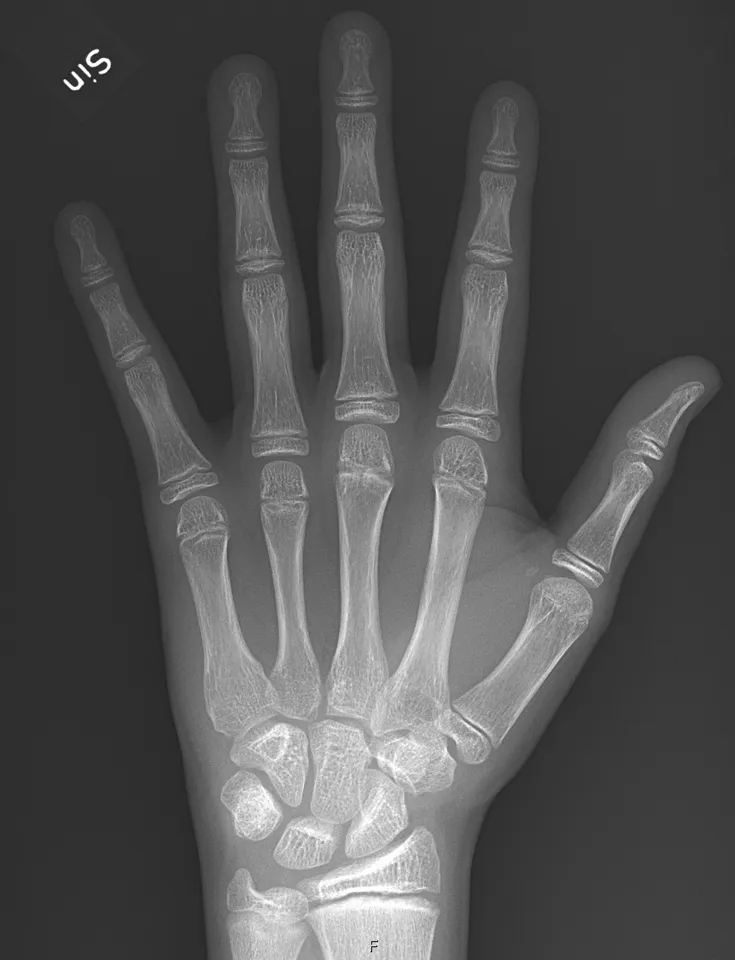
| Constitutional delay of growth and puberty | Late but normal puberty, short for age, delayed bone age, family history of late bloomers | Bone age; exclude chronic disease |
| Hypogonadotropic hypogonadism | No puberty, possibly anosmia (Kallmann), low LH and FSH | LH, FSH, sex steroids; MRI if indicated |
| Hypergonadotropic hypogonadism (Turner, Klinefelter) | Raised LH and FSH, dysmorphic features | Karyotype |
| Central precocious puberty | Progressive puberty before 8 (girls) or 9 (boys), accelerated growth | LH (basal or GnRH-stimulated), bone age, brain MRI |
| Physiological gynaecomastia versus pathological | Tender subareolar disc in mid-puberty versus large, unilateral or with small testes | Clinical; testicular examination; hormones if atypical |
| Depression | Low mood, irritability, withdrawal, sleep change over 2 weeks or more | Clinical assessment with HEEADSSS; validated questionnaires |
| Eating disorder | Weight loss, amenorrhoea, bradycardia, preoccupation with shape | Weight-for-height centile, ECG, electrolytes (MEED risk assessment) |
| Pregnancy | Secondary amenorrhoea, nausea in a sexually active adolescent | Urine hCG |
Exam pearls
Guideline
WHO Global Accelerated Action for the Health of Adolescents (AA-HA!) guidance (2nd ed, 2023), NICE NG43 Transition from children's to adults' services (2016), NICE NG134 Depression in children and young people (2019), NICE NG225 Self-harm (2022), WHO HPV vaccine position paper (2022) and FSRH contraception guidance
References
- Sawyer SM, Azzopardi PS, Wickremarathne D, Patton GC.. The age of adolescence. Lancet Child Adolesc Health 2018.
- Patton GC, Sawyer SM, Santelli JS, et al.. Our future: a Lancet commission on adolescent health and wellbeing. Lancet 2016.
- World Health Organization. Global Accelerated Action for the Health of Adolescents (AA-HA!): guidance to support country implementation. WHO 2023.
- National Institute for Health and Care Excellence. Transition from children's to adults' services for young people using health or social care services (NG43). NICE guideline 2016.
- National Institute for Health and Care Excellence. Self-harm: assessment, management and preventing recurrence (NG225). NICE guideline 2022.
- National Institute for Health and Care Excellence. Depression in children and young people: identification and management (NG134). NICE guideline 2019.
Related topics
By Dr Khalid Seidi (B.Sc., M.D.) · MedEd World Clinical Knowledge library. Original teaching content checked against current guidelines (November 2026); confirm the latest local guidance before clinical use. Not a substitute for clinical judgement.