Clinical Knowledge › Paediatrics › Basics of paediatrics
Paediatric basic and advanced life support
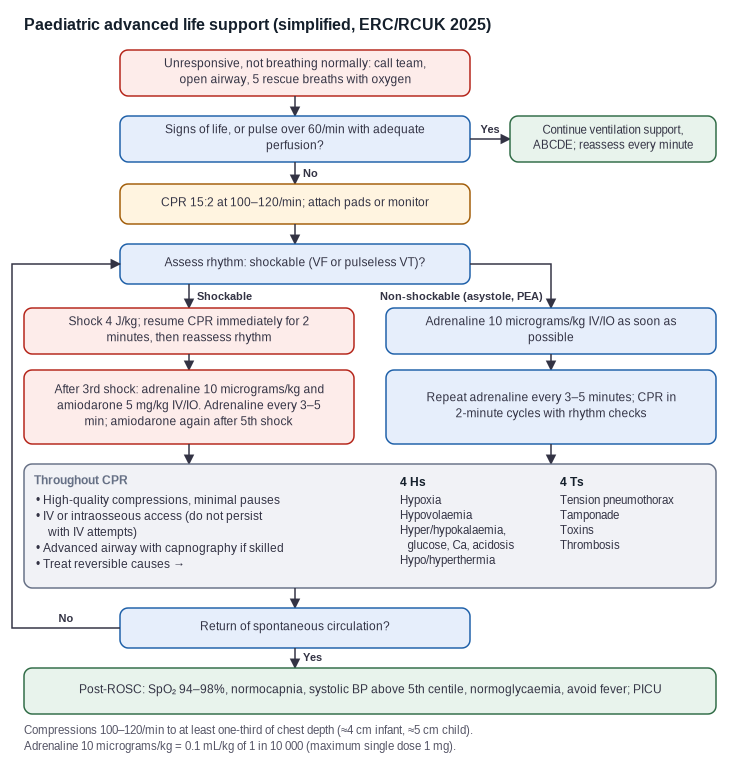
Cardiac arrest in children is usually the end point of hypoxia or shock rather than a primary cardiac event, so most arrests present as asystole or pulseless electrical activity and outcomes depend on early recognition of the seriously ill child and on prompt ventilation. Paediatric basic life support (European and UK guidance) starts with five rescue breaths, then chest compressions at 100–120/min to one-third of chest depth with a 15:2 ratio. Advanced life support adds bag-mask ventilation with oxygen, rhythm analysis, intravenous or intraosseous access and weight-based drugs: adrenaline 10 micrograms/kg every 3–5 minutes, and, for ventricular fibrillation, shocks of 4 J/kg with amiodarone 5 mg/kg after the third and fifth shocks. Reversible causes (4 Hs and 4 Ts) are sought throughout. Choking follows its own sequence of back blows and chest or abdominal thrusts. After return of spontaneous circulation, care targets normal oxygenation, ventilation, blood pressure, glucose and temperature. Newborns at birth follow newborn life support.
Patient case, mechanism, investigations, management, flashcards and exam-style questions.Open the lesson →
Key facts
- Most paediatric arrests are hypoxic or circulatory; initial rhythm is usually asystole or PEA; VF/pVT occurs in under about 10–15% (more in adolescents and cardiac disease)
- ERC/RCUK PBLS: open airway, 5 rescue breaths, then 15 compressions to 2 breaths; AHA starts with compressions (C-A-B) and uses 30:2 for a single rescuer and 15:2 for two rescuers
- Compressions: rate 100–120/min, depth at least one-third of the anteroposterior chest diameter (about 4 cm infant, 5 cm child), full recoil
- Infant compressions: two-thumb encircling (or one-hand) technique; AHA 2025 removed the two-finger technique
- Adrenaline 10 micrograms/kg IV/IO (0.1 mL/kg of 1 in 10 000; maximum 1 mg) every 3–5 minutes; give immediately in non-shockable rhythms
- Shockable rhythm: 4 J/kg shocks (ERC allows escalation towards 8 J/kg in refractory VF); adrenaline and amiodarone 5 mg/kg after the 3rd shock, amiodarone again after the 5th
- IV access attempts should not delay intraosseous access (ERC 2025: no more than about 5 minutes, sooner in arrest)
- Choking with ineffective cough: 5 back blows then 5 chest thrusts in infants or 5 abdominal thrusts in children over 1 year
Differential diagnosis
| Condition | Clues | Key test |
|---|---|---|
| Respiratory arrest with pulse | Apnoea or gasping but signs of life present | Ventilate 12–20 breaths/min (ERC) and reassess pulse and signs of life |
| Hypoxic bradycardia | Heart rate under 60/min with poor perfusion | Ventilate with oxygen; start CPR if persists |
| Pulseless electrical activity | Organised rhythm without pulse or signs of life | Monitor rhythm with no central pulse; seek 4 Hs and 4 Ts |
| Ventricular fibrillation | Sudden collapse, often adolescent, cardiac disease, commotio cordis, drugs | Monitor or AED rhythm |
| Seizure or post-ictal state | Breathing and pulse present, abnormal movements | Airway support, glucose, anticonvulsant protocol |
| Anaphylaxis | Stridor, wheeze, hypotension after trigger | Clinical; IM adrenaline immediately |
| Severe hypoglycaemia | Unresponsive with low glucose | Capillary glucose; 2 mL/kg 10% glucose |
Exam pearls
Guideline
European Resuscitation Council Guidelines 2025 Paediatric Life Support, Resuscitation Council UK Paediatric Life Support Guidelines 2025, 2025 AHA/AAP Pediatric Basic and Advanced Life Support guidelines, and ILCOR 2025 CoSTR
References
- Djakow J, Turner NM, Skellett S, et al.. European Resuscitation Council Guidelines 2025 Paediatric Life Support. Resuscitation 2025.
- Lasa JJ, Dhillon GS, Duff JP, et al.. Part 8: Pediatric advanced life support: 2025 American Heart Association and American Academy of Pediatrics guidelines for cardiopulmonary resuscitation and emergency cardiovascular care. Circulation 2025.
- Resuscitation Council UK. Paediatric life support guidelines 2025. Resuscitation Council UK 2025.
- International Liaison Committee on Resuscitation. 2025 International consensus on cardiopulmonary resuscitation and emergency cardiovascular care science with treatment recommendations. ILCOR 2025.
- Resuscitation Council UK. Emergency treatment of anaphylaxis: guidelines for healthcare providers. Resuscitation Council UK 2021.
- Advanced Life Support Group. Advanced Paediatric Life Support: A Practical Approach to Emergencies. 2016.
Related topics
By Dr Khalid Seidi (B.Sc., M.D.) · MedEd World Clinical Knowledge library. Original teaching content checked against current guidelines (November 2026); confirm the latest local guidance before clinical use. Not a substitute for clinical judgement.