Clinical Knowledge › Obstetrics and gynaecology › Postpartum care and complications
Postnatal depression and puerperal psychosis
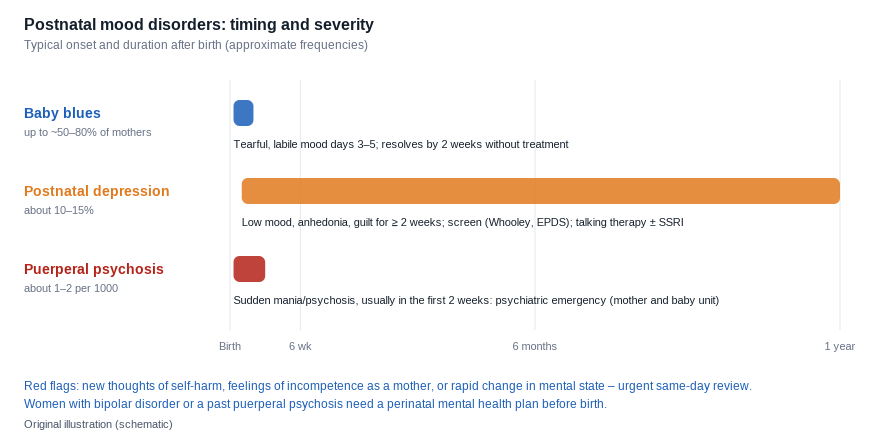
Perinatal mental illness ranges from the transient 'baby blues' to postnatal depression and the emergency of puerperal psychosis. The blues affect up to 80% of mothers, peak on days 3–5 and resolve within 2 weeks. Postnatal depression affects about 1 in 10 women in the first year, with low mood, anhedonia, anxiety, guilt about mothering and insomnia beyond the baby's demands. Screening uses the Whooley questions and the Edinburgh Postnatal Depression Scale (EPDS). Treatment is stepped: self-help and psychological therapy (CBT, interpersonal therapy), then antidepressants, with sertraline usually preferred in breastfeeding. Puerperal psychosis affects 1–2 per 1000 births, usually starts within 2 weeks with fluctuating mania, confusion and delusions, and is strongly linked to bipolar disorder. It needs exclusion of organic causes, same-day psychiatric review and admission, ideally to a mother and baby unit. Suicide is a leading cause of maternal death in the year after birth, so risk assessment and safeguarding are central.
Patient case, mechanism, investigations, management, flashcards and exam-style questions.Open the lesson →
Key facts
- Baby blues: up to 80% of mothers, onset days 3–5, tearful and labile but functioning, resolves by 2 weeks; reassure, but review if it persists beyond 2 weeks
- Postnatal depression: about 10–15% of mothers; DSM-5 'with peripartum onset' covers onset in pregnancy or within 4 weeks of birth, but clinically any episode in the first postnatal year counts
- Whooley questions at booking and postnatal contacts; EPDS (10 items, maximum 30): 13 or more suggests probable depression; any positive score on item 10 (self-harm) needs same-day assessment
- Mild to moderate depression: guided self-help, CBT or interpersonal therapy; moderate to severe: add an SSRI (sertraline preferred in breastfeeding) and refer to perinatal mental health
- Puerperal psychosis: 1–2 per 1000 births; onset usually within the first 2 weeks, often in the first days; mania, mixed states, confusion, perplexity, delusions about the baby
- Highest-risk groups: bipolar disorder (over a third relapse postnatally, about 1 in 5 with a severe manic or psychotic episode) and previous puerperal psychosis (recurrence after a later birth about 30–50%); relapse is far higher if mood stabilisers are stopped
- Red flags (MBRRACE-UK): recent significant change in mental state, new thoughts or acts of violent self-harm, new and persistent sense of incompetence as a mother or estrangement from the baby
- Psychosis is an emergency: exclude infection, pre-eclampsia, thyroid disease, hyponatraemia, drugs and intracranial pathology; admit to a mother and baby unit; antipsychotic, lithium or ECT
Differential diagnosis
| Condition | Clues | Key test |
|---|---|---|
| Baby blues | Days 3–5, mild lability, functioning preserved, resolves by 2 weeks | Clinical review at 10–14 days |
| Postpartum thyroiditis | Hyperthyroid phase at 1–4 months then hypothyroid low mood at 4–8 months, small painless goitre | TSH, free T4, TPO antibodies |
| Anaemia and sleep deprivation | Fatigue, breathlessness, pallor after PPH; mood otherwise preserved | Full blood count and ferritin |
| Perinatal anxiety, OCD or PTSD | Intrusive unwanted thoughts of harming the baby with avoidance; birth flashbacks | Clinical interview; GAD-2/GAD-7 |
| Delirium from sepsis, eclampsia or hyponatraemia | Fluctuating consciousness, fever, raised BP, focal signs | Observations, FBC, CRP, sodium, urinalysis, imaging if focal |
| Cerebral venous sinus thrombosis | Headache, seizures, focal deficit in the puerperium | CT or MR venography |
| Substance intoxication or withdrawal | History of alcohol or drug use, autonomic signs | Toxicology, collateral history |
Exam pearls
Guideline
NICE CG192 Antenatal and postnatal mental health (2014, updated 2020); ACOG Clinical Practice Guidelines No. 4 and No. 5 on perinatal mental health (2023); MBRRACE-UK confidential enquiry reports
References
- National Institute for Health and Care Excellence. Antenatal and postnatal mental health: clinical management and service guidance (CG192). NICE clinical guideline CG192 2014.
- American College of Obstetricians and Gynecologists. Screening and diagnosis of mental health conditions during pregnancy and postpartum (Clinical Practice Guideline No. 4); Treatment and management of mental health conditions during pregnancy and postpartum (Clinical Practice Guideline No. 5). Obstet Gynecol 2023.
- MBRRACE-UK. Saving Lives, Improving Mothers' Care: lessons learned to inform maternity care from the UK and Ireland Confidential Enquiries into Maternal Deaths and Morbidity. National Perinatal Epidemiology Unit, University of Oxford 2024.
- Wesseloo R, Kamperman AM, Munk-Olsen T, Pop VJ, Kushner SA, Bergink V.. Risk of postpartum relapse in bipolar disorder and postpartum psychosis: a systematic review and meta-analysis. Am J Psychiatry 2016.
- Di Florio A, Mei Kay Yang J, Crawford K, et al.. Post-partum psychosis and its association with bipolar disorder in the UK: a case-control study using polygenic risk scores. Lancet Psychiatry 2021.
- Cox JL, Holden JM, Sagovsky R.. Detection of postnatal depression: development of the 10-item Edinburgh Postnatal Depression Scale. Br J Psychiatry 1987.
Related topics
By Dr Khalid Seidi (B.Sc., M.D.) · MedEd World Clinical Knowledge library. Original teaching content checked against current guidelines (November 2026); confirm the latest local guidance before clinical use. Not a substitute for clinical judgement.