Clinical Knowledge › Obstetrics and gynaecology › Postpartum care and complications
Retained placenta
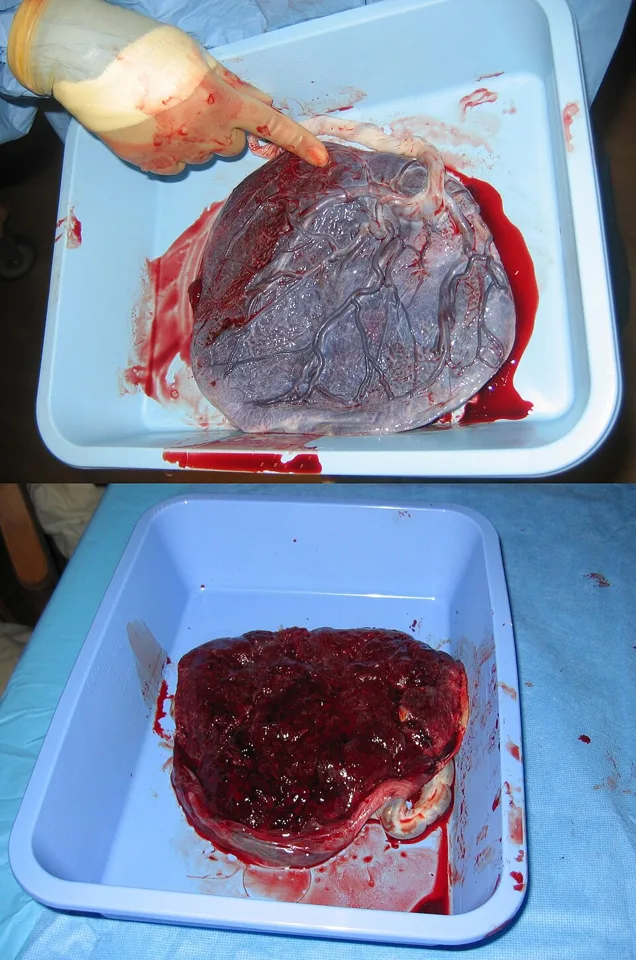
Retained placenta is failure of the placenta to deliver within 30 minutes of birth with active management of the third stage, or within 60 minutes with physiological management. It complicates about 2–3% of vaginal births in high-income countries and is a major cause of postpartum haemorrhage. There are three mechanisms: placenta adherens (the myometrium behind the placenta fails to contract), trapped placenta (a separated placenta held behind a closing cervix) and placenta accreta spectrum (abnormal invasion preventing separation). Strong risk factors are a previous retained placenta, preterm or small-for-gestational-age birth, stillbirth, pre-eclampsia, prolonged oxytocin exposure, previous uterine surgery and assisted conception. Management starts with assessment for bleeding, IV access, bloods, emptying the bladder and a further attempt at controlled cord traction after a uterotonic; if bleeding is heavy, treat as PPH. Definitive treatment is manual removal of the placenta in theatre under regional or general anaesthesia with a single dose of prophylactic antibiotics. Umbilical vein oxytocin and sublingual nitroglycerin have not been shown to avoid manual removal in large trials.
Patient case, mechanism, investigations, management, flashcards and exam-style questions.Open the lesson →
Key facts
- Definition (NICE): prolonged third stage if not completed within 30 minutes of birth with active management, or 60 minutes with physiological management
- Incidence about 2–3% of vaginal births in high-income settings; much higher case fatality in low-resource settings because of PPH
- Types: placenta adherens (failed retroplacental contraction), trapped placenta (separated but held behind the cervix), placenta accreta spectrum (abnormal adherence)
- Risk factors: previous retained placenta, preterm birth, SGA baby, stillbirth, pre-eclampsia, long oxytocin infusion in labour, previous uterine surgery or curettage, IVF, uterine anomalies
- Do not use umbilical vein oxytocin (Release trial) or nitroglycerin (GOT-IT trial) routinely – neither reduced the need for manual removal in large RCTs
- Do not give IV oxytocin only to deliver the placenta (NICE); give uterotonics if the woman is bleeding
- Manual removal of placenta in theatre under regional or general anaesthesia, with a single dose of prophylactic antibiotics (WHO: ampicillin or a first-generation cephalosporin)
- If an accreta is suspected (no plane of cleavage), stop, call a senior and prepare for haemorrhage; do not tear the placenta out piecemeal
Differential diagnosis
| Condition | Clues | Key test |
|---|---|---|
| Trapped placenta | Placenta separated (cord lengthens) but held behind a closing cervix | Vaginal examination: placenta felt in cervix or lower segment |
| Placenta adherens | No signs of separation; uterus soft behind placenta | Clinical; resolves with manual removal |
| Placenta accreta spectrum | Previous caesarean with praevia; no cleavage plane at manual removal | Antenatal ultrasound/MRI; findings at removal |
| Uterine inversion | Cord traction on an unseparated fundal placenta; shock; fundus not palpable | Abdominal and vaginal examination |
| Retained cotyledon or succenturiate lobe | Placenta delivered but incomplete or a torn vessel at the membrane edge | Inspection of placenta and membranes |
| Cord avulsion | Cord snaps during traction; placenta still in situ | Clinical |
Exam pearls
Guideline
NICE NG235 Intrapartum care (2023); RCOG Green-top Guideline No. 52 Prevention and management of postpartum haemorrhage (2016); WHO/FIGO/ICM consolidated PPH guidelines (2025) and WHO recommendations for prevention and treatment of maternal peripartum infections (2015)
References
- National Institute for Health and Care Excellence. Intrapartum care (NG235). NICE guideline NG235 2023.
- Mavrides E, Allard S, Chandraharan E, et al.. Prevention and management of postpartum haemorrhage: Green-top Guideline No. 52. BJOG 2016.
- World Health Organization; International Federation of Gynecology and Obstetrics; International Confederation of Midwives. Consolidated guidelines on the prevention, diagnosis and treatment of postpartum haemorrhage. World Health Organization, Geneva 2025.
- World Health Organization. WHO recommendations for prevention and treatment of maternal peripartum infections. World Health Organization, Geneva 2015.
- Weeks AD. The retained placenta. Best Pract Res Clin Obstet Gynaecol 2008.
- Weeks AD, Alia G, Vernon G, et al.. Umbilical vein oxytocin for the treatment of retained placenta (Release Study): a double-blind, randomised controlled trial. Lancet 2010.
Related topics
By Dr Khalid Seidi (B.Sc., M.D.) · MedEd World Clinical Knowledge library. Original teaching content checked against current guidelines (November 2026); confirm the latest local guidance before clinical use. Not a substitute for clinical judgement.