Clinical Knowledge › Obstetrics and gynaecology › Postpartum care and complications
Uterine inversion
Acute uterine inversion is a rare obstetric emergency in which the uterine fundus turns inside out and descends into or through the cervix, usually during the third stage of labour. It occurs in roughly 1 in 2000 to 1 in 20 000 births and is classically linked to traction on the cord or fundal pressure while the uterus is relaxed, especially with a fundal or adherent placenta. Typical features are sudden severe lower abdominal pain, massive postpartum haemorrhage and shock that may be out of proportion to visible blood loss because of vagal stimulation, an absent or cup-shaped fundus on abdominal palpation and a smooth, bluish-red mass in the vagina or at the introitus. Management is immediate: call for help, stop oxytocin, leave an attached placenta in place and replace the uterus manually (Johnson manoeuvre) while resuscitating. If a cervical ring prevents replacement, tocolysis, general anaesthesia, hydrostatic replacement or laparotomy (Huntington or Haultain procedure) are used. Once replaced, uterotonics maintain contraction and the PPH is managed.
Patient case, mechanism, investigations, management, flashcards and exam-style questions.Open the lesson →
Key facts
- Incidence about 1 in 2000 to 1 in 20 000 births (about 1 in 20 000 vaginal births in a Dutch national cohort); most occur in low-risk women during the third stage
- Timing: acute within 24 hours (most common), subacute 24 hours to 4 weeks, chronic after 4 weeks (often non-puerperal, from a submucous fibroid)
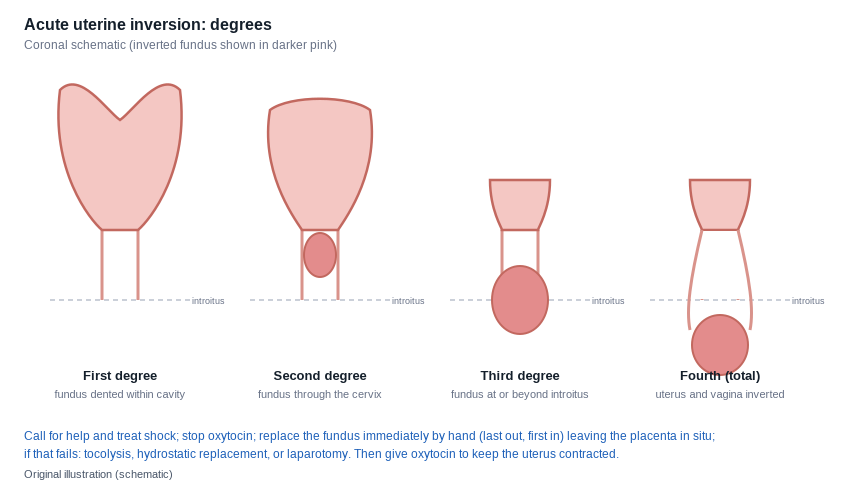
- Degree: first (fundus within the cavity), second (through the cervix into the vagina), third (to or beyond the introitus), fourth (total, with vaginal inversion)
- Classic triad: PPH, shock out of proportion to blood loss (vagal, sometimes bradycardia) and absent fundus with a vaginal mass
- First actions: call for help, stop oxytocin, do not remove an attached placenta, immediate manual replacement (Johnson manoeuvre), two large-bore cannulas and blood
- If a constriction ring forms: tocolysis (terbutaline 0.25 mg SC, glyceryl trinitrate 50–100 micrograms IV or magnesium sulfate 4 g IV; teaching doses) or general anaesthesia with a volatile agent
- Hydrostatic method (O'Sullivan): warm saline run into the posterior fornix with the introitus sealed; surgery: Huntington (traction on round ligaments) or Haultain (incision of the posterior ring)
- After replacement: hold the uterus in place, give uterotonics (oxytocin infusion, ergometrine or carboprost), remove the placenta, tranexamic acid, antibiotics and close observation
Differential diagnosis
| Condition | Clues | Key test |
|---|---|---|
| Uterine atony | Soft, enlarged uterus palpable abdominally; responds to massage and uterotonics | Abdominal palpation |
| Retained placenta | Fundus palpable, placenta undelivered after 30–60 minutes | Palpation; examination under anaesthesia |
| Prolapsed submucous fibroid (polyp) | Firm mass through cervix with a pedicle; fundus normal in position | Ultrasound; examination |
| Uterine rupture | Scarred uterus, pain, fetal parts palpable, haemoperitoneum | Ultrasound, laparotomy |
| Vaginal or paravaginal haematoma | Severe perineal pain, tense bulging mass, uterus normal | Examination; ultrasound |
| Amniotic fluid embolism | Sudden collapse, hypoxia, DIC; no vaginal mass | Clinical; coagulation screen |
| Uterovaginal prolapse (chronic) | Gradual protrusion, cervix visible at the apex | Examination, POP-Q |
Exam pearls
Guideline
WHO, FIGO and ICM consolidated guideline on postpartum haemorrhage (October 2025); RCOG Green-top Guideline No. 52 Postpartum haemorrhage, prevention and management (2016); NICE NG235 Intrapartum care (2023)
References
- Witteveen T, van Stralen G, Zwart J, van Roosmalen J.. Puerperal uterine inversion in the Netherlands: a nationwide cohort study. Acta Obstet Gynecol Scand 2013.
- Royal College of Obstetricians and Gynaecologists. Prevention and management of postpartum haemorrhage (Green-top Guideline No. 52). BJOG 2016.
- World Health Organization, FIGO and International Confederation of Midwives. WHO recommendations on the prevention, diagnosis and treatment of postpartum haemorrhage (consolidated guideline). World Health Organization, Geneva 2025.
- You WB, Zahn CM.. Postpartum hemorrhage: abnormally adherent placenta, uterine inversion, and puerperal hematomas. Clin Obstet Gynecol 2006.
- Papageorgiou S, Brodowski L, Lewinski H, et al.. Practical obstetric multi-professional training (PROMPT): the evidence for effective training. Arch Gynecol Obstet 2025.
- Giouleka S, Tsakiridis I, Kalogiannidis I, et al.. Postpartum hemorrhage: a comprehensive review of guidelines. Obstet Gynecol Surv 2022.
Related topics
By Dr Khalid Seidi (B.Sc., M.D.) · MedEd World Clinical Knowledge library. Original teaching content checked against current guidelines (November 2026); confirm the latest local guidance before clinical use. Not a substitute for clinical judgement.