Clinical Knowledge › Obstetrics and gynaecology › Postpartum care and complications
Postpartum haemorrhage
Postpartum haemorrhage (PPH) is the leading cause of maternal death worldwide. Primary PPH is classically blood loss of 500 mL or more within 24 hours of birth (RCOG: minor 500–1000 mL; major over 1000 mL or with shock); secondary PPH is abnormal bleeding from 24 hours to 12 weeks, usually from endometritis or retained tissue. The WHO, FIGO and ICM consolidated guidelines (October 2025) stress objective measurement with calibrated drapes and action when measured loss reaches 300 mL with any abnormal vital sign, or 500 mL regardless. Causes are the 4 Ts: tone (uterine atony, about 70%), trauma, tissue and thrombin. Prevention is active management of the third stage with oxytocin 10 IU IM and treatment of antenatal anaemia. Once PPH is diagnosed, the E-MOTIVE bundle – uterine massage, oxytocic drugs, tranexamic acid, IV fluids, examination of the genital tract and escalation – is given together; it cut severe outcomes by 60% in a large trial. Further uterotonics (ergometrine, carboprost, misoprostol), blood products guided by fibrinogen and viscoelastic tests, balloon tamponade, compression sutures, embolisation and hysterectomy follow if bleeding continues.
Patient case, mechanism, investigations, management, flashcards and exam-style questions.Open the lesson →
Key facts
- Primary PPH: 500 mL or more within 24 hours of birth; RCOG minor 500–1000 mL, major over 1000 mL (moderate 1001–2000, severe over 2000) or clinical shock; ACOG: 1000 mL or more, or loss with signs of hypovolaemia
- WHO/FIGO/ICM 2025: measure blood loss objectively (calibrated drape) and diagnose PPH at 300 mL or more with any abnormal vital sign, or at 500 mL or more
- Secondary PPH: abnormal or excessive bleeding from 24 hours to 12 weeks after birth – usually endometritis with or without retained products
- 4 Ts: Tone (about 70%), Trauma (about 20%), Tissue (about 10%), Thrombin (under 1%)
- Prevention: oxytocin 10 IU IM in the third stage for every birth; heat-stable carbetocin where cold chain is unreliable; misoprostol only if injectables are unavailable
- MOTIVE bundle: uterine Massage, Oxytocic drugs, Tranexamic acid 1 g IV (within 3 hours of birth), IV fluids, Vaginal and genital tract examination, Escalation
- Second-line uterotonics (teaching doses): ergometrine 0.5 mg IM or slow IV (not if hypertensive), carboprost 250 micrograms IM every 15 minutes up to 8 doses (caution in asthma), misoprostol 800 micrograms sublingual
- Keep fibrinogen above 2 g/L and platelets above 75 ×10^9/L; surgical ladder: balloon tamponade, compression sutures, vessel ligation or embolisation, hysterectomy
Differential diagnosis
| Condition | Clues | Key test |
|---|---|---|
| Uterine atony | Soft, boggy, enlarged uterus above the umbilicus; bleeding with clots | Abdominal palpation; firms with massage |
| Genital tract trauma | Bleeding despite a well-contracted uterus; steady bright red trickle | Speculum examination of perineum, vagina, cervix |
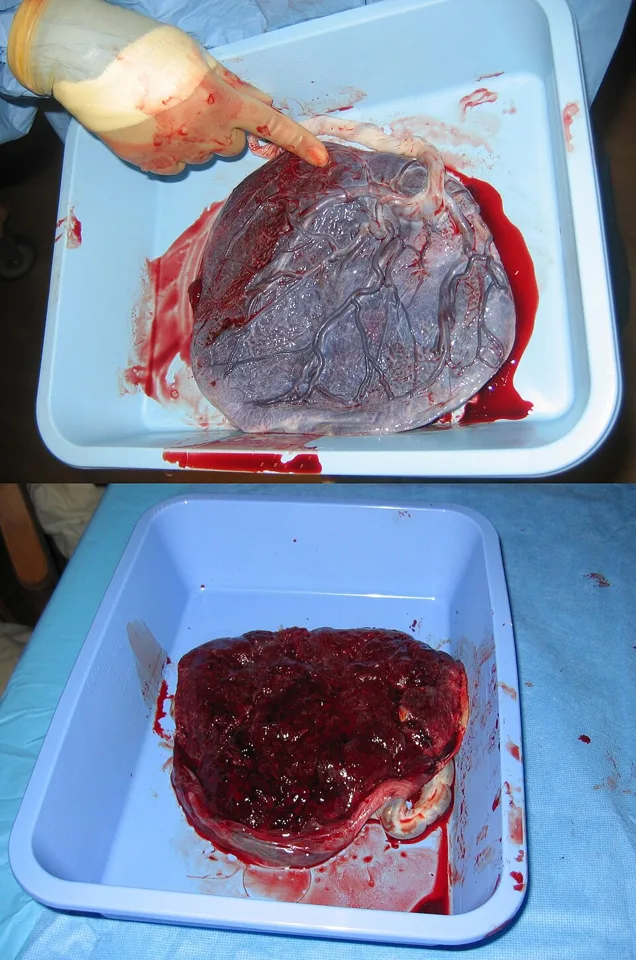
| Retained placenta or products | Incomplete placenta or membranes; ongoing bleeding | Placental inspection, examination under anaesthesia |
| Coagulopathy | Oozing from wounds and IV sites; abruption, AFE, pre-eclampsia or sepsis | Clauss fibrinogen, PT, APTT, platelets, viscoelastic tests |
| Uterine rupture | Previous caesarean, abdominal pain, fetal distress before birth, haemoperitoneum | Ultrasound or laparotomy |
| Uterine inversion | Shock out of proportion to blood loss; fundus not palpable abdominally; mass in vagina | Clinical examination |
| Concealed haematoma (broad ligament, vulvovaginal, rectus sheath) | Pain and shock with little visible bleeding | Examination, ultrasound or CT |
Exam pearls
Guideline
WHO, FIGO and ICM consolidated guidelines on the prevention, diagnosis and treatment of postpartum haemorrhage (2025); RCOG Green-top Guideline No. 52 Prevention and management of postpartum haemorrhage (2016); ACOG Practice Bulletin No. 183 (2017)
References
- World Health Organization; International Federation of Gynecology and Obstetrics; International Confederation of Midwives. Consolidated guidelines on the prevention, diagnosis and treatment of postpartum haemorrhage. World Health Organization, Geneva 2025.
- Mavrides E, Allard S, Chandraharan E, et al.. Prevention and management of postpartum haemorrhage: Green-top Guideline No. 52. BJOG 2016.
- WOMAN Trial Collaborators. Effect of early tranexamic acid administration on mortality, hysterectomy, and other morbidities in women with post-partum haemorrhage (WOMAN): an international, randomised, double-blind, placebo-controlled trial. Lancet 2017.
- Gallos I, Devall A, Martin J, et al.. Randomized trial of early detection and treatment of postpartum hemorrhage. N Engl J Med 2023.
- National Institute for Health and Care Excellence. Intrapartum care (NG235). NICE guideline NG235 2023.
- American College of Obstetricians and Gynecologists. Practice Bulletin No. 183: Postpartum hemorrhage. Obstet Gynecol 2017.
Related topics
By Dr Khalid Seidi (B.Sc., M.D.) · MedEd World Clinical Knowledge library. Original teaching content checked against current guidelines (November 2026); confirm the latest local guidance before clinical use. Not a substitute for clinical judgement.