Clinical Knowledge › Ear, nose and throat › Larynx and trachea
Recurrent respiratory papillomatosis
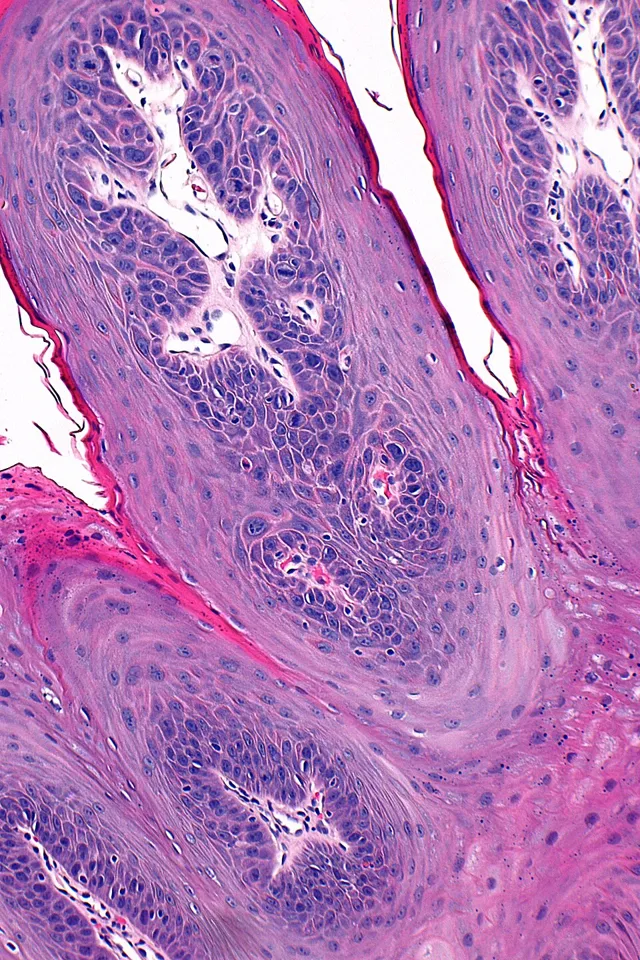
Recurrent respiratory papillomatosis (RRP) is a chronic disease in which benign squamous papillomas, caused by human papillomavirus (HPV) types 6 and 11, grow in the airway, most often the larynx. Juvenile-onset disease usually appears before age 5 after HPV exposure at birth; first-born children of young mothers with genital warts are at highest risk. Adult-onset disease peaks in the third and fourth decades. Papillomas cluster where squamous and ciliated epithelium meet. They cause progressive hoarseness, a weak cry and later stridor, and are often first misdiagnosed as croup or asthma. HPV 11, young age at onset and tracheostomy predict aggressive disease, distal tracheal and lung spread, and rare malignant change. Diagnosis is by laryngoscopy and biopsy with HPV typing. Repeated surgical debulking that spares normal tissue is the mainstay. Systemic bevacizumab and HPV vaccination are used as adjuvants. PRGN-2012, an HPV 6/11 immunotherapy, became the first FDA-approved drug for adult RRP in 2025. National HPV vaccination has sharply reduced juvenile cases.
Patient case, mechanism, investigations, management, flashcards and exam-style questions.Open the lesson →
Key facts
- Caused by HPV 6 and 11 (low-risk types); HPV 11 tends to cause more aggressive disease
- Juvenile onset: usually diagnosed at 2–5 years; risk triad of first-born child, vaginal delivery and young mother with genital warts
- Papillomas form at squamociliary junctions: vestibule, ventricle, undersurface of the folds, carina; tracheostomy promotes distal spread
- Presents with progressive hoarseness then stridor; frequently mislabelled as croup, asthma or vocal nodules
- Diagnosis: laryngoscopy and biopsy with HPV typing; severity tracked with the Derkay staging score
- Mainstay: repeated debulking (microdebrider, cold steel or laser) that preserves normal mucosa; avoid tracheostomy if possible
- Adjuvants: systemic bevacizumab, HPV vaccination; PRGN-2012 (zopapogene imadenovec) FDA-approved for adults in 2025 (51% complete response)
- Australia's national HPV programme was followed by a fall in juvenile RRP from 0.16 to 0.02 per 100 000 children (2012–2016)
Differential diagnosis
| Condition | Clues | Key test |
|---|---|---|
| Vocal fold nodules | Bilateral symmetrical mid-fold swellings, no stridor, stable size | Laryngoscopy |
| Croup | Acute barking cough, coryza, rapid resolution | Clinical; recurrent or atypical croup needs airway endoscopy |
| Asthma | Expiratory wheeze responding to bronchodilators, normal voice | Spirometry; laryngoscopy if hoarse |
| Subglottic haemangioma | Infant under 6 months, biphasic stridor, cutaneous haemangioma | Airway endoscopy |
| Laryngeal squamous cell carcinoma | Older smoker, ulcerated or infiltrative lesion, fixed fold | Biopsy |
| Laryngeal granuloma | Posterior lesion on vocal process after intubation or reflux | Laryngoscopy and biopsy if atypical |
| Vocal fold leukoplakia or dysplasia | White plaque in a smoker | Excision biopsy |
Exam pearls
Guideline
No single international guideline; practice per RRP Task Force consensus and reviews (Derkay 2008), AAO-HNS Dysphonia guideline (2018), and FDA approval of zopapogene imadenovec (PRGN-2012) for adults (2025)
References
- Derkay CS, Wiatrak B. Recurrent respiratory papillomatosis: a review. Laryngoscope 2008.
- Novakovic D, Cheng ATL, Zurynski Y, et al.. A prospective study of the incidence of juvenile-onset recurrent respiratory papillomatosis after implementation of a national HPV vaccination program. J Infect Dis 2018.
- Norberg SM, Valdez J, Napier S, et al.. PRGN-2012 gene therapy in adults with recurrent respiratory papillomatosis: a pivotal phase 1/2 clinical trial. Lancet Respir Med 2025.
- Baali MH, et al.. The efficacy and safety of systemic treatment for managing recurrent respiratory papillomatosis: a systematic review and meta-analysis. J Voice 2026.
- Stachler RJ, Francis DO, Schwartz SR, et al.. Clinical practice guideline: hoarseness (dysphonia) (update). Otolaryngol Head Neck Surg 2018.
- Kozin ED, Lustig LR. In: Papadakis MA, Rabow MW, McQuaid KR, eds.. CURRENT Medical Diagnosis & Treatment 2026, chapter 8: Otolaryngology disorders. McGraw Hill 2026.
Related topics
By Dr Khalid Seidi (B.Sc., M.D.) · MedEd World Clinical Knowledge library. Original teaching content checked against current guidelines (November 2026); confirm the latest local guidance before clinical use. Not a substitute for clinical judgement.