Clinical Knowledge › Ear, nose and throat › Larynx and trachea
Vocal fold paralysis
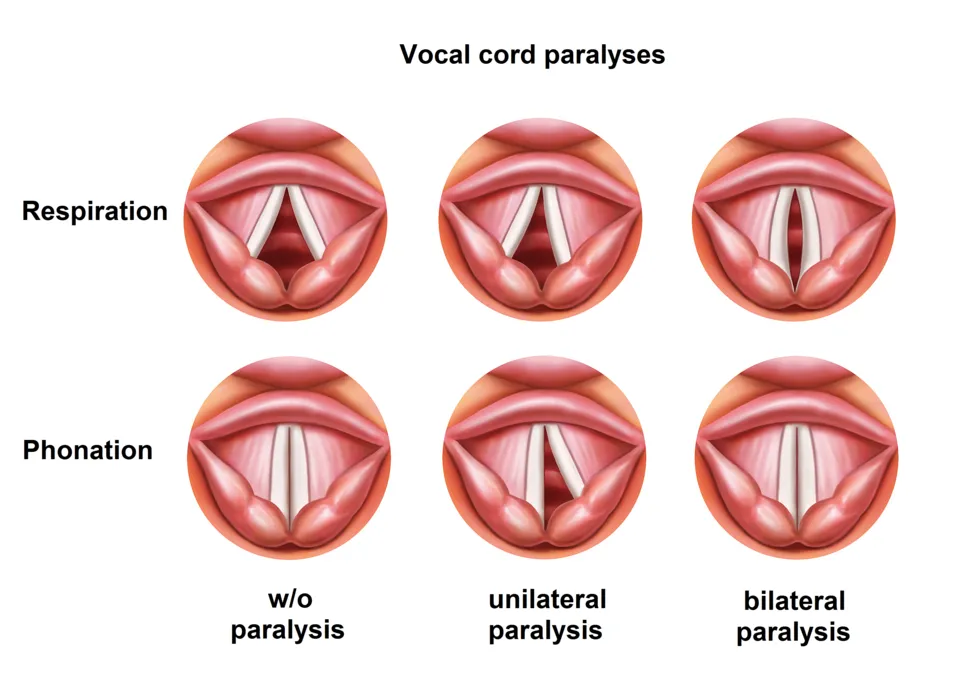
Vocal fold paralysis is loss of movement of one or both vocal folds from injury to the vagus nerve or its recurrent laryngeal branch. The recurrent laryngeal nerve (RLN) supplies all intrinsic laryngeal muscles except cricothyroid, including posterior cricoarytenoid, the only abductor. The left RLN loops under the aortic arch, so left palsy is commoner. Leading causes are surgery (thyroid, anterior cervical spine, carotid, cardiothoracic and oesophageal), cancer of the lung apex, oesophagus, thyroid or mediastinum, intubation and idiopathic neuropathy. Unilateral palsy gives a weak, breathy voice, a poor cough and aspiration of thin fluids. Bilateral palsy leaves the folds near the midline: the voice may be fair but inspiratory stridor can threaten the airway. Laryngoscopy confirms immobility. If no surgical cause is obvious, contrast CT from skull base to aortic arch looks for a lesion along the nerve. Treatment includes voice therapy, early injection laryngoplasty, medialisation thyroplasty or reinnervation. Bilateral palsy may need tracheostomy or a glottis-widening procedure.
Patient case, mechanism, investigations, management, flashcards and exam-style questions.Open the lesson →
Key facts
- RLN supplies all intrinsic laryngeal muscles except cricothyroid (external branch of the superior laryngeal nerve)
- Posterior cricoarytenoid is the only abductor; its loss leaves the fold paramedian
- Left RLN hooks under the aortic arch at the ligamentum arteriosum; right hooks under the subclavian artery, so left palsy is commoner
- Commonest cause today is surgery; in one large series non-thyroid surgery (spine, carotid, chest) overtook thyroidectomy
- Unilateral: breathy weak voice, short phonation time, weak cough, aspiration of thin liquids
- Bilateral: near-normal voice but inspiratory stridor and exertional dyspnoea; often after total thyroidectomy; airway emergency
- Unexplained palsy needs contrast CT from skull base to aortic arch (include mediastinum and lung apex)
- Early temporary injection laryngoplasty improves voice and swallowing and may reduce later need for thyroplasty
Differential diagnosis
| Condition | Clues | Key test |
|---|---|---|
| Cricoarytenoid joint fixation | Rheumatoid arthritis, prior intubation trauma; fold immobile but nerve intact | Laryngeal EMG normal; palpation of arytenoid under anaesthesia |
| Arytenoid dislocation | Hoarseness immediately after difficult intubation | Laryngoscopy, CT larynx |
| Posterior glottic stenosis | Scar between arytenoids after prolonged intubation; stridor | Microlaryngoscopy |
| Laryngeal cancer infiltrating the fold | Smoker, fixed fold with a mass | Laryngoscopy and biopsy; CT |
| Superior laryngeal nerve palsy | Loss of high pitch and vocal fatigue; folds move | Stroboscopy: rotated glottis; laryngeal EMG |
| Functional (paradoxical) vocal fold motion | Episodic inspiratory stridor; normal folds between attacks | Laryngoscopy during symptoms |
| Myasthenia gravis or motor neurone disease | Fatigable or progressive bulbar signs | Acetylcholine receptor antibodies, EMG, neurology review |
Exam pearls
Guideline
AAO-HNS Clinical Practice Guideline: Improving Voice Outcomes after Thyroid Surgery (2013); AAO-HNS Hoarseness (Dysphonia) update (2018)
References
- Chandrasekhar SS, Randolph GW, Seidman MD, et al.. Clinical practice guideline: improving voice outcomes after thyroid surgery. Otolaryngol Head Neck Surg 2013.
- Stachler RJ, Francis DO, Schwartz SR, et al.. Clinical practice guideline: hoarseness (dysphonia) (update). Otolaryngol Head Neck Surg 2018.
- Rosenthal LH, Benninger MS, Deeb RH. Vocal fold immobility: a longitudinal analysis of etiology over 20 years. Laryngoscope 2007.
- Alghonaim Y, Roskies M, Kost K, Young J. Evaluating the timing of injection laryngoplasty for vocal fold paralysis in an attempt to avoid future type 1 thyroplasty. J Otolaryngol Head Neck Surg 2013.
- Mor N, Wu G, Aylward A, Christos PJ, Sulica L. Predictors for permanent medialization laryngoplasty in unilateral vocal fold paralysis. Otolaryngol Head Neck Surg 2016.
- National Institute for Health and Care Excellence. Suspected cancer: recognition and referral (NG12). NICE, London 2015.
Related topics
By Dr Khalid Seidi (B.Sc., M.D.) · MedEd World Clinical Knowledge library. Original teaching content checked against current guidelines (November 2026); confirm the latest local guidance before clinical use. Not a substitute for clinical judgement.