Clinical Knowledge › Ear, nose and throat › Larynx and trachea
Vocal fold nodules, polyps and cysts
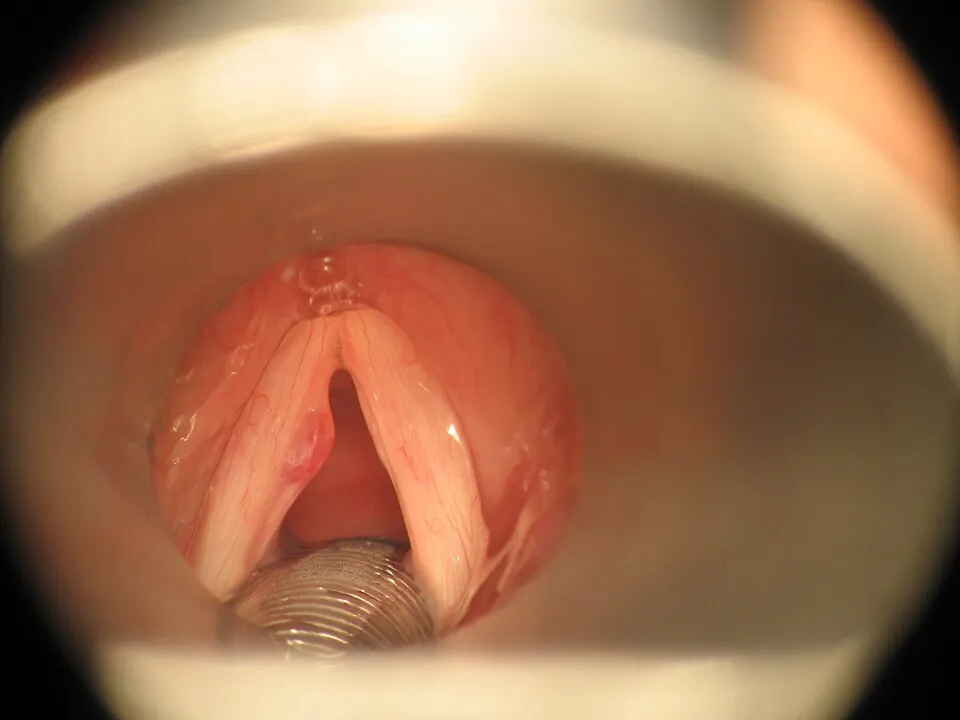
Vocal fold nodules, polyps and cysts are the commonest benign lesions of the vocal folds and a frequent cause of chronic hoarseness. They arise in the superficial lamina propria (Reinke space) of the membranous vocal fold, usually at the junction of its anterior and middle thirds, where vibration and impact forces are greatest. Nodules are bilateral, symmetrical callus-like thickenings caused by chronic phonotrauma in teachers, singers and shouting children; they are treated first with voice therapy. Polyps are usually unilateral and exophytic, often after a single vocal strain or haemorrhage, and are linked to smoking and anticoagulants; many need microlaryngeal excision. Cysts are subepithelial mucus retention or epidermoid cysts that rarely resolve with therapy and are removed by microflap surgery. All cause hoarseness, vocal fatigue and loss of range. Diagnosis needs laryngoscopy, ideally with videostroboscopy. Persistent hoarseness, especially in smokers or adults over 45, needs prompt laryngoscopy to exclude cancer, and steroids or antireflux drugs should not be given blindly.
Patient case, mechanism, investigations, management, flashcards and exam-style questions.Open the lesson →
Key facts
- Site: junction of anterior and middle thirds of the membranous vocal fold, in the superficial lamina propria (Reinke space)
- Nodules: bilateral, symmetrical, broad-based; chronic phonotrauma; children (boys) and adult women; hourglass glottic closure
- Polyps: usually unilateral, sessile or pedunculated, gelatinous or haemorrhagic; acute phonotrauma, smoking, anticoagulants
- Cysts: mucus retention (blocked gland) or epidermoid (keratin); unilateral, often with a reactive lesion on the opposite fold
- Videostroboscopy shows a reduced or absent mucosal wave over cysts and scar; nodules keep a mostly normal wave
- Voice therapy is first line for nodules; polyps and cysts often need phonomicrosurgery (microflap) plus pre- and post-operative therapy
- AAO-HNS dysphonia guideline (2018): laryngoscopy if hoarseness does not resolve or improve within 4 weeks, or sooner if serious cause suspected
- NICE NG12: suspected cancer pathway referral for people aged 45 or over with persistent unexplained hoarseness
Differential diagnosis
| Condition | Clues | Key test |
|---|---|---|
| Reinke oedema (polypoid corditis) | Bilateral, floppy, whole-length swelling; heavy smoker; low-pitched voice | Laryngoscopy; stop smoking |
| Laryngeal squamous cell carcinoma | Smoker over 45, progressive hoarseness, irregular or leukoplakic lesion, stiff fold | Laryngoscopy and biopsy; CT neck |
| Contact or intubation granuloma | Posterior lesion on the vocal process; reflux, throat clearing or recent intubation | Laryngoscopy (posterior site) |
| Recurrent respiratory papillomatosis | Warty, multiple, recurring lesions; child or young adult; may cause stridor | Laryngoscopy, biopsy, HPV typing |
| Vocal fold paralysis | Breathy weak voice, aspiration; immobile fold, no mass | Laryngoscopy; CT skull base to chest |
| Muscle tension dysphonia | Strained voice, supraglottic squeezing, normal folds | Laryngoscopy; speech and language therapy assessment |
| Vocal fold sulcus or scar | Lifelong or post-surgical breathy voice; stiff fold | Videostroboscopy (absent mucosal wave) |
Exam pearls
Guideline
AAO-HNS Clinical Practice Guideline: Hoarseness (Dysphonia) update (2018); NICE NG12 Suspected cancer: recognition and referral (2015, updated)
References
- Stachler RJ, Francis DO, Schwartz SR, et al.. Clinical practice guideline: hoarseness (dysphonia) (update). Otolaryngol Head Neck Surg 2018.
- Johns MM. Update on the etiology, diagnosis, and treatment of vocal fold nodules, polyps, and cysts. Curr Opin Otolaryngol Head Neck Surg 2003.
- Hartnick C, Ballif C, De Guzman V, et al.. Indirect vs direct voice therapy for children with vocal nodules: a randomized clinical trial. JAMA Otolaryngol Head Neck Surg 2018.
- Adriaansen A, Meerschman I, Van Lierde K, D'haeseleer E. Effects of voice therapy in children with vocal fold nodules: a systematic review. Int J Lang Commun Disord 2022.
- National Institute for Health and Care Excellence. Suspected cancer: recognition and referral (NG12). NICE, London 2015.
- Kozin ED, Lustig LR. In: Papadakis MA, Rabow MW, McQuaid KR, eds.. CURRENT Medical Diagnosis & Treatment 2026, chapter 8: Otolaryngology disorders. McGraw Hill 2026.
Related topics
By Dr Khalid Seidi (B.Sc., M.D.) · MedEd World Clinical Knowledge library. Original teaching content checked against current guidelines (November 2026); confirm the latest local guidance before clinical use. Not a substitute for clinical judgement.