Clinical Knowledge › Ear, nose and throat › Larynx and trachea
Subglottic stenosis
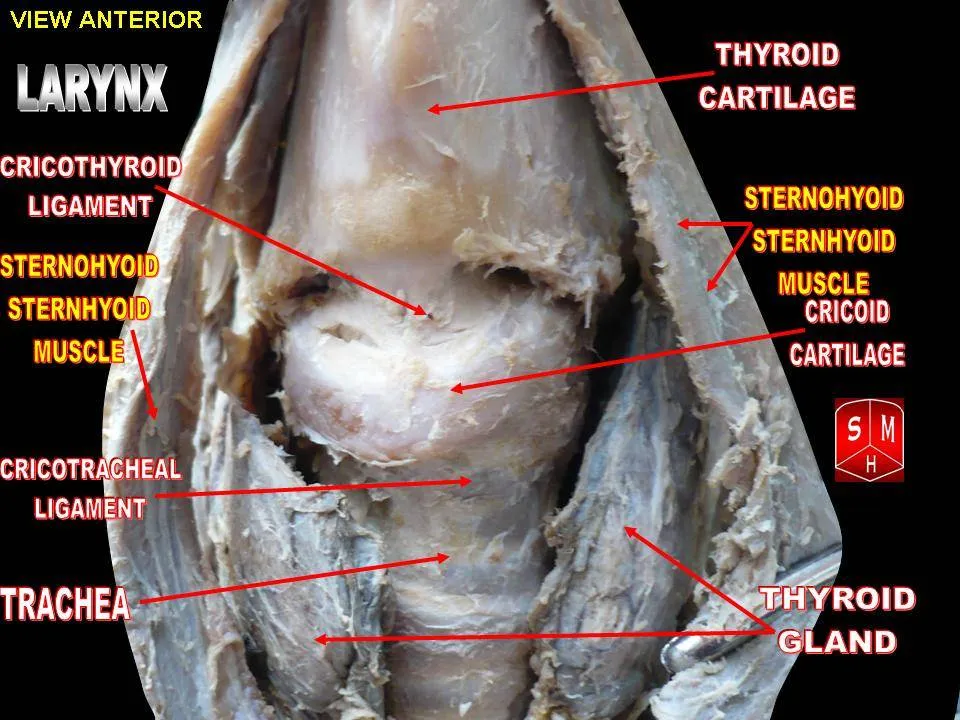
Subglottic stenosis is narrowing of the airway between the undersurface of the vocal folds and the lower border of the cricoid cartilage. The cricoid is the only complete cartilaginous ring in the airway, so swelling or scar there cannot expand outwards. Most cases are acquired after prolonged or traumatic endotracheal intubation: an oversized tube or a high-pressure cuff causes mucosal ischaemia, ulceration and fibrosis. Congenital stenosis comes from incomplete recanalisation of the larynx. In adults, other causes include granulomatosis with polyangiitis and idiopathic subglottic stenosis, which mainly affects women aged 30–60. Patients present with biphasic stridor, recurrent or prolonged croup, failed extubation, or exertional breathlessness misdiagnosed as asthma. Diagnosis is by endoscopy and sizing; severity is graded by the Myer–Cotton system. Treatment ranges from endoscopic dilation, laser incision and steroid injection to laryngotracheal reconstruction or cricotracheal resection. Correct tube size and cuff pressure prevent most acquired cases.
Patient case, mechanism, investigations, management, flashcards and exam-style questions.Open the lesson →
Key facts
- Subglottis extends from about 1 cm below the vocal folds to the lower border of the cricoid, the only complete ring
- Term neonate: lumen 4 mm or less is stenosis (normal about 4.5–5.5 mm); preterm: 3 mm or less
- About 90% of paediatric cases are acquired, mostly after endotracheal intubation; congenital stenosis is the third commonest congenital laryngeal anomaly
- Myer–Cotton grades: I 0–50%, II 51–70%, III 71–99%, IV no detectable lumen
- Adults: post-intubation or tracheostomy, granulomatosis with polyangiitis, idiopathic subglottic stenosis (women 30–60), trauma, relapsing polychondritis
- Flow-volume loop in fixed upper airway obstruction: flattening of both inspiratory and expiratory limbs
- Idiopathic disease: reoperation at 5 years about 50% after dilation, 30% after endoscopic resection with medical therapy, 5% after cricotracheal resection
- Prevention: correct tube size, cuff pressure kept at 20–30 cmH2O, shortest intubation, check for a leak
Differential diagnosis
| Condition | Clues | Key test |
|---|---|---|
| Croup | Acute onset, coryza, barking cough, settles in days | Clinical; endoscopy if recurrent, atypical or under 6 months |
| Subglottic haemangioma | Infant 1–6 months, biphasic stridor, often with a cutaneous haemangioma | Airway endoscopy; responds to propranolol |
| Laryngomalacia | Inspiratory stridor worse when feeding or supine, from birth | Flexible laryngoscopy |
| Bilateral vocal fold paralysis | Stridor with good voice; neurological or surgical history | Laryngoscopy (immobile folds) |
| Asthma or COPD | Wheeze, variable obstruction, bronchodilator response | Spirometry and flow-volume loop |
| Tracheal stenosis or tumour | Lower lesion; stridor, haemoptysis in tumour | CT and bronchoscopy |
| Recurrent respiratory papillomatosis | Hoarseness first, warty lesions | Laryngoscopy and biopsy |
Exam pearls
Guideline
Myer–Cotton grading system (1994); European Laryngological Society consensus on classification of benign laryngotracheal stenosis (2015); North American Airway Collaborative comparative outcomes for idiopathic subglottic stenosis (2020, 5-year update 2023); DAS 2025 and ASA 2022 airway guidelines for prevention and emergency care
References
- Myer CM 3rd, O'Connor DM, Cotton RT. Proposed grading system for subglottic stenosis based on endotracheal tube sizes. Ann Otol Rhinol Laryngol 1994.
- Monnier P, Dikkers FG, Eckel H, et al.. Preoperative assessment and classification of benign laryngotracheal stenosis: a consensus paper of the European Laryngological Society. Eur Arch Otorhinolaryngol 2015.
- Gelbard A, Anderson C, Berry LD, et al.. Comparative treatment outcomes for patients with idiopathic subglottic stenosis. JAMA Otolaryngol Head Neck Surg 2020.
- Tierney WS, Huang LC, Chen SC, et al.. Comparative treatment outcomes for idiopathic subglottic stenosis: 5-year update. Otolaryngol Head Neck Surg 2023.
- Apfelbaum JL, Hagberg CA, Connis RT, et al.. 2022 American Society of Anesthesiologists practice guidelines for management of the difficult airway. Anesthesiology 2022.
- Ahmad I, El-Boghdadly K, Iliff H, et al.. Difficult Airway Society 2025 guidelines for management of unanticipated difficult tracheal intubation in adults. Br J Anaesth 2026.
Related topics
By Dr Khalid Seidi (B.Sc., M.D.) · MedEd World Clinical Knowledge library. Original teaching content checked against current guidelines (November 2026); confirm the latest local guidance before clinical use. Not a substitute for clinical judgement.