Clinical Knowledge › Neurology › Clinical problems
Speech and language disturbance: approach to the patient
Disorders of communication fall into three groups: aphasia (dysphasia), a disorder of language from damage to the dominant (usually left) hemisphere; dysarthria, a motor speech disorder of articulation from lesions anywhere in the motor pathway, cerebellum, basal ganglia, cranial nerves, neuromuscular junction or muscles; and dysphonia, a disorder of voice from laryngeal or vagal pathology. Bedside assessment of spontaneous speech (fluency), comprehension, repetition, naming, reading and writing classifies aphasias – Broca (non-fluent, comprehension preserved), Wernicke (fluent, paraphasic, poor comprehension), conduction (poor repetition), global and transcortical types. Sudden aphasia or dysarthria is a stroke symptom requiring the acute stroke pathway. Gradually progressive language decline suggests primary progressive aphasia, classified into non-fluent, semantic and logopenic variants. Dysarthria types (spastic, flaccid, ataxic, hypokinetic, hyperkinetic) point to the lesion site. Speech and language therapy is central to rehabilitation and swallow assessment.
Patient case, mechanism, investigations, management, flashcards and exam-style questions.Open the lesson →
Key facts
- Aphasia = language disorder (dominant hemisphere); dysarthria = articulation disorder; dysphonia = voice disorder
- Assess fluency, comprehension, repetition, naming, reading and writing
- Broca aphasia: non-fluent, effortful, telegraphic speech; comprehension relatively preserved; often with right hemiparesis (left inferior frontal gyrus)
- Wernicke aphasia: fluent but meaningless speech with paraphasias and neologisms; poor comprehension; often no hemiparesis (left superior temporal gyrus)
- Conduction aphasia: fluent, good comprehension, poor repetition (arcuate fasciculus)
- Sudden speech disturbance is a stroke symptom: FAST/BE-FAST, call emergency services, imaging for thrombolysis/thrombectomy
- Ataxic dysarthria (scanning, slurred) = cerebellum; hypokinetic (soft, monotonous) = Parkinson disease
- Primary progressive aphasia variants: non-fluent/agrammatic, semantic, logopenic (Gorno-Tempini 2011)
Differential diagnosis
| Condition | Clues | Key test |
|---|---|---|
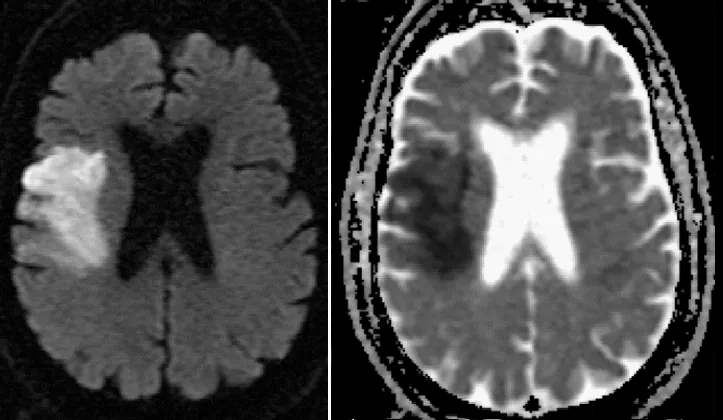
| Acute stroke (MCA territory) | Sudden aphasia with right hemiparesis or field defect | CT/CTA, MRI DWI |
| Primary progressive aphasia | Gradual language decline over years with relative preservation of other domains | MRI, FDG-PET, amyloid biomarkers |
| Cerebellar disease | Ataxic scanning dysarthria, limb ataxia, nystagmus | MRI brain |
| Parkinson disease | Hypophonic monotonous speech, bradykinesia | Clinical |
| Myasthenia gravis | Fatigable nasal dysarthria, ptosis | AChR antibodies |
| Motor neurone disease | Mixed spastic–flaccid dysarthria, tongue fasciculation | EMG |
| Recurrent laryngeal nerve palsy | Hoarse breathy voice, weak cough | Laryngoscopy, CT neck/chest |
| Functional speech disorder | Inconsistent, foreign accent-like or stuttering onset after stress | Clinical; SLT |
Exam pearls
Guideline
AHA/ASA 2026 acute ischaemic stroke guideline, NICE NG128 stroke and TIA (2019, updated 2025) and UK National Clinical Guideline for Stroke (2023), and Gorno-Tempini PPA classification (2011)
References
- Prabhakaran S, Gonzalez NR, Zachrison KS, et al.. 2026 Guideline for the Early Management of Patients With Acute Ischemic Stroke. Stroke 2026.
- National Institute for Health and Care Excellence (NICE). Stroke and transient ischaemic attack in over 16s: diagnosis and initial management (NG128). NICE guideline 2019.
- Intercollegiate Stroke Working Party. National Clinical Guideline for Stroke for the UK and Ireland. Intercollegiate Stroke Working Party 2023.
- Gorno-Tempini ML, Hillis AE, Weintraub S, et al.. Classification of primary progressive aphasia and its variants. Neurology 2011.
- Jack CR Jr, Andrews JS, Beach TG, et al.. Revised criteria for diagnosis and staging of Alzheimer's disease: Alzheimer's Association Workgroup. Alzheimers Dement 2024.
- Papadakis MA, Rabow MW, McQuaid KR, eds.. CURRENT Medical Diagnosis & Treatment 2026. McGraw Hill 2026.
Related topics
By Dr Khalid Seidi (B.Sc., M.D.) · MedEd World Clinical Knowledge library. Original teaching content checked against current guidelines (November 2026); confirm the latest local guidance before clinical use. Not a substitute for clinical judgement.