Clinical Knowledge › Neurology › Clinical problems
Tremor: approach to the patient
Tremor is an involuntary, rhythmic, oscillatory movement of a body part. The 2018 International Parkinson and Movement Disorder Society consensus classifies tremor on two axes: clinical features (activation condition, distribution, frequency, associated signs) and aetiology. Rest tremor occurs when the limb is fully supported and is typical of Parkinson disease (4–6 Hz, asymmetric, 'pill-rolling', re-emerging after a delay on posture). Action tremor includes postural tremor (arms outstretched) and kinetic tremor, seen in enhanced physiological tremor, essential tremor (bilateral upper-limb action tremor for at least 3 years, often familial, alcohol-responsive) and drug-induced tremor; intention tremor that worsens approaching a target indicates cerebellar disease. Always look for reversible causes: thyrotoxicosis, drugs (salbutamol, valproate, lithium, SSRIs, caffeine), alcohol withdrawal, hypoglycaemia and Wilson disease in younger patients. Management depends on the cause: propranolol or primidone for essential tremor, dopaminergic therapy for Parkinson disease.
Patient case, mechanism, investigations, management, flashcards and exam-style questions.Open the lesson →
Key facts
- Classify tremor by when it occurs: rest, postural, kinetic, intention, task-specific
- Parkinson rest tremor: 4–6 Hz, asymmetric, pill-rolling, reduces with action, re-emerges after posture held
- Essential tremor: bilateral upper-limb action tremor for ≥3 years, ± head or voice tremor, no other neurological signs
- Essential tremor improves with alcohol in about half of patients and is often autosomal dominant
- Intention tremor (worse near target) = cerebellar disease (MS, stroke, alcohol, drugs)
- Check TSH, glucose, drug history and (if under 50) copper and caeruloplasmin for Wilson disease
- First-line drugs for essential tremor: propranolol or primidone
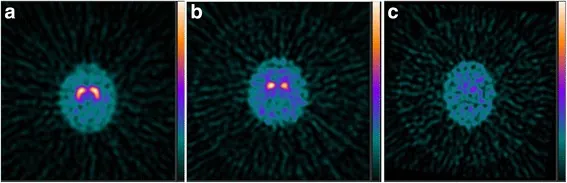
- DaT-SPECT distinguishes Parkinson disease (reduced uptake) from essential, drug-induced and functional tremor (normal)
Differential diagnosis
| Condition | Clues | Key test |
|---|---|---|
| Parkinson disease | Asymmetric rest tremor, bradykinesia, rigidity | Clinical (MDS criteria); DaT-SPECT if unclear |
| Essential tremor | Bilateral postural/kinetic tremor, family history, alcohol responsive | Clinical diagnosis |
| Enhanced physiological tremor | Fine postural tremor with anxiety, caffeine, drugs, thyrotoxicosis | TSH, drug review |
| Drug-induced tremor | Lithium, valproate, salbutamol, SSRIs, amiodarone, tacrolimus | Medication history, lithium level |
| Cerebellar tremor | Intention tremor with ataxia, dysmetria, nystagmus | MRI brain |
| Dystonic tremor | Irregular, jerky, with abnormal posture; null point | Clinical |
| Wilson disease | Young patient, wing-beating tremor, liver disease, Kayser–Fleischer rings | Caeruloplasmin, 24-h urine copper, slit lamp |
| Functional tremor | Variable frequency, entrainment, distractibility | Clinical positive signs |
Exam pearls
Guideline
MDS consensus statement on the classification of tremors (2018), MDS clinical diagnostic criteria for Parkinson disease (2015), NICE NG71 Parkinson disease (2017) and AAN essential tremor guideline (2011, reaffirmed)
References
- Bhatia KP, Bain P, Bajaj N, et al.. Consensus Statement on the classification of tremors. From the task force on tremor of the International Parkinson and Movement Disorder Society. Mov Disord 2018.
- Postuma RB, Berg D, Stern M, et al.. MDS clinical diagnostic criteria for Parkinson's disease. Mov Disord 2015.
- National Institute for Health and Care Excellence (NICE). Parkinson's disease in adults (NG71). NICE guideline 2017.
- Zesiewicz TA, Elble RJ, Louis ED, et al.. Evidence-based guideline update: treatment of essential tremor. Neurology 2011.
- Papadakis MA, Rabow MW, McQuaid KR, eds.. CURRENT Medical Diagnosis & Treatment 2026. McGraw Hill 2026.
- Darby MJ, Barron DA, Hyland RE, eds.. Oxford Handbook of Medical Imaging. Oxford University Press 2012.
Related topics
By Dr Khalid Seidi (B.Sc., M.D.) · MedEd World Clinical Knowledge library. Original teaching content checked against current guidelines (November 2026); confirm the latest local guidance before clinical use. Not a substitute for clinical judgement.