Clinical Knowledge › Neurology › Clinical problems
Weakness: approach to the patient
True weakness is loss of muscle power, distinct from fatigue, malaise or movement limited by pain or stiffness. The approach is anatomical: define the distribution (one limb, one side, both legs, all four limbs, proximal, distal, bulbar, ocular), the tempo (seconds, hours to days, weeks, months) and associated features, then localise to upper motor neurone (brain, brainstem, cord), anterior horn cell, root, plexus, peripheral nerve, neuromuscular junction or muscle. Hemiparesis suggests a brain lesion; paraparesis with a sensory level suggests a cord lesion; ascending areflexic weakness suggests Guillain–Barré syndrome; fatigable ocular and bulbar weakness suggests myasthenia; proximal symmetrical weakness with normal sensation suggests myopathy. Systemic causes – hypokalaemia, hypercalcaemia, hypothyroidism, drugs (statins, steroids) – are common. Emergencies include stroke, cord compression, GBS with respiratory failure and myasthenic crisis; serial forced vital capacity, swallowing and autonomic monitoring are essential in acute generalised weakness.
Patient case, mechanism, investigations, management, flashcards and exam-style questions.Open the lesson →
Key facts
- Distinguish true weakness from fatigue, pain-limited movement and apraxia
- Distribution plus tempo plus UMN/LMN signs localises the lesion
- Sudden unilateral weakness = stroke until proven otherwise (time-critical)
- Paraparesis with sensory level or sphincter disturbance = cord compression until proven otherwise
- Ascending symmetrical weakness with areflexia over days = Guillain–Barré syndrome
- Fatigable ptosis, diplopia and bulbar weakness with normal reflexes = myasthenia gravis
- Monitor FVC in acute neuromuscular weakness: FVC <20 mL/kg (or rapid fall) suggests need for ventilation (20/30/40 rule)
- Check potassium, calcium, CK, TSH and glucose in generalised weakness
Differential diagnosis
| Condition | Clues | Key test |
|---|---|---|
| Stroke | Sudden hemiparesis with face involvement, aphasia or neglect | CT/CTA, MRI DWI |
| Spinal cord compression | Paraparesis, sensory level, sphincter disturbance, back pain | Urgent MRI whole spine |
| Guillain–Barré syndrome | Ascending flaccid weakness, areflexia, recent infection | NCS, CSF protein, FVC |
| Myasthenia gravis | Fatigable ptosis, diplopia, bulbar and proximal weakness | AChR/MuSK antibodies, RNS, CT thorax |
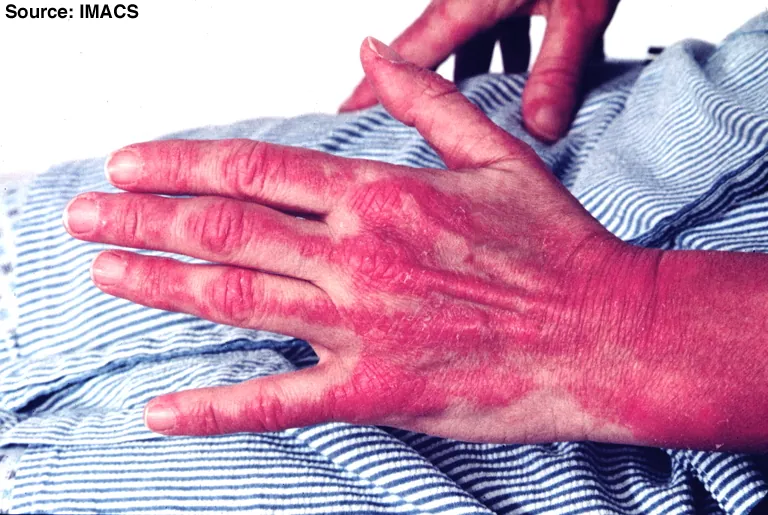
| Inflammatory myopathy | Subacute proximal weakness, raised CK, ± rash | CK, myositis antibodies, EMG, MRI, biopsy |
| Hypokalaemic periodic paralysis or hypokalaemia | Episodic flaccid weakness, low potassium | Serum potassium, ECG, TFTs |
| Motor neurone disease | Progressive mixed UMN/LMN weakness, fasciculation | EMG |
| Functional weakness | Inconsistent weakness, Hoover sign | Clinical positive signs |
Exam pearls
Guideline
AHA/ASA 2026 acute ischaemic stroke guideline, NICE NG234 metastatic spinal cord compression (2023), EAN/PNS Guillain–Barré syndrome guideline (2023), international myasthenia gravis consensus (2020 update) and NICE NG42 motor neurone disease
References
- Prabhakaran S, Gonzalez NR, Zachrison KS, et al.. 2026 Guideline for the Early Management of Patients With Acute Ischemic Stroke. Stroke 2026.
- National Institute for Health and Care Excellence (NICE). Spinal metastases and metastatic spinal cord compression (NG234). NICE guideline 2023.
- van Doorn PA, Van den Bergh PYK, Hadden RDM, et al.. European Academy of Neurology/Peripheral Nerve Society Guideline on diagnosis and treatment of Guillain–Barré syndrome. Eur J Neurol 2023.
- Narayanaswami P, Sanders DB, Wolfe G, et al.. International Consensus Guidance for Management of Myasthenia Gravis: 2020 Update. Neurology 2021.
- National Institute for Health and Care Excellence (NICE). Motor neurone disease: assessment and management (NG42). NICE guideline 2016.
- Medical Research Council. Aids to the Examination of the Peripheral Nervous System (Memorandum No. 45). Her Majesty's Stationery Office, London 1976.
Related topics
By Dr Khalid Seidi (B.Sc., M.D.) · MedEd World Clinical Knowledge library. Original teaching content checked against current guidelines (November 2026); confirm the latest local guidance before clinical use. Not a substitute for clinical judgement.