Clinical Knowledge › Internal medicine › Gastroenterology and hepatology › Diseases of the colon, rectum and anus
Angiodysplasia
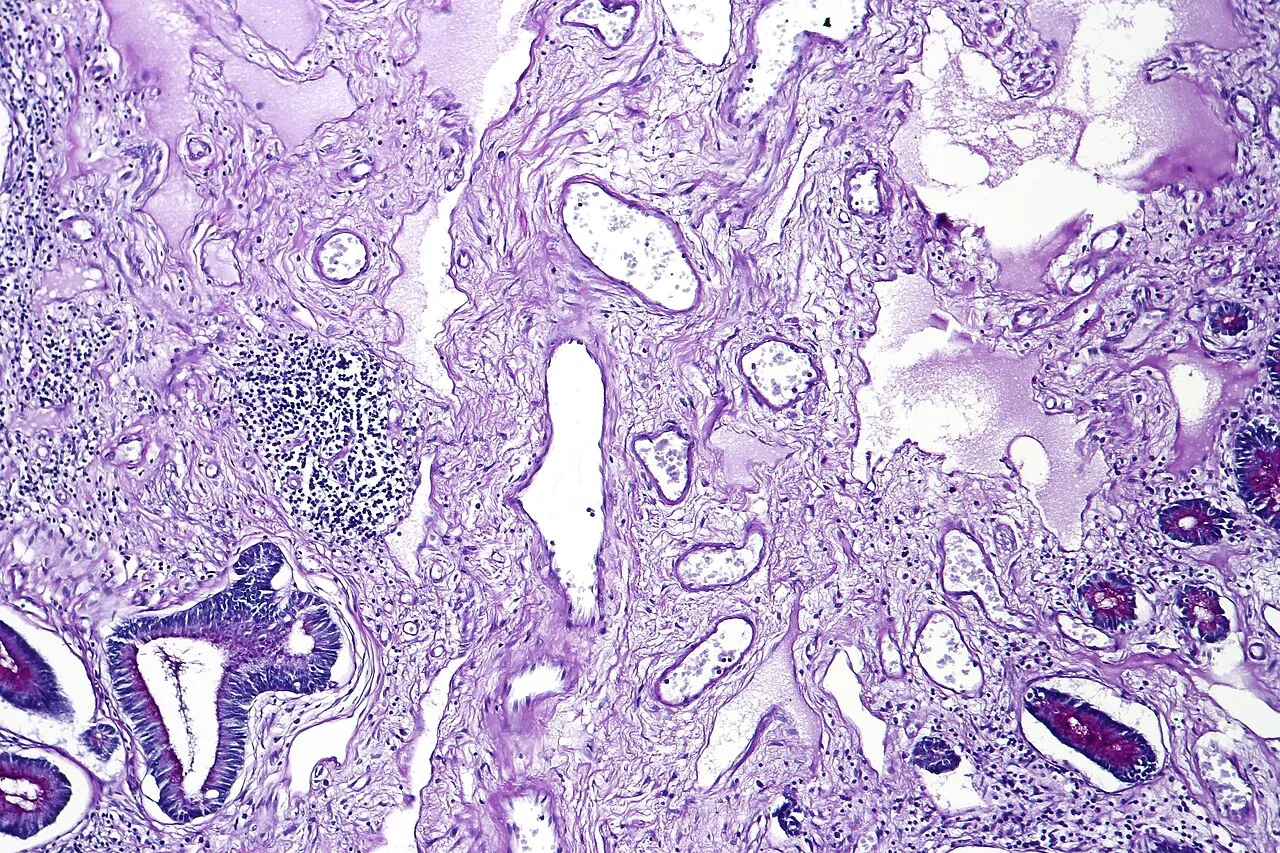
Angiodysplasia (angioectasia) is an acquired, degenerative vascular lesion of the gut made of dilated, thin-walled submucosal veins, venules and capillaries. It is the commonest vascular abnormality of the gastrointestinal tract and a leading cause of obscure and occult bleeding in older adults. Lesions are usually multiple and lie mainly in the caecum and ascending colon, but also in the small bowel, where they are the commonest cause of small bowel bleeding in older people. Bleeding is typically painless, intermittent and venous: it causes iron deficiency anaemia or recurrent melaena or haematochezia rather than shock. Risk is higher with age, chronic kidney disease, aortic stenosis (Heyde syndrome, through acquired von Willebrand disease), left ventricular assist devices and antithrombotic drugs. Colonoscopy shows flat, bright red, fern-like lesions; capsule endoscopy finds small bowel lesions. Incidental lesions need no treatment. Bleeding lesions are treated with argon plasma coagulation, iron replacement and, for refractory cases, octreotide or thalidomide.
Patient case, mechanism, investigations, management, flashcards and exam-style questions.Open the lesson →
Key facts
- Angiodysplasia is an acquired degenerative ectasia of submucosal veins and capillaries, unlike congenital arteriovenous malformations
- Most colonic lesions are in the caecum and ascending colon; small bowel angioectasias are the commonest cause of small bowel bleeding in older adults
- Typical picture: older patient with recurrent iron deficiency anaemia or painless low-volume bleeding, often on antithrombotics
- Heyde syndrome: aortic stenosis with bleeding angiodysplasia due to acquired von Willebrand disease (loss of large multimers); valve replacement often stops bleeding
- Endoscopy shows flat, bright red, 2–10 mm fern-like or stellate lesions; capsule endoscopy is first-line for suspected small bowel bleeding (ESGE 2022)
- Argon plasma coagulation is first-line treatment for bleeding lesions; incidental non-bleeding lesions are not treated
- Refractory bleeding: octreotide (OCEAN trial, 2024) and thalidomide (NEJM 2023) reduce transfusion needs; hormonal therapy is ineffective
- Iron replacement (often intravenous) is part of management; review anticoagulants and antiplatelets with the cardiology team
Differential diagnosis
| Condition | Clues | Key test |
|---|---|---|
| Diverticular bleeding | Sudden large-volume painless arterial bleeding | CT angiography; colonoscopy |
| Colorectal cancer | Iron deficiency, change in bowel habit, weight loss | Colonoscopy with biopsy |
| Hereditary haemorrhagic telangiectasia | Epistaxis, mucocutaneous telangiectasias, family history | Curaçao criteria; genetic testing (ENG, ACVRL1) |
| Gastric antral vascular ectasia (GAVE) | Iron deficiency in cirrhosis or systemic sclerosis; 'watermelon stomach' | Upper endoscopy |
| Peptic ulcer disease | Melaena, dyspepsia, NSAID use | Upper endoscopy |
| Small bowel tumour or Meckel diverticulum | Younger patient, mass or obstruction | Capsule endoscopy, CT enterography, Meckel scan |
| Dieulafoy lesion | Sudden brisk arterial bleeding from a normal-looking mucosa, usually upper stomach | Endoscopy during active bleeding |
Exam pearls
Guideline
ESGE guideline on small-bowel capsule endoscopy and device-assisted enteroscopy (Update 2022), ACG clinical guideline on small bowel bleeding (2015), BSG iron deficiency anaemia guideline (2021) and ACG acute lower GI bleeding guideline (2023)
References
- Pennazio M, Rondonotti E, Despott EJ, et al.. Small-bowel capsule endoscopy and device-assisted enteroscopy for diagnosis and treatment of small-bowel disorders: European Society of Gastrointestinal Endoscopy (ESGE) Guideline - Update 2022. Endoscopy 2023.
- Gerson LB, Fidler JL, Cave DR, Leighton JA.. ACG Clinical Guideline: Diagnosis and Management of Small Bowel Bleeding. Am J Gastroenterol 2015.
- Snook J, Bhala N, Beales ILP, et al.. British Society of Gastroenterology guidelines for the management of iron deficiency anaemia in adults. Gut 2021.
- Sami SS, Al-Araji SA, Ragunath K.. Review article: gastrointestinal angiodysplasia - pathogenesis, diagnosis and management. Aliment Pharmacol Ther 2014.
- Vincentelli A, Susen S, Le Tourneau T, et al.. Acquired von Willebrand syndrome in aortic stenosis. N Engl J Med 2003.
- Goltstein LCMJ, Grooteman KV, Bernts LHP, et al.. Standard of Care Versus Octreotide in Angiodysplasia-Related Bleeding (the OCEAN Study): A Multicenter Randomized Controlled Trial. Gastroenterology 2024.
Related topics
By Dr Khalid Seidi (B.Sc., M.D.) · MedEd World Clinical Knowledge library. Original teaching content checked against current guidelines (November 2026); confirm the latest local guidance before clinical use. Not a substitute for clinical judgement.