Clinical Knowledge › Internal medicine › Gastroenterology and hepatology › Diseases of the colon, rectum and anus
Rectal prolapse
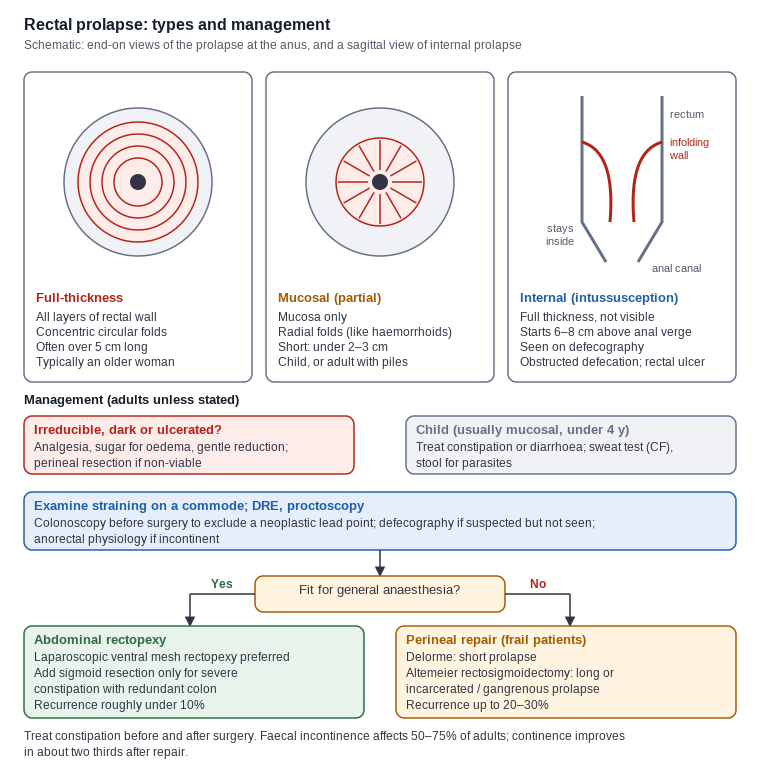
Rectal prolapse is protrusion of the rectum through the anus. In full-thickness (complete) prolapse, or procidentia, all layers of the rectal wall come out and show concentric circular folds; in mucosal prolapse only the mucosa protrudes, with radial folds; internal prolapse (intussusception) stays inside the anal canal. Adult prolapse mainly affects older women with chronic straining, multiparity and a weak pelvic floor. In children it is usually mucosal, self-limiting and may signal cystic fibrosis, malnutrition or parasitic infection. Patients notice a mass on straining that may reduce spontaneously or need manual reduction, with mucus, bleeding and, in most adults, faecal incontinence or obstructed defecation. Diagnosis is clinical, best by asking the patient to strain on a commode; colonoscopy excludes a lead point. Surgery is the only cure: abdominal rectopexy (often laparoscopic ventral mesh rectopexy) for fit patients, and perineal procedures (Delorme or Altemeier) for frail patients, accepting more recurrence.
Patient case, mechanism, investigations, management, flashcards and exam-style questions.Open the lesson →
Key facts
- Full-thickness prolapse shows concentric circular folds; mucosal prolapse and haemorrhoids show radial folds
- Adults: about 80–90% are women, peak in the 7th decade; associated with chronic straining, multiparity and pelvic floor weakness
- Children: usually mucosal prolapse under 4 years, often resolves; always consider cystic fibrosis (sweat test)
- Faecal incontinence in 50–75% of adults and constipation or obstructed defecation in 25–50%
- Examine the patient straining on a commode or toilet; if not seen, defecography can show internal prolapse
- Colonoscopy (or at least flexible sigmoidoscopy) before surgery to exclude a neoplastic lead point and solitary rectal ulcer
- Abdominal rectopexy has lower recurrence; perineal procedures (Delorme, Altemeier) suit frail patients but recur more often
- Incarcerated or strangulated prolapse is an emergency: reduce if viable (sugar to reduce oedema), resect perineally if gangrenous
Differential diagnosis
| Condition | Clues | Key test |
|---|---|---|
| Prolapsing (grade III–IV) haemorrhoids | Separate cushions with radial folds and a groove between them | Examination and proctoscopy |
| Mucosal prolapse | Short protrusion (under 2–3 cm) with radial folds | Examination; palpation shows thin mucosa only |
| Prolapsing rectal polyp or tumour | Pedunculated mass, bleeding, change in bowel habit | Colonoscopy and biopsy |
| Intussusception in a child | Colicky pain, redcurrant jelly stool; finger passes between mass and anal wall | Ultrasound (target sign) |
| Solitary rectal ulcer syndrome | Straining, mucus and bleeding with an anterior rectal ulcer | Sigmoidoscopy and biopsy (fibromuscular obliteration) |
| Rectocele or uterine prolapse | Vaginal bulge, need to splint the vagina to defecate | Vaginal examination, defecography |
Exam pearls
Guideline
ASCRS Clinical Practice Guidelines for the treatment of rectal prolapse (2017), Dutch rectal prolapse guideline (2017) and ACG benign anorectal disorders guideline (2021)
References
- Bordeianou L, Paquette I, Johnson E, et al.. Clinical practice guidelines for the treatment of rectal prolapse. Dis Colon Rectum 2017.
- van der Schans EM, Paulides TJC, Wijffels NA, Consten ECJ.. Management of patients with rectal prolapse: the 2017 Dutch guidelines. Tech Coloproctol 2018.
- Senapati A, Gray RG, Middleton LJ, et al.. PROSPER: a randomised comparison of surgical treatments for rectal prolapse. Colorectal Dis 2013.
- Tou S, Brown SR, Nelson RL.. Surgery for complete (full-thickness) rectal prolapse in adults. Cochrane Database Syst Rev 2015.
- D'Hoore A, Cadoni R, Penninckx F.. Long-term outcome of laparoscopic ventral rectopexy for total rectal prolapse. Br J Surg 2004.
- Mercer-Jones MA, D'Hoore A, Dixon AR, et al.. Consensus on ventral rectopexy: report of a panel of experts. Colorectal Dis 2014.
Related topics
By Dr Khalid Seidi (B.Sc., M.D.) · MedEd World Clinical Knowledge library. Original teaching content checked against current guidelines (November 2026); confirm the latest local guidance before clinical use. Not a substitute for clinical judgement.