Clinical Knowledge › Internal medicine › Gastroenterology and hepatology › Diseases of the colon, rectum and anus
Colorectal polyps and hereditary polyposis syndromes
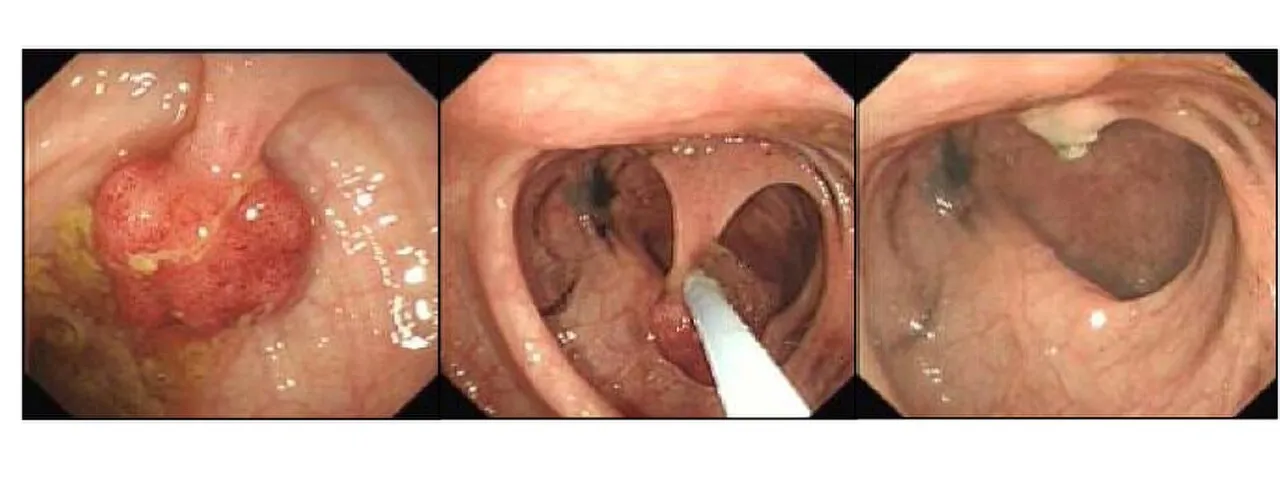
Colorectal polyps are growths projecting from the colonic mucosa. Most are found at screening or diagnostic colonoscopy and cause no symptoms. Conventional adenomas (tubular, tubulovillous, villous) and serrated lesions (sessile serrated lesions and traditional serrated adenomas) are premalignant and give rise to most colorectal cancers; hyperplastic, inflammatory and most hamartomatous polyps carry little or no risk on their own. Risk rises with size of 10 mm or more, villous histology, high-grade dysplasia and number of lesions. Treatment is complete endoscopic resection: cold snare for small polyps, endoscopic mucosal resection for large flat lesions and submucosal dissection or surgery for suspected invasive cancer. Surveillance intervals are set by the number, size and histology of the polyps removed. A small group of patients has a hereditary syndrome: familial adenomatous polyposis (APC), MUTYH-associated polyposis, Lynch syndrome (mismatch repair genes), Peutz–Jeghers, juvenile polyposis or serrated polyposis. These need genetic testing, intensive surveillance, prophylactic surgery in some cases and screening of relatives.
Patient case, mechanism, investigations, management, flashcards and exam-style questions.Open the lesson →
Key facts
- Adenomas and serrated lesions are premalignant; hyperplastic polyps in the rectosigmoid are almost always harmless
- Advanced adenoma: 10 mm or more, villous component or high-grade dysplasia
- Sessile serrated lesions are flat, right-sided, mucus-capped and BRAF-mutant, and are a major source of interval cancers
- Resect polyps under 10 mm with cold snare; large non-pedunculated lesions by endoscopic mucosal resection (EMR)
- BSG 2020: one surveillance colonoscopy at 3 years for high-risk findings; otherwise return to population screening
- FAP: autosomal dominant APC variant, hundreds to thousands of adenomas from adolescence, near-certain cancer without colectomy
- Lynch syndrome: autosomal dominant mismatch repair defect, few polyps but fast progression, endometrial and other cancers; colonoscopy every 2 years
- Peutz–Jeghers (STK11): hamartomatous small-bowel polyps causing intussusception plus lip and buccal pigmentation
Differential diagnosis
| Condition | Clues | Key test |
|---|---|---|
| Sporadic adenoma | Older adult, few polyps, no family history | Colonoscopy and histology |
| Familial adenomatous polyposis | Hundreds of adenomas in a teenager or young adult, family history, CHRPE | Germline APC testing |
| MUTYH-associated polyposis | 10–100 adenomas, no dominant family history, siblings affected | Germline MUTYH testing (biallelic) |
| Lynch syndrome | Early-onset CRC or endometrial cancer, few polyps, MMR-deficient tumour | Tumour MMR immunohistochemistry, then germline testing |
| Peutz–Jeghers syndrome | Lip and buccal pigmentation, small-bowel intussusception in childhood | Histology (hamartoma) and STK11 testing |
| Juvenile polyposis syndrome | Five or more juvenile polyps, rectal bleeding, anaemia; HHT features with SMAD4 | Histology and SMAD4/BMPR1A testing |
| Serrated polyposis syndrome | Multiple serrated lesions proximal to the rectum, often smokers | WHO 2019 clinical criteria at colonoscopy |
| Inflammatory pseudopolyps | Long-standing ulcerative colitis or Crohn colitis | History and histology |
Exam pearls
Guideline
BSG/ACPGBI/PHE post-polypectomy surveillance guidelines (2020), ESGE post-polypectomy surveillance (2020) and polypectomy/EMR (2024), US Multi-Society Task Force follow-up after colonoscopy (2020), BSG/ACPGBI/UKCGG hereditary colorectal cancer (2020) and ACG adenomatous polyposis syndromes (2026)
References
- Rutter MD, East J, Rees CJ, et al.. British Society of Gastroenterology/Association of Coloproctology of Great Britain and Ireland/Public Health England post-polypectomy and post-colorectal cancer resection surveillance guidelines. Gut 2020.
- Hassan C, Antonelli G, Dumonceau JM, et al.. Post-polypectomy colonoscopy surveillance: European Society of Gastrointestinal Endoscopy (ESGE) Guideline – Update 2020. Endoscopy 2020.
- Gupta S, Lieberman D, Anderson JC, et al.. Recommendations for follow-up after colonoscopy and polypectomy: a consensus update by the US Multi-Society Task Force on Colorectal Cancer. Gastroenterology 2020.
- Monahan KJ, Bradshaw N, Dolwani S, et al.. Guidelines for the management of hereditary colorectal cancer from the British Society of Gastroenterology (BSG)/Association of Coloproctology of Great Britain and Ireland (ACPGBI)/United Kingdom Cancer Genetics Group (UKCGG). Gut 2020.
- American College of Gastroenterology. ACG Clinical Guideline: adenomatous colorectal polyposis syndromes. Am J Gastroenterol 2026.
- Ferlitsch M, Hassan C, Bisschops R, et al.. Colorectal polypectomy and endoscopic mucosal resection: European Society of Gastrointestinal Endoscopy (ESGE) Guideline – Update 2024. Endoscopy 2024.
Related topics
By Dr Khalid Seidi (B.Sc., M.D.) · MedEd World Clinical Knowledge library. Original teaching content checked against current guidelines (November 2026); confirm the latest local guidance before clinical use. Not a substitute for clinical judgement.