Clinical Knowledge › Internal medicine › Gastroenterology and hepatology › Diseases of the colon, rectum and anus
Colonic pseudo-obstruction (Ogilvie syndrome)
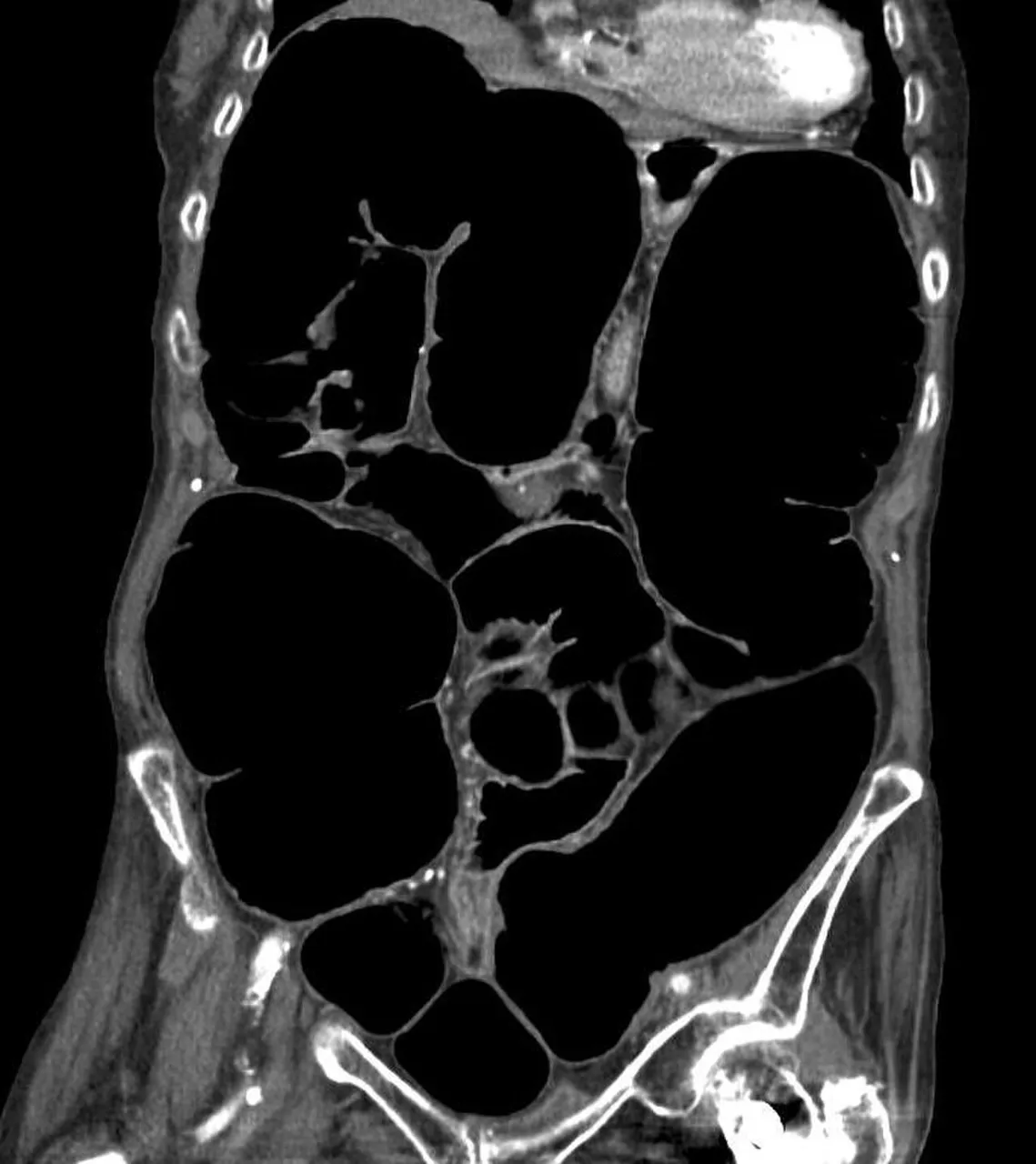
Acute colonic pseudo-obstruction (Ogilvie syndrome) is massive dilatation of the colon, usually the caecum and right colon, with the clinical picture of large-bowel obstruction but no mechanical cause. It occurs in people already unwell in hospital: after surgery (orthopaedic, cardiac, caesarean section), with sepsis, electrolyte disturbance (low potassium or magnesium) and opioid or anticholinergic drugs. Autonomic imbalance, with loss of parasympathetic drive to the distal colon, is the likely mechanism. Patients develop progressive, mildly painful distension, often still passing flatus. CT with contrast excludes a mechanical cause and measures the caecum; a caecum above 12 cm, long duration and tenderness signal risk of perforation. Most cases settle with supportive care. Intravenous neostigmine with cardiac monitoring is the first drug treatment; colonoscopic decompression follows if it fails, and surgery is reserved for perforation or ischaemia.
Patient case, mechanism, investigations, management, flashcards and exam-style questions.Open the lesson →
Key facts
- Acute dilatation of the colon (mainly caecum and right colon) without a mechanical obstruction, in an already ill or post-operative patient
- Classic triggers: recent surgery (orthopaedic, cardiac, caesarean), sepsis, trauma, electrolyte disturbance and opioid or anticholinergic drugs
- Thought to reflect autonomic imbalance with reduced parasympathetic (sacral) drive to the distal colon
- CT abdomen and pelvis with contrast excludes mechanical obstruction (cancer, volvulus) and measures caecal diameter
- Caecal diameter above 12 cm and duration beyond about 6 days increase the risk of ischaemia and perforation
- First 24–72 hours: nil by mouth, nasogastric and rectal tubes, stop opioids and anticholinergics, correct potassium and magnesium, mobilise
- Neostigmine 2 mg IV over 3–5 minutes with ECG monitoring and atropine at the bedside resolves most cases; bradycardia is the main risk
- Colonoscopic decompression if neostigmine fails or is contraindicated; surgery for perforation, ischaemia or peritonitis
Differential diagnosis
| Condition | Clues | Key test |
|---|---|---|
| Mechanical large-bowel obstruction (colorectal cancer) | Absolute constipation, colicky pain, weight loss or iron deficiency | CT with contrast shows a transition point and mass |
| Sigmoid or caecal volvulus | Sudden pain and very large distension; 'coffee bean' loop | Abdominal X-ray and CT whirl sign |
| Toxic megacolon | Bloody diarrhoea, fever, tachycardia in colitis (IBD or C. difficile) | Stool C. difficile toxin, CRP, transverse colon dilatation above 6 cm |
| Paralytic (post-operative) ileus | Small and large bowel both dilated, quiet abdomen after surgery | CT shows diffuse small and large bowel gas |
| Faecal impaction | Elderly, immobile, rectum full of hard stool, overflow diarrhoea | Digital rectal examination, X-ray |
| Chronic intestinal pseudo-obstruction | Recurrent episodes over months, systemic sclerosis or neuromuscular disease | Manometry, history, full-thickness biopsy |
Exam pearls
Guideline
ASCRS Clinical Practice Guidelines for the management of colonic volvulus and acute colonic pseudo-obstruction (2021) and ASGE guideline on endoscopy in acute colonic pseudo-obstruction and colonic volvulus (2020)
References
- Alavi K, Poylin V, Davids JS, et al.. The American Society of Colon and Rectal Surgeons clinical practice guidelines for the management of colonic volvulus and acute colonic pseudo-obstruction. Dis Colon Rectum 2021.
- Naveed M, Jamil LH, Fujii-Lau LL, et al.. American Society for Gastrointestinal Endoscopy guideline on the role of endoscopy in the management of acute colonic pseudo-obstruction and colonic volvulus. Gastrointest Endosc 2020.
- Ponec RJ, Saunders MD, Kimmey MB.. Neostigmine for the treatment of acute colonic pseudo-obstruction. N Engl J Med 1999.
- Vanek VW, Al-Salti M.. Acute pseudo-obstruction of the colon (Ogilvie's syndrome). An analysis of 400 cases. Dis Colon Rectum 1986.
- Ogilvie H.. Large-intestine colic due to sympathetic deprivation: a new clinical syndrome. Br Med J 1948.
- Sgouros SN, Vlachogiannakos J, Vassiliadis K, et al.. Effect of polyethylene glycol electrolyte balanced solution on patients with acute colonic pseudo obstruction after resolution of colonic dilation: a prospective, randomised, placebo controlled trial. Gut 2006.
Related topics
By Dr Khalid Seidi (B.Sc., M.D.) · MedEd World Clinical Knowledge library. Original teaching content checked against current guidelines (November 2026); confirm the latest local guidance before clinical use. Not a substitute for clinical judgement.