Clinical Knowledge › Internal medicine › Gastroenterology and hepatology › Diseases of the colon, rectum and anus
Faecal incontinence
Faecal incontinence is the recurrent involuntary loss of liquid or solid stool; anal incontinence also includes flatus. It affects about 8% of community-dwelling adults and up to half of nursing-home residents, yet most people never mention it unless asked directly. Continence depends on stool consistency, rectal capacity and sensation, the internal and external anal sphincters, puborectalis and intact nerves, so incontinence is usually multifactorial. Common causes are diarrhoea, faecal impaction with overflow, obstetric sphincter injury, anorectal surgery, neurological disease and radiation proctitis. Assessment includes a targeted history, severity score, digital rectal examination and tests chosen by the cause: stool studies, endoscopy, anorectal manometry and endoanal ultrasound. Treatment is stepwise: correct stool consistency with fibre and loperamide, treat impaction, then biofeedback and pelvic floor therapy, and for persistent symptoms sacral neuromodulation, selected sphincter repair or, finally, a stoma.
Patient case, mechanism, investigations, management, flashcards and exam-style questions.Open the lesson →
Key facts
- Ask directly: patients rarely volunteer incontinence; about 8% of adults and up to 50% of nursing-home residents are affected
- Passive soiling suggests internal sphincter weakness; urge incontinence suggests external sphincter weakness or reduced rectal capacity
- Diarrhoea is the commonest treatable contributor; faecal impaction with overflow is a key cause in frail older adults
- Obstetric anal sphincter injury (third- and fourth-degree tears) is the main cause of sphincter defects in women
- Digital rectal examination assesses resting tone, squeeze, impaction and prolapse; endoanal ultrasound shows sphincter defects
- First-line: stool-bulking fibre, loperamide (also raises internal sphincter tone), bowel routine, treating impaction
- Biofeedback and pelvic floor muscle training help many patients who fail simple measures
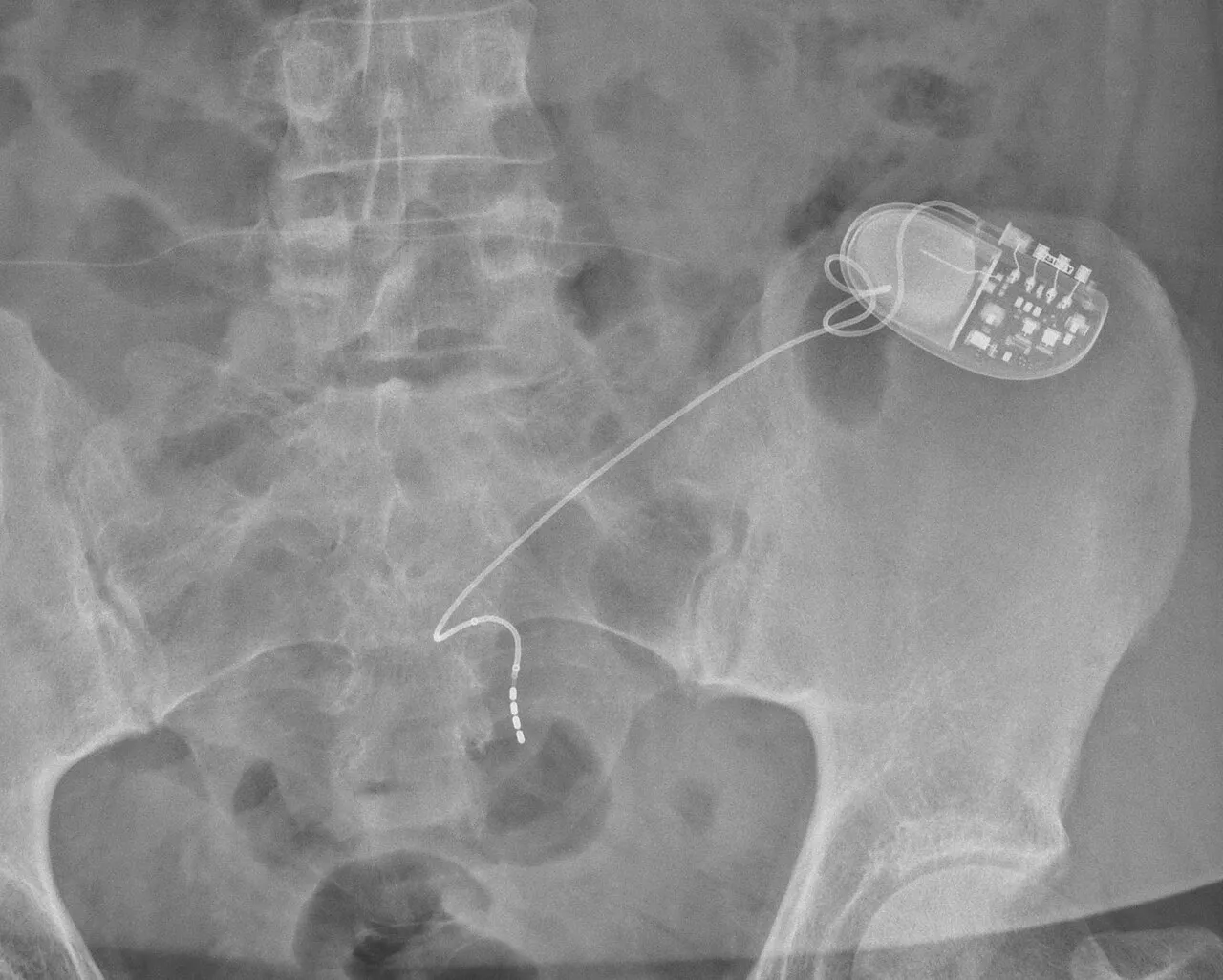
- Sacral neuromodulation is the main second-line procedure; sphincteroplasty mainly for acute obstetric injury; stoma is the last resort
Differential diagnosis
| Condition | Clues | Key test |
|---|---|---|
| Overflow from faecal impaction | Frail, immobile older person with liquid leakage and constipation | Digital rectal examination; abdominal X-ray |
| Infective or inflammatory diarrhoea | Acute or bloody diarrhoea with urgency | Stool culture, C. difficile toxin, calprotectin |
| Rectal prolapse | Mass on straining with patulous anus | Examination straining on a commode |
| Cauda equina syndrome | Saddle anaesthesia, back pain, urinary retention, leg weakness | Urgent MRI lumbosacral spine |
| Rectal cancer | Tenesmus, bleeding, weight loss, change in bowel habit | Colonoscopy and biopsy |
| Low anterior resection syndrome | Clustering, urgency and incontinence after rectal cancer surgery | Surgical history, LARS score |
Exam pearls
Guideline
ASCRS Clinical Practice Guidelines for the management of fecal incontinence (2023), ACG benign anorectal disorders guideline (2021) and NICE CG49 faecal incontinence in adults (2007)
References
- Bordeianou LG, Thorsen AJ, Keller DS, et al.. The American Society of Colon and Rectal Surgeons clinical practice guidelines for the management of fecal incontinence. Dis Colon Rectum 2023.
- Wald A, Bharucha AE, Limketkai B, et al.. ACG Clinical Guidelines: management of benign anorectal disorders. Am J Gastroenterol 2021.
- National Institute for Health and Care Excellence (NICE). Faecal incontinence in adults: management (CG49). NICE clinical guideline 2007.
- Paquette IM, Varma MG, Kaiser AM, Steele SR, Rafferty JF.. The American Society of Colon and Rectal Surgeons' clinical practice guideline for the treatment of fecal incontinence. Dis Colon Rectum 2015.
- Ng KS, Sivakumaran Y, Nassar N, Gladman MA.. Fecal incontinence: community prevalence and associated factors – a systematic review. Dis Colon Rectum 2015.
- Knowles CH, Horrocks EJ, Bremner SA, et al.. Percutaneous tibial nerve stimulation versus sham electrical stimulation for the treatment of faecal incontinence in adults (CONFIDeNT): a double-blind, multicentre, pragmatic, parallel-group, randomised controlled trial. Lancet 2015.
Related topics
By Dr Khalid Seidi (B.Sc., M.D.) · MedEd World Clinical Knowledge library. Original teaching content checked against current guidelines (November 2026); confirm the latest local guidance before clinical use. Not a substitute for clinical judgement.