Clinical Knowledge › Internal medicine › Cardiology and angiology › Diseases of the aorta and arteries
Aortic dissection
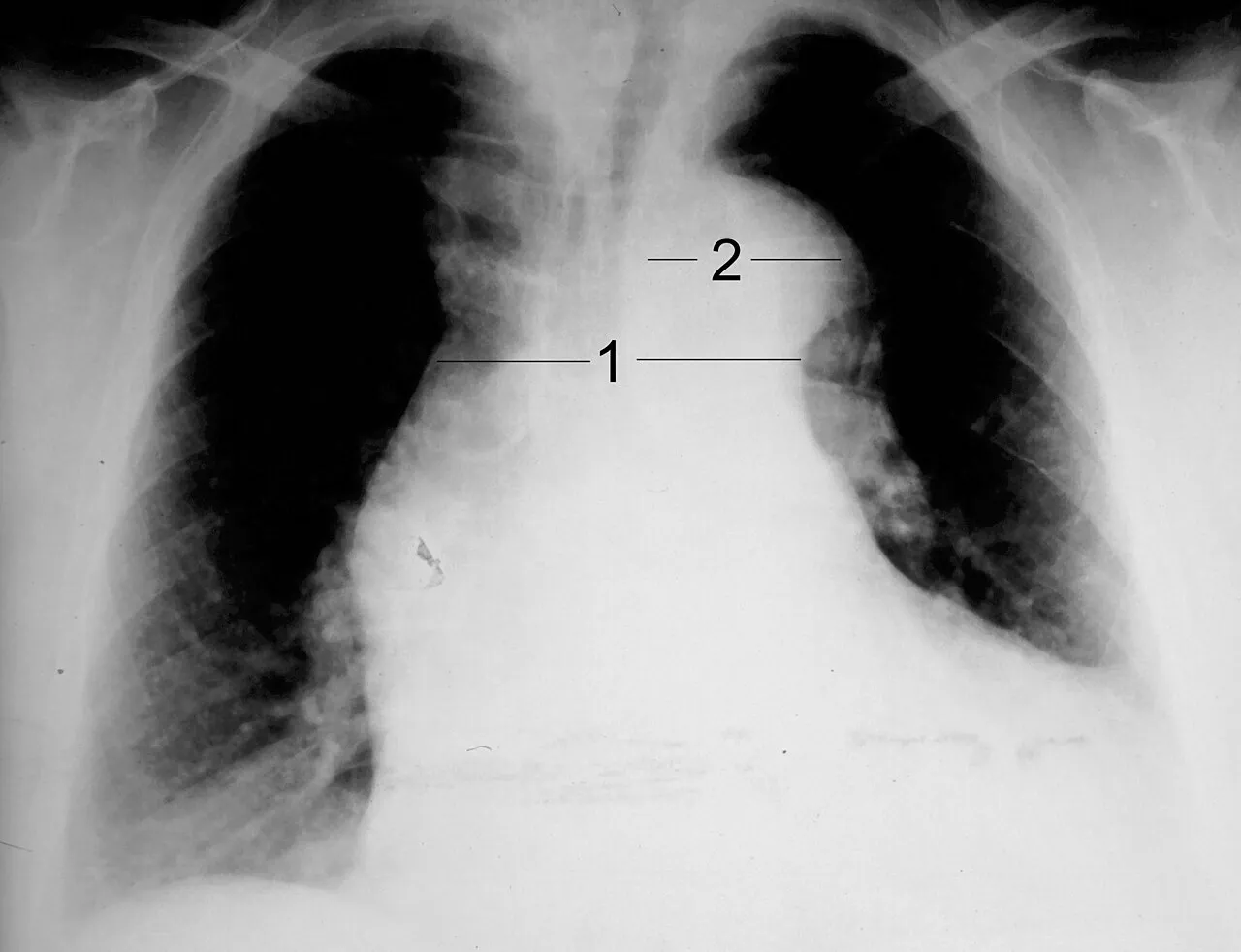
Aortic dissection is a tear in the aortic intima that lets blood split the media, creating a true and a false lumen. With intramural haematoma and penetrating aortic ulcer it forms the acute aortic syndromes. Dissections involving the ascending aorta (Stanford type A) are surgical emergencies with a mortality of about 1–2% per hour untreated; those confined beyond the left subclavian artery (type B) are usually managed medically unless complicated. Hypertension is the main risk factor; heritable aortopathies (Marfan, Loeys–Dietz, vascular Ehlers–Danlos), bicuspid aortic valve, coarctation, cocaine and pregnancy also matter. The classic picture is abrupt, severe chest or back pain with pulse or blood pressure differences, aortic regurgitation or malperfusion of the heart, brain, gut, kidneys, spinal cord or limbs. A detection risk score (ADD-RS) with D-dimer guides testing; CT angiography confirms the diagnosis. Immediate treatment is analgesia and intravenous beta-blockade to lower heart rate and blood pressure, then emergency surgery for type A and TEVAR for complicated type B dissection.
Patient case, mechanism, investigations, management, flashcards and exam-style questions.Open the lesson →
Key facts
- Acute aortic syndromes = classic dissection, intramural haematoma and penetrating atherosclerotic ulcer
- Stanford A involves the ascending aorta (emergency surgery); Stanford B spares it (medical therapy unless complicated)
- Hypertension is present in about three-quarters; consider Marfan and other heritable aortopathies in younger patients
- Pain is abrupt and maximal at onset; pulse deficit and new AR murmur are present in only a minority
- ADD-RS 0–1 plus D-dimer below 500 ng/mL makes acute aortic syndrome very unlikely (ADvISED)
- CT angiography is the first-line test in stable patients; TOE or bedside echo in unstable patients
- IV beta-blocker first (target HR about 60/min, SBP 100–120 mmHg), then vasodilator if needed; avoid antithrombotics and thrombolysis
- Complicated type B (malperfusion, rupture, refractory pain or hypertension, rapid growth) needs TEVAR
Differential diagnosis
| Condition | Clues | Key test |
|---|---|---|
| Acute coronary syndrome | Crescendo pressure-like pain, territorial ST changes; dissection can cause inferior STEMI | ECG, troponin; CT aorta if dissection features before antithrombotics |
| Pulmonary embolism | Pleuritic pain, hypoxaemia, DVT signs | CTPA (a triple rule-out CT may be used) |
| Pericarditis | Positional pleuritic pain, rub, diffuse ST elevation | ECG, echo |
| Oesophageal rupture | Pain after vomiting, surgical emphysema | CT with oral contrast |
| Ruptured abdominal aortic aneurysm | Abdominal or back pain, pulsatile mass, shock | Bedside ultrasound, CT |
| Musculoskeletal or renal colic | Positional or colicky pain, no pulse deficit | Clinical; CT if red flags |
| Acute mesenteric ischaemia | Pain out of proportion to signs, AF | CT angiography |
Exam pearls
Guideline
2024 ESC Guidelines for peripheral arterial and aortic diseases, 2022 ACC/AHA Guideline for aortic disease and 2024 EACTS/STS Guidelines for acute and chronic syndromes of the aortic organ
References
- Mazzolai L, Teixido-Tura G, Lanzi S, et al.. 2024 ESC Guidelines for the management of peripheral arterial and aortic diseases. Eur Heart J 2024.
- Isselbacher EM, Preventza O, Hamilton Black J 3rd, et al.. 2022 ACC/AHA Guideline for the Diagnosis and Management of Aortic Disease. Circulation 2022.
- Czerny M, Grabenwöger M, Berger T, et al.. EACTS/STS Guidelines for diagnosing and treating acute and chronic syndromes of the aortic organ. Eur J Cardiothorac Surg 2024.
- Hagan PG, Nienaber CA, Isselbacher EM, et al.. The International Registry of Acute Aortic Dissection (IRAD): new insights into an old disease. JAMA 2000.
- Evangelista A, Isselbacher EM, Bossone E, et al.. Insights From the International Registry of Acute Aortic Dissection: A 20-Year Experience of Collaborative Clinical Research. Circulation 2018.
- Nazerian P, Mueller C, Soeiro AM, et al.. Diagnostic Accuracy of the Aortic Dissection Detection Risk Score Plus D-Dimer for Acute Aortic Syndromes: The ADvISED Prospective Multicenter Study. Circulation 2018.
Related topics
By Dr Khalid Seidi (B.Sc., M.D.) · MedEd World Clinical Knowledge library. Original teaching content checked against current guidelines (November 2026); confirm the latest local guidance before clinical use. Not a substitute for clinical judgement.