Clinical Knowledge › Internal medicine › Cardiology and angiology › Diseases of the aorta and arteries
Fibromuscular dysplasia
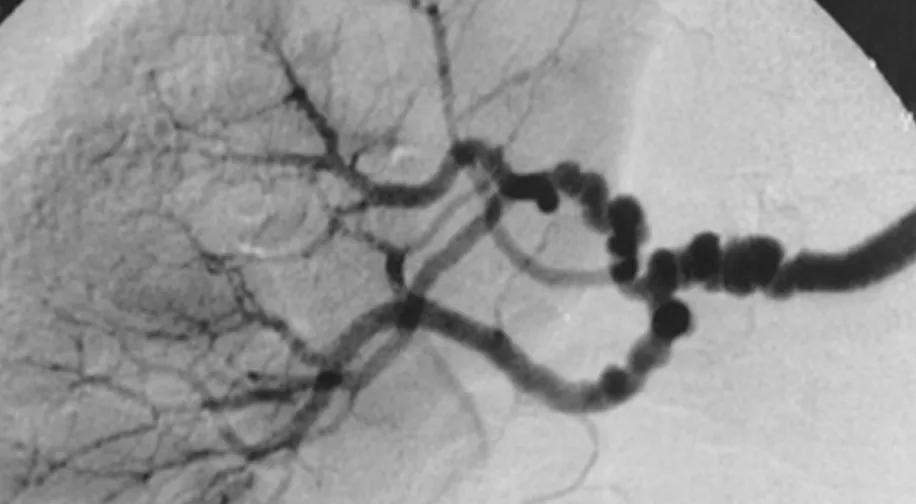
Fibromuscular dysplasia (FMD) is an idiopathic, segmental, non-atherosclerotic and non-inflammatory disease of medium-sized arteries that causes stenosis, aneurysm, dissection and tortuosity. About 90% of patients are women, typically diagnosed in middle age, although FMD occurs at any age. The renal and extracranial carotid and vertebral arteries are most often affected, followed by mesenteric, iliac and coronary arteries. Multifocal FMD gives the classic 'string of beads' in the mid and distal renal or internal carotid artery; focal FMD is a single smooth narrowing, more common in children and young adults. Presentations include renovascular hypertension in a young woman, pulsatile tinnitus, cervical bruit, arterial dissection, stroke, renal infarction and spontaneous coronary artery dissection. Diagnosis is by duplex, CT or MR angiography, and catheter angiography before intervention. Once FMD is found, image all arterial beds from head to pelvis once. Treatment is antiplatelet therapy, blood pressure control and balloon angioplasty without stenting for renal FMD with hypertension.
Patient case, mechanism, investigations, management, flashcards and exam-style questions.Open the lesson →
Key facts
- FMD is a non-atherosclerotic, non-inflammatory arterial disease causing stenosis, aneurysm, dissection and tortuosity
- Around 90% of patients are women; mean age at diagnosis is about 50 years
- Renal arteries are most often involved, then extracranial carotid and vertebral arteries
- Multifocal FMD: string of beads in mid–distal artery (medial fibroplasia); focal FMD: single tubular stenosis
- Suspect FMD in hypertension under 30 years (especially women), pulsatile tinnitus, cervical dissection or SCAD
- After diagnosis, perform one-time head-to-pelvis CT or MR angiography to find other lesions and aneurysms
- Renal FMD with hypertension: percutaneous balloon angioplasty without stenting; stent only for dissection or failure
- Low-dose aspirin is reasonable for most patients; manage hypertension, aneurysms and dissection individually
Differential diagnosis
| Condition | Clues | Key test |
|---|---|---|
| Atherosclerotic renal artery stenosis | Older, smoker, diffuse atherosclerosis; ostial or proximal lesion | Duplex or CT angiography |
| Takayasu arteritis | Young woman with raised ESR, arm claudication, aortic and arch branch wall thickening | CRP/ESR, CT or MR angiography, PET |
| Vascular Ehlers–Danlos syndrome | Arterial rupture, easy bruising, thin skin, bowel or uterine rupture | COL3A1 genetic testing |
| Segmental arterial mediolysis | Visceral artery aneurysms and dissections with abdominal bleeding | CT angiography; evolution on follow-up |
| Primary hyperaldosteronism | Hypertension with hypokalaemia and suppressed renin | Aldosterone–renin ratio |
| Standing arterial waves (catheter artefact) | Regular, transient undulations on angiography | Repeat imaging after vasodilator |
| Loeys–Dietz syndrome | Arterial tortuosity, aneurysms, bifid uvula, hypertelorism | Genetic testing (TGFBR1/2, SMAD3) |
Exam pearls
Guideline
First International (ESH/SVM) consensus on FMD 2019, ESVS 2025 guidelines on mesenteric and renal arteries and veins, 2024 ESC guidelines on peripheral arterial and aortic diseases and on hypertension, and 2025 AHA/ACC hypertension guideline
References
- Gornik HL, Persu A, Adlam D, et al.. First International Consensus on the diagnosis and management of fibromuscular dysplasia. Vasc Med 2019.
- Koelemay MJ, Geelkerken RH, Kärkkäinen J, et al.. European Society for Vascular Surgery (ESVS) 2025 Clinical Practice Guidelines on the Management of Diseases of the Mesenteric and Renal Arteries and Veins. Eur J Vasc Endovasc Surg 2025.
- Mazzolai L, Teixido-Tura G, Lanzi S, et al.. 2024 ESC Guidelines for the management of peripheral arterial and aortic diseases. Eur Heart J 2024.
- McEvoy JW, McCarthy CP, Bruno RM, et al.. 2024 ESC Guidelines for the management of elevated blood pressure and hypertension. Eur Heart J 2024.
- Jones DW, Ferdinand KC, Taler SJ, et al.. 2025 AHA/ACC/AANP/AAPA/ABC/ACCP/ACPM/AGS/AMA/ASPC/NMA/PCNA/SGIM Guideline for the Prevention, Detection, Evaluation and Management of High Blood Pressure in Adults. Circulation 2025.
- Olin JW, Froehlich J, Gu X, et al.. The United States Registry for Fibromuscular Dysplasia: results in the first 447 patients. Circulation 2012.
Related topics
By Dr Khalid Seidi (B.Sc., M.D.) · MedEd World Clinical Knowledge library. Original teaching content checked against current guidelines (November 2026); confirm the latest local guidance before clinical use. Not a substitute for clinical judgement.