Clinical Knowledge › Internal medicine › Cardiology and angiology › Diseases of the aorta and arteries
Renal artery stenosis
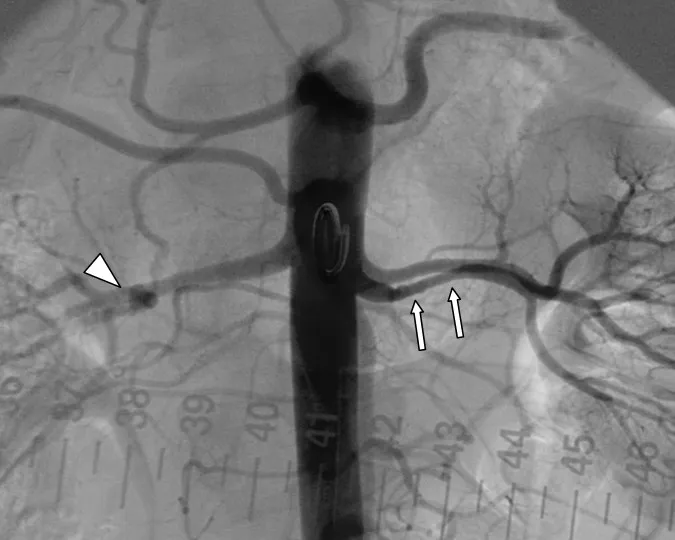
Renal artery stenosis is narrowing of one or both renal arteries, causing reduced kidney perfusion, renin-driven (renovascular) hypertension and ischaemic nephropathy. About 90% is atherosclerotic, affecting the ostium or proximal artery of older smokers with diabetes, dyslipidaemia and vascular disease elsewhere. Fibromuscular dysplasia, a non-atherosclerotic disease, typically causes a 'string of beads' in the mid or distal artery of younger women. Clues include hypertension starting before 30 or severe after 55, resistant or suddenly worsening hypertension, flash pulmonary oedema, an abdominal bruit, asymmetric kidneys, hypokalaemia and a creatinine rise above 30% after an ACE inhibitor or ARB. Duplex ultrasound is the usual first test; CT or MR angiography confirms it, and catheter angiography is used when revascularisation is planned. In atherosclerotic disease, ASTRAL and CORAL showed no benefit from routine stenting over optimal medical therapy (BP control including renin–angiotensin blockers, statin, antiplatelet therapy, smoking cessation), so revascularisation is reserved for selected patients. Balloon angioplasty is the treatment of choice for hypertension due to fibromuscular dysplasia.
Patient case, mechanism, investigations, management, flashcards and exam-style questions.Open the lesson →
Key facts
- Two main causes: atherosclerosis (about 90%, ostial, older patients) and fibromuscular dysplasia (younger women, mid/distal 'string of beads')
- Reduced renal perfusion activates the renin–angiotensin–aldosterone system, causing renovascular hypertension
- Clues: onset under 30 or severe after 55, resistant or accelerated hypertension, flash pulmonary oedema, abdominal bruit, kidney asymmetry over 1.5 cm
- A creatinine rise above 30% after an ACE inhibitor or ARB suggests bilateral stenosis or stenosis to a solitary kidney
- Duplex ultrasound first (peak systolic velocity above about 200 cm/s); CTA or MRA to confirm; catheter angiography with pressure gradient when intervening
- Atherosclerotic disease: optimal medical therapy; routine stenting gave no benefit in ASTRAL and CORAL
- Consider revascularisation for recurrent flash pulmonary oedema, rapidly declining kidney function with bilateral or solitary-kidney stenosis, or truly resistant hypertension
- Fibromuscular dysplasia: balloon angioplasty without stenting; image other arterial beds once (head to pelvis)
Differential diagnosis
| Condition | Clues | Key test |
|---|---|---|
| Primary aldosteronism | Hypokalaemia with low renin and high aldosterone | Aldosterone-to-renin ratio |
| Essential hypertension | Gradual onset, family history, no clues to secondary cause | Diagnosis of exclusion |
| Chronic kidney disease from other causes | Proteinuria, haematuria, symmetrical small kidneys | Urinalysis, ultrasound, biopsy |
| Phaeochromocytoma | Paroxysmal headache, sweating, palpitations | Plasma metanephrines |
| Coarctation of the aorta | Arm–leg BP gradient, radio-femoral delay | Echo, CT/MR angiography |
| Atheroembolic renal disease | AKI after angiography, livedo, eosinophilia | Clinical; skin or renal biopsy |
| Takayasu arteritis | Young woman, absent pulses, raised ESR, aortic involvement | CT/MR angiography, PET-CT |
Exam pearls
Guideline
2024 ESC Guidelines for elevated blood pressure and hypertension, 2025 AHA/ACC multisociety high blood pressure guideline, 2017 ESC/ESVS peripheral arterial diseases guideline (renal artery section), AHA 2022 scientific statement on revascularisation for renovascular disease and 2019 International FMD Consensus
References
- McEvoy JW, McCarthy CP, Bruno RM, et al.. 2024 ESC Guidelines for the management of elevated blood pressure and hypertension. Eur Heart J 2024.
- Jones DW, Ferdinand KC, Taler SJ, et al.. 2025 AHA/ACC/AANP/AAPA/ABC/ACCP/ACPM/AGS/AMA/ASPC/NMA/PCNA/SGIM Guideline for the Prevention, Detection, Evaluation and Management of High Blood Pressure in Adults. Hypertension 2025.
- Aboyans V, Ricco JB, Bartelink MEL, et al.. 2017 ESC Guidelines on the Diagnosis and Treatment of Peripheral Arterial Diseases, in collaboration with the European Society for Vascular Surgery (ESVS). Eur Heart J 2018.
- Bhalla V, Textor SC, Beckman JA, et al.. Revascularization for Renovascular Disease: A Scientific Statement From the American Heart Association. Hypertension 2022.
- ASTRAL Investigators; Wheatley K, Ives N, Gray R, et al.. Revascularization versus medical therapy for renal-artery stenosis. N Engl J Med 2009.
- Cooper CJ, Murphy TP, Cutlip DE, et al.. Stenting and medical therapy for atherosclerotic renal-artery stenosis. N Engl J Med 2014.
Related topics
By Dr Khalid Seidi (B.Sc., M.D.) · MedEd World Clinical Knowledge library. Original teaching content checked against current guidelines (November 2026); confirm the latest local guidance before clinical use. Not a substitute for clinical judgement.