Clinical Knowledge › Obstetrics and gynaecology › Benign gynaecological conditions
Asherman syndrome
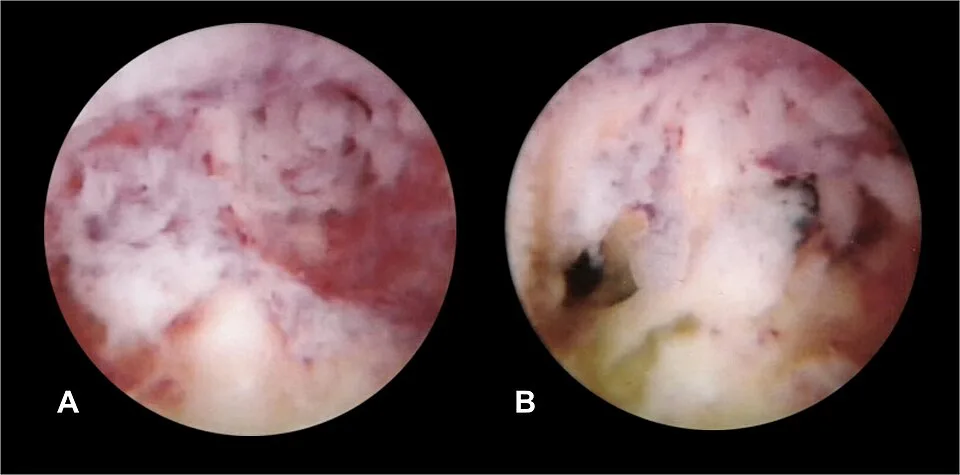
Asherman syndrome is the presence of intrauterine adhesions (synechiae) with symptoms such as hypomenorrhoea or secondary amenorrhoea, subfertility, recurrent pregnancy loss or cyclical pain from trapped menstrual blood. It follows damage to the endometrial basalis, most often curettage of a recently pregnant uterus, but also caesarean section, myomectomy, hysteroscopic surgery and, in endemic areas, genital tuberculosis. Adhesions follow about one in five miscarriages, mostly mild. The classic exam picture is amenorrhoea after a D&C with a negative pregnancy test, normal FSH, LH, oestradiol and prolactin, and no withdrawal bleed after oestrogen and progestogen. Ultrasound, saline sonography or hysterosalpingography suggest adhesions; hysteroscopy is the gold standard for diagnosis and treatment. Management is hysteroscopic adhesiolysis with cold instruments, measures to prevent re-adhesion (intrauterine balloon or device, gels, postoperative oestrogen) and second-look hysteroscopy. Pregnancies afterwards are high risk, including placenta accreta spectrum.
Patient case, mechanism, investigations, management, flashcards and exam-style questions.Open the lesson →
Key facts
- Asherman syndrome = intrauterine adhesions plus symptoms (menstrual disturbance, subfertility, pregnancy loss, pain)
- Main cause is trauma to the endometrial basalis of a gravid or recently pregnant uterus, especially curettage 2–4 weeks postpartum or after miscarriage
- Intrauterine adhesions occur in about 19% of women after miscarriage (mostly mild); risk rises with the number of D&Cs (Hooker 2014)
- Genital tuberculosis is an important non-surgical cause in endemic regions and carries a poor prognosis
- Typical tests: negative pregnancy test, normal FSH, LH, oestradiol, prolactin and TSH; no withdrawal bleed after combined oestrogen–progestogen challenge (end-organ cause)
- Hysteroscopy is the gold standard for diagnosis, classification and treatment
- Treatment: hysteroscopic adhesiolysis with cold scissors, then re-adhesion prevention and second-look hysteroscopy
- After treatment, pregnancies risk miscarriage, preterm birth, fetal growth restriction, placenta praevia and placenta accreta spectrum
Differential diagnosis
| Condition | Clues | Key test |
|---|---|---|
| Pregnancy | Amenorrhoea in a sexually active woman | Pregnancy test |
| Sheehan syndrome | Postpartum haemorrhage followed by failure of lactation, amenorrhoea, fatigue | Low FSH/LH, cortisol, TSH/fT4 |
| Polycystic ovary syndrome | Oligomenorrhoea, hyperandrogenism, polycystic ovaries | LH:FSH, testosterone, ultrasound |
| Premature ovarian insufficiency | Amenorrhoea with menopausal symptoms under 40 | Raised FSH on two occasions |
| Hyperprolactinaemia | Galactorrhoea, headaches | Serum prolactin, MRI pituitary |
| Functional hypothalamic amenorrhoea | Low weight, stress, exercise | Low FSH/LH, low oestradiol |
| Cervical stenosis | Cyclical pain, haematometra after cervical surgery | Ultrasound showing distended cavity; cervical dilatation |
Exam pearls
Guideline
AAGL/ESGE practice guidelines on intrauterine adhesions (2017); Cochrane review of anti-adhesion therapy after operative hysteroscopy (2017); NICE NG126 ectopic pregnancy and miscarriage (2019, updated 2023); ESHRE recurrent pregnancy loss guideline (2022); NICE CG156 fertility
References
- AAGL Elevating Gynecologic Surgery and European Society of Gynaecological Endoscopy. AAGL practice report: practice guidelines on intrauterine adhesions developed in collaboration with the European Society of Gynaecological Endoscopy (ESGE). Gynecol Surg 2017.
- Yu D, Wong YM, Cheong Y, Xia E, Li TC.. Asherman syndrome: one century later. Fertil Steril 2008.
- Hooker AB, Lemmers M, Thurkow AL, et al.. Systematic review and meta-analysis of intrauterine adhesions after miscarriage: prevalence, risk factors and long-term reproductive outcome. Hum Reprod Update 2014.
- Bosteels J, Weyers S, D'Hooghe TM, et al.. Anti-adhesion therapy following operative hysteroscopy for treatment of female subfertility. Cochrane Database Syst Rev 2017.
- National Institute for Health and Care Excellence. Ectopic pregnancy and miscarriage: diagnosis and initial management (NG126). NICE guideline NG126 2019.
- The American Fertility Society. The American Fertility Society classifications of adnexal adhesions, distal tubal occlusion, tubal occlusion secondary to tubal ligation, tubal pregnancies, mullerian anomalies and intrauterine adhesions. Fertil Steril 1988.
Related topics
By Dr Khalid Seidi (B.Sc., M.D.) · MedEd World Clinical Knowledge library. Original teaching content checked against current guidelines (November 2026); confirm the latest local guidance before clinical use. Not a substitute for clinical judgement.