Clinical Knowledge › Obstetrics and gynaecology › Benign gynaecological conditions
Cervical ectropion and polyps
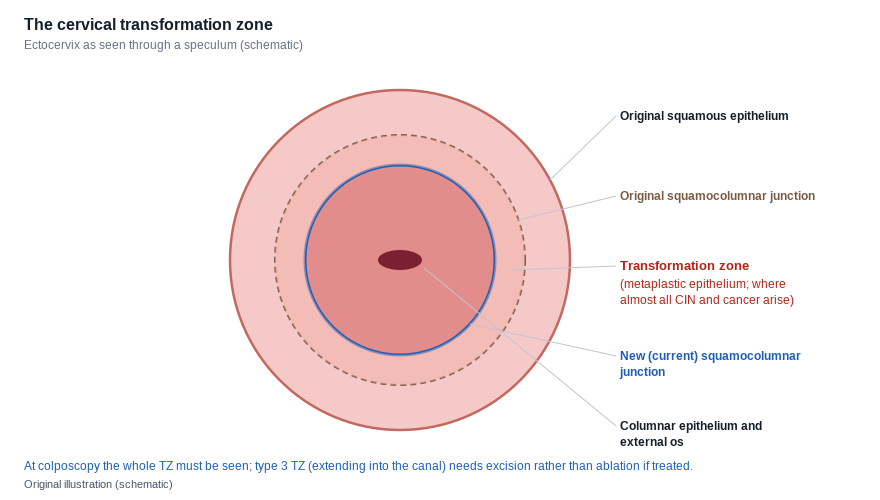
Cervical ectropion (ectopy) is the presence of glandular columnar epithelium from the endocervical canal on the ectocervix, seen as a red, velvety area around the external os. It is a physiological, oestrogen-driven change common at puberty, in pregnancy and with combined hormonal contraception and its metaplasia forms the transformation zone. Cervical polyps are benign, usually pedunculated outgrowths of endocervical (rarely ectocervical) tissue, commonest in multiparous women aged 40–60. Both are often asymptomatic but can cause mucoid discharge, postcoital or intermenstrual bleeding. These symptoms must not be attributed to an ectropion or polyp until cervical cancer and infection are excluded: inspect the cervix with a speculum, check screening history, test for chlamydia and gonorrhoea, and refer urgently if the cervix looks suspicious. Asymptomatic ectropion needs no treatment; troublesome cases may stop combined contraception or have ablation. Polyps are usually removed by avulsion and sent for histology, with endometrial assessment after the menopause.
Patient case, mechanism, investigations, management, flashcards and exam-style questions.Open the lesson →
Key facts
- Ectropion = endocervical columnar epithelium visible on the ectocervix; physiological under oestrogen (puberty, pregnancy, combined hormonal contraception)
- Squamous metaplasia of everted columnar epithelium creates the transformation zone, the site of CIN and most cervical cancers
- Nabothian cysts are retention cysts formed when metaplastic squamous epithelium covers endocervical crypts; they are benign
- Postcoital bleeding needs speculum examination, screening history and chlamydia/gonorrhoea NAAT; a screening test does not investigate symptoms
- Refer urgently if the cervix looks suspicious of cancer (NICE NG12); persistent unexplained postcoital bleeding warrants colposcopy referral
- Cervical polyps occur in about 2–5% of women, are commonest in multiparous women in their 40s–50s and are rarely malignant
- Polyps are removed by twisting (avulsion) with polyp forceps and sent for histology; postmenopausal women also need endometrial assessment
- NHS England: HPV-negative women aged 25–49 are recalled every 5 years from July 2025 (previously 3 years)
Differential diagnosis
| Condition | Clues | Key test |
|---|---|---|
| Cervical cancer | Friable, irregular, ulcerated or hard cervix; contact bleeding; older or unscreened | Urgent colposcopy and biopsy |
| Chlamydial or gonococcal cervicitis | Mucopurulent discharge, friable oedematous cervix, new partner | NAAT swab |
| Trichomonas cervicitis | Frothy discharge, punctate 'strawberry' cervix | NAAT or microscopy |
| CIN | Usually invisible; abnormal screening result | HPV test and colposcopy |
| Endometrial polyp prolapsing through the os | Polyp arising from above the canal, abnormal uterine bleeding | TVUS, hysteroscopy |
| Prolapsed submucosal fibroid | Firm pink mass through os, heavy bleeding, cramping | Examination, ultrasound |
| Decidual polyp in pregnancy | Soft polyp in a pregnant woman, often regresses | Clinical; remove only if bleeding or suspicious |
Exam pearls
Guideline
NHS Cervical Screening Programme (HPV primary screening; 5-yearly recall for HPV-negative 25–49-year-olds from July 2025); WHO guideline for cervical pre-cancer screening and treatment, 2nd edition (2021); NICE NG12 Suspected cancer (2015, updated); FSRH Problematic bleeding with hormonal contraception (2015); BASHH chlamydia guideline
References
- NHS England. NHS Cervical Screening Programme: HPV primary screening and personalised 5-yearly recall for HPV-negative women aged 25–49 (from July 2025). NHS England 2025.
- World Health Organization. WHO guideline for screening and treatment of cervical pre-cancer lesions for cervical cancer prevention, 2nd edition. World Health Organization, Geneva 2021.
- National Institute for Health and Care Excellence. Suspected cancer: recognition and referral (NG12). NICE guideline NG12 2015.
- Shapley M, Jordan J, Croft PR.. A systematic review of postcoital bleeding and risk of cervical cancer. Br J Gen Pract 2006.
- Tanos V, Berry KE, Seikkula J, et al.. The management of polyps in female reproductive organs. Int J Surg 2017.
- Faculty of Sexual and Reproductive Healthcare. Problematic bleeding with hormonal contraception. FSRH Clinical Guidance 2015.
Related topics
By Dr Khalid Seidi (B.Sc., M.D.) · MedEd World Clinical Knowledge library. Original teaching content checked against current guidelines (November 2026); confirm the latest local guidance before clinical use. Not a substitute for clinical judgement.