Clinical Knowledge › Obstetrics and gynaecology › Benign gynaecological conditions
Uterine fibroids
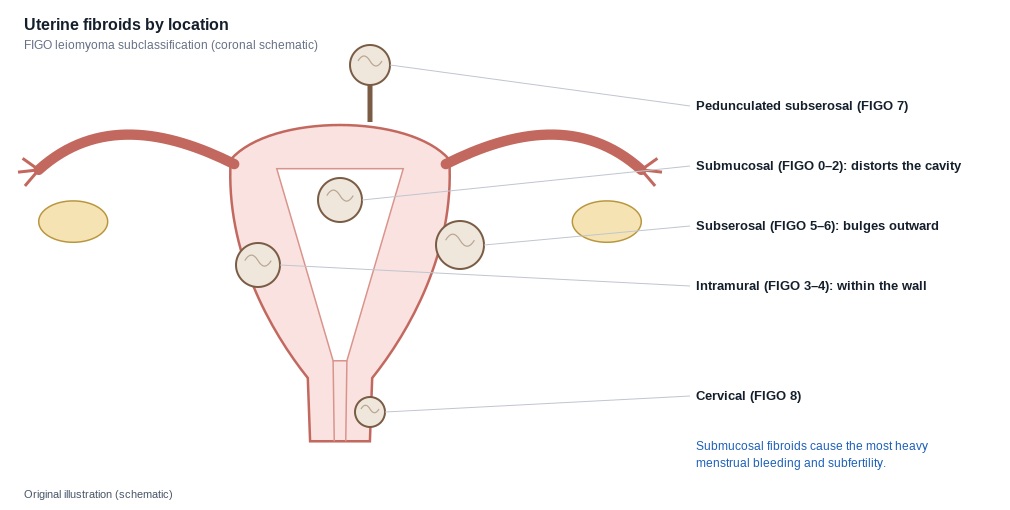
Uterine fibroids (leiomyomas) are benign, hormone-dependent clonal smooth muscle tumours, present in most women by age 50 and earlier and larger in Black women. Most are asymptomatic. Symptoms depend on the FIGO 0–8 location: submucosal fibroids cause heavy menstrual bleeding, iron deficiency anaemia and subfertility; large intramural and subserosal fibroids cause pressure symptoms, and degeneration or torsion causes pain. Transvaginal and transabdominal ultrasound is first line; saline sonography or hysteroscopy maps submucosal fibroids and MRI guides uterus-sparing treatment. Management follows NICE NG88 and ACOG: tranexamic acid, NSAIDs, the LNG-IUD (if the cavity is not distorted) or hormonal contraception; GnRH agonists before surgery; and oral GnRH antagonists with add-back therapy (relugolix combination therapy, linzagolix). Procedures include hysteroscopic resection, myomectomy, uterine artery embolisation, ablation and hysterectomy. In pregnancy, red degeneration, malpresentation, preterm labour and postpartum haemorrhage occur.
Patient case, mechanism, investigations, management, flashcards and exam-style questions.Open the lesson →
Key facts
- Fibroids affect up to 70% of white and over 80% of Black women by age 50; they arise during reproductive life and shrink after the menopause
- FIGO leiomyoma subclassification: types 0–2 submucosal, 3–4 intramural, 5–7 subserosal, 8 other (cervical, parasitic); hybrid types written as two numbers, for example 2–5
- Submucosal fibroids (types 0–2) cause heavy menstrual bleeding and reduce fertility; hysteroscopic resection is the treatment of choice
- NICE NG88: fibroids under 3 cm without cavity distortion are treated like other heavy menstrual bleeding (LNG-IUD first); larger fibroids need imaging and specialist options
- Relugolix 40 mg with estradiol 1 mg and norethisterone acetate 0.5 mg once daily (relugolix combination therapy) reduced menstrual blood loss in about 70% of women in LIBERTY 1 and 2
- GnRH agonists for 3–4 months shrink fibroids by up to about 30–50% and correct anaemia before surgery, but fibroids regrow after stopping
- Red (carneous) degeneration typically occurs in the second trimester with pain, localised tenderness and low-grade fever; manage with analgesia
- Leiomyosarcoma is rare; rapid growth after the menopause, abnormal MRI or high LDH should prompt specialist assessment, and uncontained power morcellation is avoided
Differential diagnosis
| Condition | Clues | Key test |
|---|---|---|
| Adenomyosis | Diffusely enlarged, globular, tender uterus with dysmenorrhoea | TVUS (MUSA features) or MRI junctional zone |
| Endometrial polyp | Intermenstrual bleeding; small focal intracavitary lesion with a feeding vessel | Saline sonography or hysteroscopy |
| Ovarian tumour | Adnexal mass separate from the uterus; may be cystic or solid | TVUS, CA-125, risk of malignancy index |
| Uterine leiomyosarcoma | Rapid growth, postmenopausal growth, pain, irregular necrotic mass | MRI with diffusion, LDH, histology |
| Pregnancy | Enlarged uterus and amenorrhoea | Pregnancy test |
| Endometrial hyperplasia or cancer | Postmenopausal or irregular bleeding with risk factors | Endometrial thickness and biopsy |
| Full bladder or pelvic kidney | Midline suprapubic mass | Repeat examination after voiding; ultrasound |
Exam pearls
Guideline
NICE NG88 Heavy menstrual bleeding: assessment and management (2018, updated 2021); ACOG Practice Bulletin No. 228 Management of symptomatic uterine leiomyomas (2021); NICE TA832 relugolix–estradiol–norethisterone acetate (2022) and TA996 linzagolix (2024) for fibroids
References
- National Institute for Health and Care Excellence. Heavy menstrual bleeding: assessment and management (NG88). NICE guideline NG88 2018.
- American College of Obstetricians and Gynecologists. Management of symptomatic uterine leiomyomas (Practice Bulletin No. 228). Obstet Gynecol 2021.
- National Institute for Health and Care Excellence. Relugolix–estradiol–norethisterone acetate for treating moderate to severe symptoms of uterine fibroids (TA832). NICE technology appraisal guidance 2022.
- National Institute for Health and Care Excellence. Linzagolix for treating moderate to severe symptoms of uterine fibroids (TA996). NICE technology appraisal guidance 2024.
- Munro MG, Critchley HOD, Fraser IS; FIGO Menstrual Disorders Committee. The two FIGO systems for normal and abnormal uterine bleeding symptoms and classification of causes of abnormal uterine bleeding in the reproductive years: 2018 revisions. Int J Gynaecol Obstet 2018.
- Stewart EA, Laughlin-Tommaso SK, Catherino WH, Lalitkumar S, Gupta D, Vollenhoven B. Uterine fibroids. Nat Rev Dis Primers 2016.
Related topics
By Dr Khalid Seidi (B.Sc., M.D.) · MedEd World Clinical Knowledge library. Original teaching content checked against current guidelines (November 2026); confirm the latest local guidance before clinical use. Not a substitute for clinical judgement.