Clinical Knowledge › Obstetrics and gynaecology › Benign gynaecological conditions
Ovarian torsion
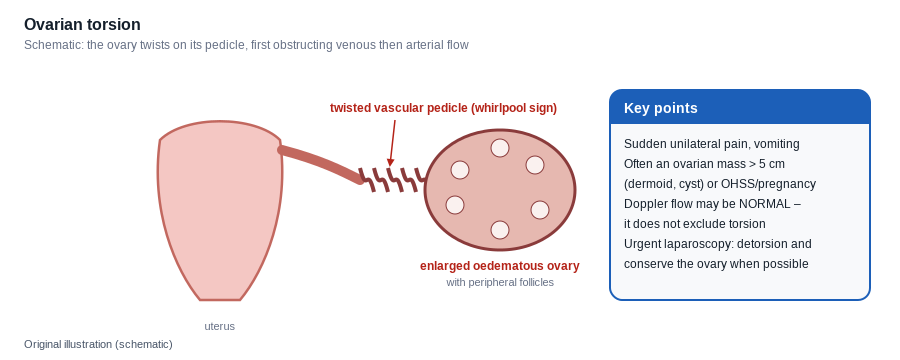
Ovarian (adnexal) torsion is partial or complete rotation of the ovary, often with the fallopian tube, around its vascular pedicle. Venous and lymphatic obstruction cause oedema and congestion before arterial inflow fails, so the ovary can be saved if it is untwisted promptly. Risk factors are an ovarian mass of about 5–10 cm (especially a dermoid), ovarian stimulation, pregnancy and enlarged polycystic ovaries, but in children up to about half of twisted ovaries are normal. Typical features are sudden severe unilateral lower abdominal pain, often intermittent, with nausea and vomiting. Ultrasound may show an enlarged oedematous ovary with peripheral follicles, a whirlpool sign or reduced Doppler flow, but no test excludes torsion; normal Doppler flow is common. Torsion is a surgical diagnosis: when suspected, perform urgent laparoscopy with detorsion and ovarian conservation, even if the ovary looks dark, and remove a cyst if present. Oophorectomy is reserved for a disintegrating necrotic ovary or suspected malignancy.
Patient case, mechanism, investigations, management, flashcards and exam-style questions.Open the lesson →
Key facts
- Adnexal torsion = rotation of the ovary ± tube on the infundibulopelvic and utero-ovarian ligaments; venous obstruction precedes arterial occlusion
- Right side is affected more often than left (the sigmoid colon limits left-sided mobility)
- Main risk: ovarian mass 5–10 cm, especially mature cystic teratoma; also ovarian stimulation, OHSS, pregnancy (first trimester) and previous torsion
- In children and adolescents up to about 46% of torsions involve a normal ovary (ACOG CO 783)
- Classic picture: sudden severe unilateral pelvic pain, often colicky or intermittent, with nausea and vomiting
- TVUS signs: enlarged oedematous ovary, peripherally displaced follicles, whirlpool sign (specificity about 91%), absent or reduced flow; normal Doppler does not exclude torsion
- Treatment: urgent laparoscopy with detorsion and conservation of the ovary regardless of colour; most ovaries regain function
- Oophorectomy only if the ovary is frankly necrotic and disintegrating, or malignancy is suspected (usually postmenopausal)
Differential diagnosis
| Condition | Clues | Key test |
|---|---|---|
| Ectopic pregnancy | Positive pregnancy test, bleeding, adnexal mass separate from ovary | hCG, TVUS |
| Ruptured or haemorrhagic ovarian cyst | Sudden pain often after intercourse or exercise, free fluid, ovary not enlarged and oedematous | TVUS, Hb |
| Acute appendicitis | Periumbilical pain migrating to right iliac fossa, fever, anorexia | Ultrasound, CT or MRI; inflammatory markers |
| Pelvic inflammatory disease or tubo-ovarian abscess | Bilateral pain, fever, discharge, cervical motion tenderness | NAAT swabs, CRP, TVUS |
| Renal or ureteric colic | Loin-to-groin pain, haematuria | Urinalysis, CT KUB |
| Ovarian hyperstimulation syndrome | Recent IVF, bilateral enlarged ovaries, ascites, no twisted pedicle | TVUS, haematocrit; torsion can coexist |
| Mesenteric adenitis (children) | Recent viral illness, enlarged mesenteric nodes | Ultrasound |
Exam pearls
Guideline
ACOG Committee Opinion No. 783 Adnexal torsion in adolescents (2019); ACOG Practice Bulletin No. 174 Evaluation and management of adnexal masses (2016); RCOG Green-top Guideline No. 62 (2011)
References
- American College of Obstetricians and Gynecologists. Adnexal torsion in adolescents (Committee Opinion No. 783). Obstet Gynecol 2019.
- Garde I, Paredes C, Ventura L, et al.. Diagnostic accuracy of ultrasound signs for detecting adnexal torsion: systematic review and meta-analysis. Ultrasound Obstet Gynecol 2023.
- Royal College of Obstetricians and Gynaecologists and British Society for Gynaecological Endoscopy. Management of suspected ovarian masses in premenopausal women (Green-top Guideline No. 62). RCOG Green-top Guideline No. 62 2011.
- American College of Obstetricians and Gynecologists. Evaluation and management of adnexal masses (Practice Bulletin No. 174). Obstet Gynecol 2016.
- Froyman W, Landolfo C, De Cock B, et al.. Risk of complications in patients with conservatively managed ovarian tumours (IOTA5): a 2-year interim analysis of a multicentre, prospective, cohort study. Lancet Oncol 2019.
- Berek JS, ed.. Berek & Novak's Gynecology. Wolters Kluwer 2019.
Related topics
By Dr Khalid Seidi (B.Sc., M.D.) · MedEd World Clinical Knowledge library. Original teaching content checked against current guidelines (November 2026); confirm the latest local guidance before clinical use. Not a substitute for clinical judgement.