Clinical Knowledge › Obstetrics and gynaecology › Benign gynaecological conditions
Female genital mutilation
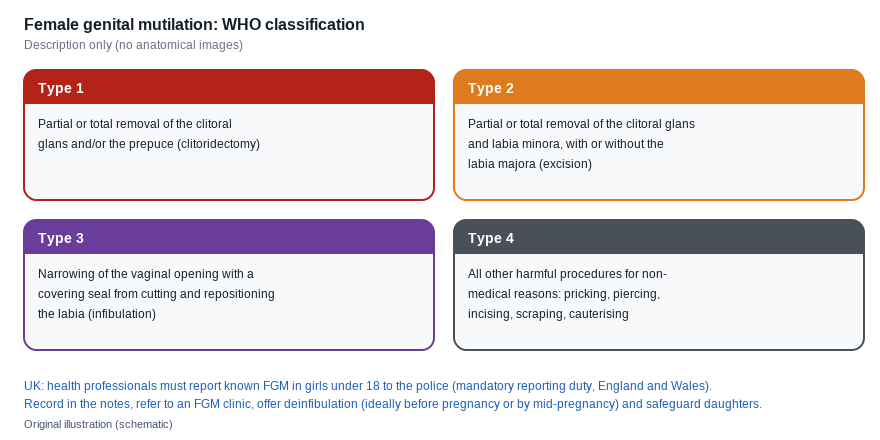
Female genital mutilation (FGM) comprises all procedures that partially or totally remove the external female genitalia, or otherwise injure the female genital organs, for non-medical reasons. More than 230 million girls and women alive have undergone FGM, mostly in Africa, the Middle East and Asia. WHO describes four types: 1 (clitoridectomy), 2 (excision of clitoris and labia minora), 3 (infibulation, a covering seal narrowing the introitus) and 4 (other harms such as pricking). Immediate harms include haemorrhage, infection and death; later harms include dyspareunia, recurrent urinary infection, voiding difficulty, cysts, psychological trauma and obstetric complications such as perineal trauma and postpartum haemorrhage. Care is non-judgemental, with professional interpreters, documentation of type, deinfibulation for type 3 (ideally before pregnancy or at about 20 weeks) and safeguarding of girls at risk. FGM is illegal in many countries; in England and Wales regulated professionals must report known FGM in a girl under 18 to the police.
Patient case, mechanism, investigations, management, flashcards and exam-style questions.Open the lesson →
Key facts
- FGM: any non-medical partial or total removal of, or injury to, the external female genitalia; WHO opposes all forms, including when done by health workers (medicalisation)
- WHO type 1 clitoridectomy; type 2 excision (clitoris and labia minora ± majora); type 3 infibulation (covering seal narrowing the introitus); type 4 all other harmful procedures
- Over 230 million girls and women affected worldwide (UNICEF 2024); usually performed between infancy and age 15
- Type 3 carries the greatest risk: urinary outflow obstruction, haematocolpos, apareunia, difficult examination and obstructed second stage
- Deinfibulation (anterior midline division of the scar to expose the urethral meatus) is offered before pregnancy, at about 20 weeks antenatally, or in the first or second stage of labour
- Reinfibulation (re-closing the scar after birth) is illegal in the UK and must not be performed even on request
- England and Wales: regulated health professionals must report known FGM (disclosed or seen) in a girl under 18 to the police by calling 101, normally within one month
- Adult women with FGM: record in the notes (and the FGM Enhanced Dataset in England), assess risk to daughters and female relatives, and refer to safeguarding when a girl is at risk
Differential diagnosis
| Condition | Clues | Key test |
|---|---|---|
| Vulval lichen sclerosus | Pale, atrophic, fissured skin with loss of labial architecture but no history of cutting | Clinical; biopsy if uncertain |
| Congenital anomaly (labial fusion, imperforate hymen) | Present from childhood without a cutting history; no scar | Examination; pelvic ultrasound |
| Obstetric perineal scarring | Scar follows a previous tear or episiotomy line posteriorly | Obstetric history and examination |
| Labial adhesions in a prepubertal girl | Thin translucent midline adhesion, no scar tissue | Examination; resolves with oestrogen cream |
| Epidermoid inclusion cyst unrelated to FGM | Smooth cyst; no clitoral or labial loss | Examination; ultrasound; excision histology |
| Cosmetic genital surgery (female genital cosmetic surgery) | Requested by an adult for appearance; legal status depends on jurisdiction and intent | History; seek legal and ethical advice |
Exam pearls
Guideline
WHO guideline on the prevention of female genital mutilation and clinical management of complications (2025); RCOG Green-top Guideline No. 53 Female genital mutilation and its management (2015); HM Government multi-agency statutory guidance on FGM (updated 2020)
References
- World Health Organization. WHO guideline on the prevention of female genital mutilation and clinical management of complications. World Health Organization, Geneva 2025.
- World Health Organization. WHO guidelines on the management of health complications from female genital mutilation. World Health Organization, Geneva 2016.
- Royal College of Obstetricians and Gynaecologists. Female genital mutilation and its management (Green-top Guideline No. 53). RCOG, London 2015.
- HM Government. Multi-agency statutory guidance on female genital mutilation. Home Office, London 2020.
- WHO study group on female genital mutilation and obstetric outcome. Female genital mutilation and obstetric outcome: WHO collaborative prospective study in six African countries. Lancet 2006.
- Society of Obstetricians and Gynaecologists of Canada. Guideline No. 395: Female genital cutting. J Obstet Gynaecol Can 2020.
Related topics
By Dr Khalid Seidi (B.Sc., M.D.) · MedEd World Clinical Knowledge library. Original teaching content checked against current guidelines (November 2026); confirm the latest local guidance before clinical use. Not a substitute for clinical judgement.