Clinical Knowledge › Obstetrics and gynaecology › Benign gynaecological conditions
Endometriosis
Endometriosis is a chronic, oestrogen-dependent inflammatory disease in which endometrium-like tissue grows outside the uterus, mainly on the pelvic peritoneum and ovaries (endometriomas) and as deep lesions of the rectovaginal septum, bowel and bladder. It affects about 1 in 10 women of reproductive age, with a diagnostic delay of about 8 years. Typical symptoms are secondary dysmenorrhoea, deep dyspareunia, chronic pelvic pain, cyclical bowel or bladder symptoms and subfertility; examination may show a fixed retroverted uterus or uterosacral nodules, or be normal. NICE NG73 (updated November 2024) advises transvaginal ultrasound for suspected endometriosis even when examination is normal, and ESHRE 2022 accepts imaging and symptoms as a basis for treatment without first requiring laparoscopy. Treatment combines analgesia, hormonal suppression (combined pill, progestogens including the LNG-IUD, GnRH agonists or oral GnRH antagonists with add-back) and laparoscopic excision. Hormonal treatment does not improve fertility; surgery or IVF is used for subfertility.
Patient case, mechanism, investigations, management, flashcards and exam-style questions.Open the lesson →
Key facts
- Endometriosis affects about 10% of women of reproductive age and up to half of women with subfertility or chronic pelvic pain; average diagnostic delay is about 8 years
- Cardinal symptoms: secondary dysmenorrhoea, deep dyspareunia, chronic pelvic pain, cyclical dyschezia or dysuria, and subfertility
- Retrograde menstruation (Sampson) occurs in most women; lesions depend on oestrogen, local aromatase activity, inflammation and progesterone resistance
- NICE NG73 (Nov 2024): offer transvaginal ultrasound to women with suspected endometriosis even if examination is normal; a normal scan does not exclude it
- ESHRE 2022: laparoscopy is no longer the only gateway to diagnosis; imaging plus symptoms can justify empirical hormonal treatment
- First-line medical treatment: NSAIDs and combined hormonal contraception or a progestogen (desogestrel, dienogest, LNG-IUD), often taken continuously
- GnRH agonists or oral GnRH antagonists with add-back are second line; relugolix combination therapy is NICE-recommended (TA1057, 2025) when earlier treatments fail
- Hormonal suppression does not improve fertility; operative laparoscopy for peritoneal disease and IVF are the fertility options
Differential diagnosis
| Condition | Clues | Key test |
|---|---|---|
| Adenomyosis | Heavy bleeding with dysmenorrhoea and a bulky, tender uterus; often coexists | TVUS (MUSA features) or MRI |
| Pelvic inflammatory disease | Fever, discharge, cervical motion tenderness, STI risk; not strictly cyclical | NAAT for chlamydia and gonorrhoea, response to antibiotics |
| Irritable bowel syndrome | Bloating and altered bowel habit related to meals and stress | Clinical diagnosis; consider endometriosis if cyclical |
| Interstitial cystitis / bladder pain syndrome | Frequency and suprapubic pain relieved by voiding | Urinalysis, cystoscopy |
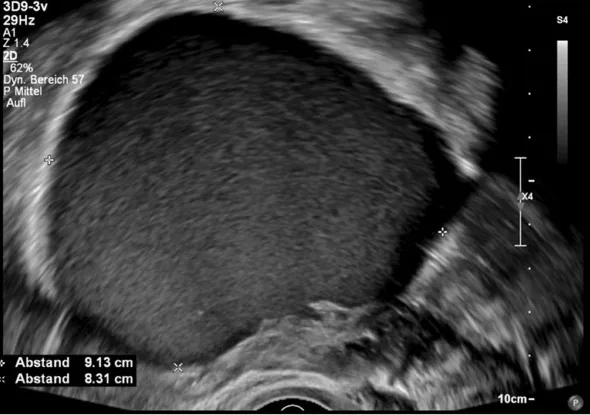
| Ovarian cyst (haemorrhagic or neoplastic) | Adnexal mass; acute pain if ruptured | TVUS: ground-glass endometrioma versus other features |
| Primary dysmenorrhoea | Pain from menarche, no dyspareunia, responds to NSAIDs or pill | Normal examination and ultrasound |
| Pelvic adhesions or chronic pelvic pain syndrome | Previous surgery or infection; central sensitisation | History, imaging, laparoscopy if needed |
Exam pearls
Guideline
NICE NG73 Endometriosis: diagnosis and management (2017; updated 2024, including diagnosis and referral in November 2024); ESHRE guideline: endometriosis (2022); NICE TA1057 relugolix–estradiol–norethisterone for endometriosis (2025)
References
- National Institute for Health and Care Excellence. Endometriosis: diagnosis and management (NG73). NICE guideline NG73 2017.
- Becker CM, Bokor A, Heikinheimo O, et al.. ESHRE guideline: endometriosis. Hum Reprod Open 2022.
- National Institute for Health and Care Excellence. Relugolix–estradiol–norethisterone for treating symptoms of endometriosis (TA1057). NICE technology appraisal guidance 2025.
- Zondervan KT, Becker CM, Missmer SA. Endometriosis. N Engl J Med 2020.
- Becker CM, Johnson NP, As-Sanie S, et al.. Two-year efficacy and safety of relugolix combination therapy in women with endometriosis-associated pain: SPIRIT open-label extension study. Hum Reprod 2024.
- Donnez J, Becker CM, Petraglia F, et al.. Linzagolix, with and without add-back therapy, in women with endometriosis-associated pain: results from EDELWEISS 6, a double-blind randomized extension and withdrawal study. Hum Reprod Open 2026.
Related topics
By Dr Khalid Seidi (B.Sc., M.D.) · MedEd World Clinical Knowledge library. Original teaching content checked against current guidelines (November 2026); confirm the latest local guidance before clinical use. Not a substitute for clinical judgement.