Clinical Knowledge › Internal medicine › Cardiology and angiology › Coronary artery disease
Atherosclerosis: pathogenesis and risk factors
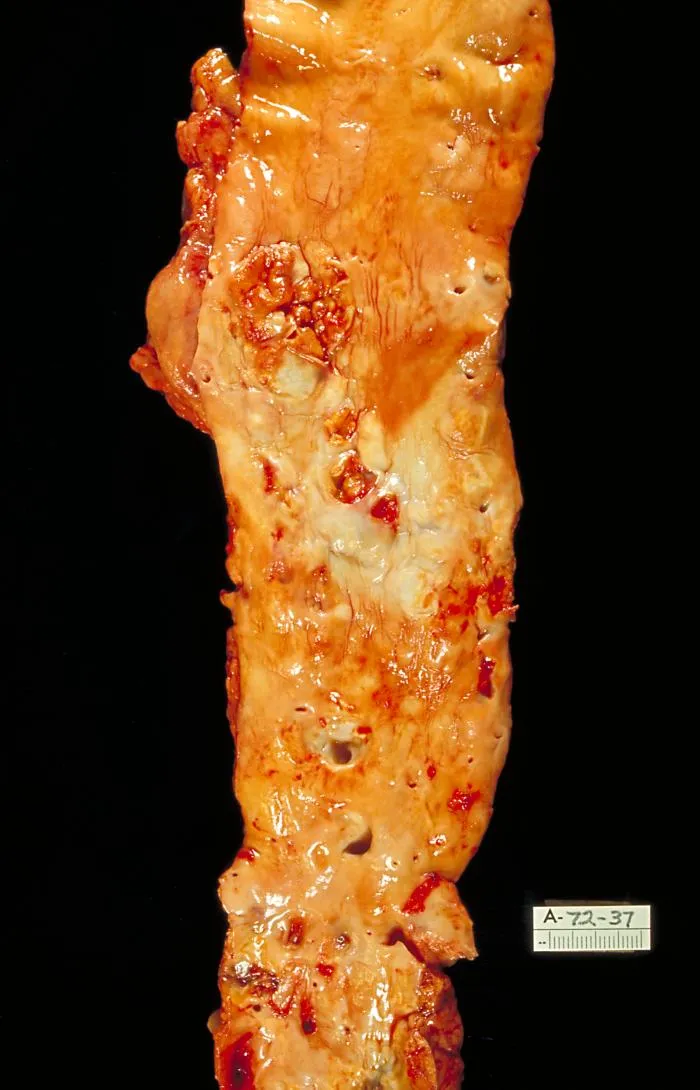
Atherosclerosis is a chronic inflammatory disease of large and medium arteries in which lipid-rich plaques build up in the intima over decades. It underlies most myocardial infarctions, ischaemic strokes and peripheral arterial disease. The process starts when apolipoprotein B-containing lipoproteins, mainly LDL, are retained and modified in the intima at sites of disturbed flow. Endothelial activation recruits monocytes that become lipid-laden foam cells; smooth muscle cells migrate and build a fibrous cap over a necrotic core. Most acute events follow rupture of a thin-capped, inflamed plaque or erosion of the endothelium, with thrombosis on top. LDL cholesterol is causal: lower exposure for longer means less disease. Other major risk factors are smoking, hypertension, diabetes, obesity, chronic kidney disease, raised lipoprotein(a) and family history. Risk is estimated with SCORE2 in Europe or PREVENT in the USA, and prevention combines lifestyle change, LDL and blood pressure lowering, smoking cessation and, in established disease, antithrombotic and anti-inflammatory therapy.
Patient case, mechanism, investigations, management, flashcards and exam-style questions.Open the lesson →
Key facts
- Atherosclerosis is lipid-driven inflammation of the arterial intima; LDL and other apoB-containing particles are causal, not just associated
- Plaques form at branch points and curves where low, oscillating shear stress reduces endothelial protection
- The sequence is endothelial dysfunction, LDL retention and oxidation, monocyte recruitment, foam cells (fatty streak), smooth muscle migration (fibrous cap) and necrotic core
- Most myocardial infarctions arise from rupture of a thin-cap fibroatheroma or from plaque erosion, often at non-severe stenoses
- INTERHEART: nine modifiable factors (apoB/apoA1 ratio, smoking, hypertension, diabetes, abdominal obesity, psychosocial stress, diet, inactivity, alcohol) explain about 90% of MI risk
- Lipoprotein(a) is a genetically determined, independent risk factor; measure it at least once in every adult
- Estimate 10-year risk with SCORE2/SCORE2-OP (ESC) or the PREVENT equations (ACC/AHA 2026) in people without known disease
- Inflammation is a treatable target: canakinumab (CANTOS) and low-dose colchicine (LoDoCo2, COLCOT) reduced events in coronary disease
Differential diagnosis
| Condition | Clues | Key test |
|---|---|---|
| Arteriolosclerosis (hyaline or hyperplastic) | Small arteries and arterioles in hypertension and diabetes; no lipid core | Histology; clinical context of hypertension or diabetes |
| Mönckeberg medial calcific sclerosis | Calcification of the media of muscular arteries in older people, diabetes or CKD; lumen not narrowed | Pipe-stem calcification on X-ray; falsely high ABPI |
| Large-vessel vasculitis (Takayasu, giant cell arteritis) | Younger woman or older adult, systemic inflammation, smooth tapering stenoses | ESR/CRP, CT or MR angiography, PET |
| Fibromuscular dysplasia | Young or middle-aged woman, renal or carotid 'string of beads' | CT or MR angiography |
| Spontaneous coronary artery dissection | MI in a young woman without risk factors, often peripartum | Coronary angiography with intracoronary imaging |
| Coronary vasospasm | Rest angina at night with transient ST elevation, smokers | Provocation testing during angiography |
Exam pearls
Guideline
2021 ESC cardiovascular disease prevention guideline, 2025 ESC/EAS dyslipidaemia focused update and 2026 ACC/AHA multisociety dyslipidaemia guideline
References
- Visseren FLJ, Mach F, Smulders YM, et al.. 2021 ESC Guidelines on cardiovascular disease prevention in clinical practice. Eur Heart J 2021.
- Mach F, Koskinas KC, Roeters van Lennep JE, et al.. 2025 Focused Update of the 2019 ESC/EAS Guidelines for the management of dyslipidaemias. Eur Heart J 2025.
- Blumenthal RS, Morris PB, Gaudino M, et al.. 2026 ACC/AHA/AACVPR/ABC/ACPM/ADA/AGS/APhA/ASPC/NLA/PCNA Guideline on the Management of Dyslipidemia. J Am Coll Cardiol 2026.
- Libby P, Buring JE, Badimon L, et al.. Atherosclerosis. Nat Rev Dis Primers 2019.
- Yusuf S, Hawken S, Ounpuu S, et al.. Effect of potentially modifiable risk factors associated with myocardial infarction in 52 countries (the INTERHEART study): case-control study. Lancet 2004.
- Ference BA, Ginsberg HN, Graham I, et al.. Low-density lipoproteins cause atherosclerotic cardiovascular disease. 1. Evidence from genetic, epidemiologic, and clinical studies. A consensus statement from the European Atherosclerosis Society Consensus Panel. Eur Heart J 2017.
Related topics
By Dr Khalid Seidi (B.Sc., M.D.) · MedEd World Clinical Knowledge library. Original teaching content checked against current guidelines (November 2026); confirm the latest local guidance before clinical use. Not a substitute for clinical judgement.