Clinical Knowledge › Internal medicine › Cardiology and angiology › Coronary artery disease
Unstable angina and NSTEMI
Non-ST-elevation acute coronary syndrome (NSTE-ACS) covers unstable angina and non-ST-elevation myocardial infarction (NSTEMI). Both present with ischaemic chest pain at rest or a crescendo pattern, without persistent ST elevation on the ECG. The difference is troponin: NSTEMI shows a rise and/or fall of high-sensitivity troponin above the sex-specific 99th centile, whereas unstable angina does not. The usual cause is a non-occlusive thrombus on a disrupted plaque. Diagnosis uses serial ECGs and a validated 0 h/1 h or 0 h/2 h troponin algorithm, with echocardiography to look for wall-motion abnormalities and alternative causes. Treatment combines aspirin, anticoagulation (fondaparinux or heparin), anti-anginal therapy and an invasive strategy timed by risk: immediate for very-high-risk features such as shock or refractory pain, within 24 hours for confirmed NSTEMI or a GRACE score above 140. After PCI, patients receive 12 months of dual antiplatelet therapy, high-intensity lipid lowering and comprehensive secondary prevention.
Patient case, mechanism, investigations, management, flashcards and exam-style questions.Open the lesson →
Key facts
- NSTE-ACS = ischaemic symptoms without persistent ST elevation; NSTEMI if troponin rises and/or falls above the 99th centile, unstable angina if it does not
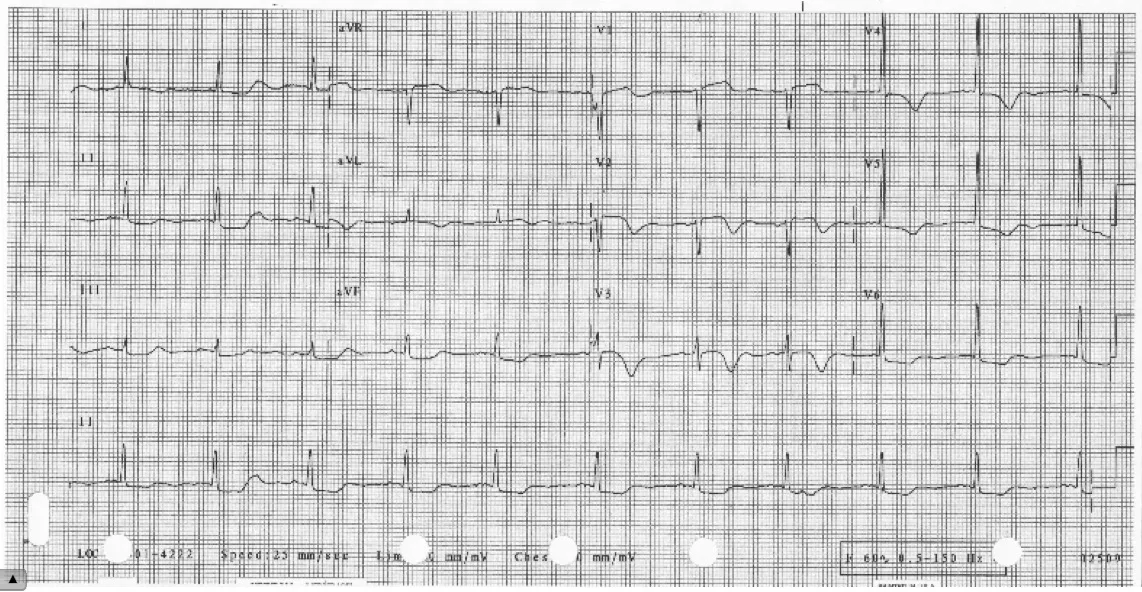
- ECG may show ST depression, T-wave inversion or be normal; repeat it with symptoms and record posterior leads if V1–V3 show ST depression
- High-sensitivity troponin 0 h/1 h (or 0 h/2 h) algorithms rule in or rule out NSTEMI quickly; a very low first value with symptoms over 3 hours can rule out
- Very-high-risk features (shock, refractory pain, life-threatening arrhythmia, mechanical complication, acute heart failure, recurrent dynamic ST changes) need angiography within 2 hours
- High-risk features (confirmed NSTEMI, dynamic ST/T changes, transient ST elevation, GRACE above 140) warrant angiography within 24 hours
- Fondaparinux 2.5 mg SC daily has the best efficacy–safety balance when angiography is not immediate; routine P2Y12 pretreatment is not recommended if angiography is early
- Prasugrel is preferred over ticagrelor in NSTE-ACS patients proceeding to PCI (ISAR-REACT 5), unless contraindicated
- Default DAPT is 12 months; shorter or de-escalated regimens reduce bleeding in high-bleeding-risk patients
Differential diagnosis
| Condition | Clues | Key test |
|---|---|---|
| STEMI or posterior MI | Persistent ST elevation; ST depression V1–V3 with tall R waves | Repeat ECG with V7–V9 |
| Secondary MI (supply–demand) | Tachyarrhythmia, anaemia, hypotension or sepsis triggering troponin rise | Identify and correct trigger; echo; selective angiography |
| Acute myocarditis | Young patient, viral prodrome, diffuse changes, unobstructed coronaries | Cardiac MRI |
| Takotsubo syndrome | Emotional or physical stress, apical ballooning out of proportion to troponin | Angiography and LV imaging |
| Pulmonary embolism | Breathlessness, hypoxaemia, RV strain, troponin rise | CTPA |
| Aortic dissection | Tearing back pain, pulse deficit, mediastinal widening | CT aortography |
| Chronic myocardial injury | Stable raised troponin without rise/fall in CKD or heart failure | Serial troponin shows no dynamic change |
Exam pearls
Guideline
2023 ESC acute coronary syndromes guideline and 2025 ACC/AHA/ACEP/NAEMSP/SCAI ACS guideline, with the Fifth Universal Definition of MI (2026)
References
- Byrne RA, Rossello X, Coughlan JJ, et al.. 2023 ESC Guidelines for the management of acute coronary syndromes. Eur Heart J 2023.
- Rao SV, O'Donoghue ML, Ruel M, et al.. 2025 ACC/AHA/ACEP/NAEMSP/SCAI Guideline for the Management of Patients With Acute Coronary Syndromes. Circulation 2025.
- Mills NL, Newby LK, Zaman S, et al.. Fifth Universal Definition of Myocardial Infarction (2026). Eur Heart J 2026.
- Wallentin L, Becker RC, Budaj A, et al.. Ticagrelor versus clopidogrel in patients with acute coronary syndromes. N Engl J Med 2009.
- Schüpke S, Neumann FJ, Menichelli M, et al.. Ticagrelor or Prasugrel in Patients with Acute Coronary Syndromes. N Engl J Med 2019.
- Mach F, Koskinas KC, Roeters van Lennep JE, et al.. 2025 Focused Update of the 2019 ESC/EAS Guidelines for the management of dyslipidaemias. Eur Heart J 2025.
Related topics
By Dr Khalid Seidi (B.Sc., M.D.) · MedEd World Clinical Knowledge library. Original teaching content checked against current guidelines (November 2026); confirm the latest local guidance before clinical use. Not a substitute for clinical judgement.