Clinical Knowledge › Internal medicine › Cardiology and angiology › Coronary artery disease
ST-elevation myocardial infarction (STEMI)
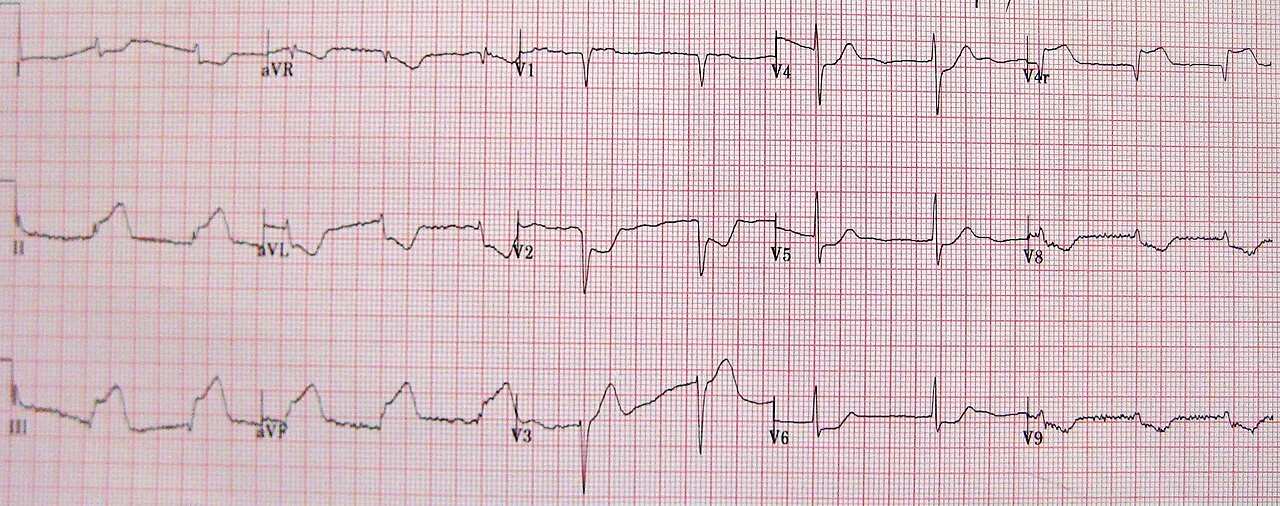
ST-elevation myocardial infarction (STEMI) is acute myocardial infarction with persistent ST elevation or an equivalent ECG pattern, usually caused by complete thrombotic occlusion of an epicardial coronary artery. Every minute of delay costs myocardium. The diagnosis is made on the ECG in a patient with ischaemic symptoms; troponin confirms but must never delay reperfusion. Primary PCI within 120 minutes of diagnosis is the preferred reperfusion strategy; when it cannot be delivered in time, fibrinolysis (for example tenecteplase) should be given within 10 minutes of diagnosis, followed by transfer for angiography. Patients receive aspirin, a P2Y12 inhibitor and anticoagulation, with oxygen only if hypoxaemic. Complete revascularisation of non-culprit lesions is recommended in stable patients, but only the culprit is treated acutely in cardiogenic shock. Early complications include ventricular fibrillation, heart block, shock and mechanical rupture. Secondary prevention mirrors other ACS, with special attention to LV function and heart failure therapy.
Patient case, mechanism, investigations, management, flashcards and exam-style questions.Open the lesson →
Key facts
- STEMI = ischaemic symptoms plus new ST elevation at the J point in two contiguous leads (1 mm limb leads; V2–V3 2 mm men 40 and over, 2.5 mm men under 40, 1.5 mm women)
- STEMI equivalents: posterior MI (ST depression V1–V3), new LBBB or paced rhythm meeting Sgarbossa criteria, de Winter T waves, and aVR elevation with diffuse ST depression and haemodynamic compromise
- Primary PCI within 120 minutes of diagnosis (door-to-wire within 60 minutes in a PCI centre) is the reperfusion strategy of choice within 12 hours of symptom onset
- If primary PCI cannot be achieved within 120 minutes, give fibrinolysis within 10 minutes of diagnosis, then transfer for angiography within 2–24 hours, or rescue PCI if ST elevation has not fallen by 50% at 60–90 minutes
- Do not wait for troponin before reperfusion
- Complete revascularisation of significant non-culprit lesions (during the index procedure or within 45 days) reduces cardiovascular death or MI (COMPLETE)
- In cardiogenic shock, treat only the culprit lesion acutely (CULPRIT-SHOCK); a microaxial flow pump reduced mortality in selected STEMI shock (DanGer Shock)
- Inferior STEMI: check right-sided leads for RV infarction (avoid nitrates, give fluids) and watch for AV block
Differential diagnosis
| Condition | Clues | Key test |
|---|---|---|
| Acute pericarditis | Diffuse concave ST elevation with PR depression, no reciprocal change except aVR, positional pain | ECG pattern, echo, CRP |
| Early repolarisation | Young, asymptomatic, notched J point, stable on serial ECGs | Serial ECGs; no troponin rise |
| Left ventricular aneurysm | Old MI with persistent ST elevation and deep Q waves | Compare with old ECG; echo |
| Takotsubo syndrome | Stress trigger, anterior ST elevation, apical ballooning, unobstructed coronaries | Angiography with ventriculography |
| Aortic dissection involving the RCA | Inferior STEMI with tearing back pain, pulse deficit | Bedside echo or CT aortography before antithrombotics |
| Brugada pattern | Coved ST elevation V1–V2 without ischaemic symptoms | Family history, ECG pattern, no troponin dynamics |
| Hyperkalaemia | Peaked T waves, broad QRS, pseudo-ST elevation | Serum potassium |
Exam pearls
Guideline
2023 ESC acute coronary syndromes guideline and 2025 ACC/AHA/ACEP/NAEMSP/SCAI ACS guideline (with the Fifth Universal Definition of MI, 2026)
References
- Byrne RA, Rossello X, Coughlan JJ, et al.. 2023 ESC Guidelines for the management of acute coronary syndromes. Eur Heart J 2023.
- Rao SV, O'Donoghue ML, Ruel M, et al.. 2025 ACC/AHA/ACEP/NAEMSP/SCAI Guideline for the Management of Patients With Acute Coronary Syndromes. Circulation 2025.
- Mills NL, Newby LK, Zaman S, et al.. Fifth Universal Definition of Myocardial Infarction (2026). Eur Heart J 2026.
- Mehta SR, Wood DA, Storey RF, et al.. Complete Revascularization with Multivessel PCI for Myocardial Infarction. N Engl J Med 2019.
- Biscaglia S, Guiducci V, Escaned J, et al.. Complete or Culprit-Only PCI in Older Patients with Myocardial Infarction. N Engl J Med 2023.
- Thiele H, Akin I, Sandri M, et al.. PCI Strategies in Patients with Acute Myocardial Infarction and Cardiogenic Shock. N Engl J Med 2017.
Related topics
By Dr Khalid Seidi (B.Sc., M.D.) · MedEd World Clinical Knowledge library. Original teaching content checked against current guidelines (November 2026); confirm the latest local guidance before clinical use. Not a substitute for clinical judgement.