Clinical Knowledge › Internal medicine › Cardiology and angiology › Coronary artery disease
Vasospastic (Prinzmetal) angina
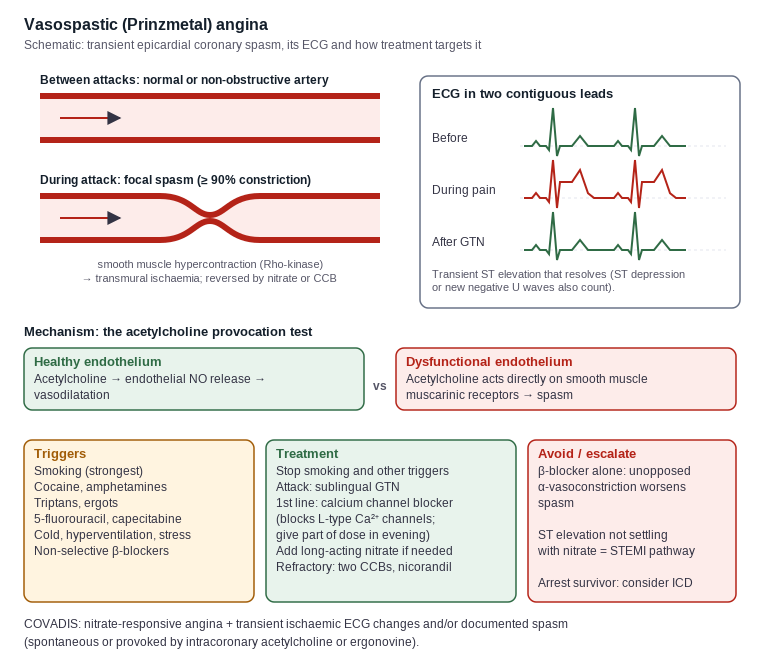
Vasospastic angina, first described by Prinzmetal as 'variant angina', is myocardial ischaemia caused by transient, intense constriction of an epicardial coronary artery. Unlike atherosclerotic stable angina, attacks typically occur at rest, at night or in the early morning, last minutes, respond rapidly to nitrates and are accompanied by transient ST elevation (or depression) that returns to normal as pain settles. It is part of the spectrum of ischaemia with non-obstructive coronary arteries (INOCA) and of MINOCA. Smoking is the strongest risk factor; stimulants, triptans, ergots, fluoropyrimidines, cold and hyperventilation are triggers, and it is commoner in East Asians. Diagnosis uses the COVADIS criteria: nitrate-responsive angina, transient ischaemic ECG changes and documented spasm, often provoked with intracoronary acetylcholine. Treatment is smoking cessation, trigger avoidance and calcium channel blockers, with long-acting nitrates added if needed; beta-blockers used alone can worsen spasm. Most do well, but spasm can cause MI, arrhythmias and sudden death.
Patient case, mechanism, investigations, management, flashcards and exam-style questions.Open the lesson →
Key facts
- Vasospastic angina = transient epicardial coronary spasm causing rest angina, typically at night or early morning, with preserved exercise capacity
- Transient ST elevation during pain that resolves with nitrate or spontaneously is the classic ECG; ST depression or new negative U waves also count
- COVADIS criteria: nitrate-responsive angina, transient ischaemic ECG changes, and angiographic spasm (90% or more constriction) – spontaneous or provoked
- Intracoronary acetylcholine (or ergonovine) provocation during angiography is the definitive test when spontaneous episodes are not captured
- Smoking is the strongest modifiable risk factor; cocaine, amphetamines, triptans, ergots, 5-fluorouracil or capecitabine, cold and hyperventilation can trigger spasm
- First-line therapy is a calcium channel blocker (e.g. diltiazem, verapamil, amlodipine or nifedipine), often given in the evening; add long-acting nitrate if needed
- Avoid beta-blockers alone (especially non-selective ones such as propranolol): unopposed alpha-adrenergic vasoconstriction can worsen spasm
- Survivors of cardiac arrest due to vasospasm should be considered for an ICD in addition to maximal medical therapy
Differential diagnosis
| Condition | Clues | Key test |
|---|---|---|
| Stable (atherosclerotic) angina | Exertional pain relieved by rest; fixed threshold | CT coronary angiography or stress imaging |
| Acute STEMI | Persistent ST elevation not resolving with nitrate, rising troponin | Emergency angiography |
| Microvascular angina | Exertional or rest angina, slow nitrate response, no epicardial spasm | Coronary flow reserve, IMR, acetylcholine testing |
| Spontaneous coronary artery dissection | Young or peripartum woman, emotional or physical stress | Angiography or intravascular imaging |
| Takotsubo syndrome | Emotional trigger, apical ballooning, postmenopausal woman | Echo, angiography, CMR |
| Cocaine-associated chest pain | Recent cocaine use, sympathomimetic signs | Toxicology, ECG, troponin |
| Oesophageal spasm | Retrosternal pain with dysphagia, may also respond to nitrates | Oesophageal manometry |
| Acute pericarditis | Pleuritic positional pain, diffuse ST elevation with PR depression, rub | ECG evolution, echo, CRP |
Exam pearls
Guideline
2024 ESC chronic coronary syndromes guideline (ANOCA/INOCA section), COVADIS vasospastic angina criteria (2017), JCS/CVIT/JCC 2023 vasospastic angina focused update, EAPCI 2020 INOCA consensus, 2023 ESC acute coronary syndromes guideline (MINOCA) and 2022 ESC ventricular arrhythmia guideline
References
- Vrints C, Andreotti F, Koskinas KC, et al.. 2024 ESC Guidelines for the management of chronic coronary syndromes. Eur Heart J 2024.
- Beltrame JF, Crea F, Kaski JC, et al.. International standardization of diagnostic criteria for vasospastic angina. Eur Heart J 2017.
- Hokimoto S, Kaikita K, Yasuda S, et al.. JCS/CVIT/JCC 2023 Guideline Focused Update on Diagnosis and Treatment of Vasospastic Angina (Coronary Spastic Angina) and Coronary Microvascular Dysfunction. Circ J 2023.
- Kunadian V, Chieffo A, Camici PG, et al.. An EAPCI Expert Consensus Document on Ischaemia with Non-Obstructive Coronary Arteries in Collaboration with European Society of Cardiology Working Group on Coronary Pathophysiology & Microcirculation Endorsed by Coronary Vasomotor Disorders International Study Group. Eur Heart J 2020.
- Ford TJ, Stanley B, Good R, et al.. Stratified Medical Therapy Using Invasive Coronary Function Testing in Angina: The CorMicA Trial. J Am Coll Cardiol 2018.
- Byrne RA, Rossello X, Coughlan JJ, et al.. 2023 ESC Guidelines for the management of acute coronary syndromes. Eur Heart J 2023.
Related topics
By Dr Khalid Seidi (B.Sc., M.D.) · MedEd World Clinical Knowledge library. Original teaching content checked against current guidelines (November 2026); confirm the latest local guidance before clinical use. Not a substitute for clinical judgement.