Clinical Knowledge › Neurology › Cerebrovascular disease
CADASIL
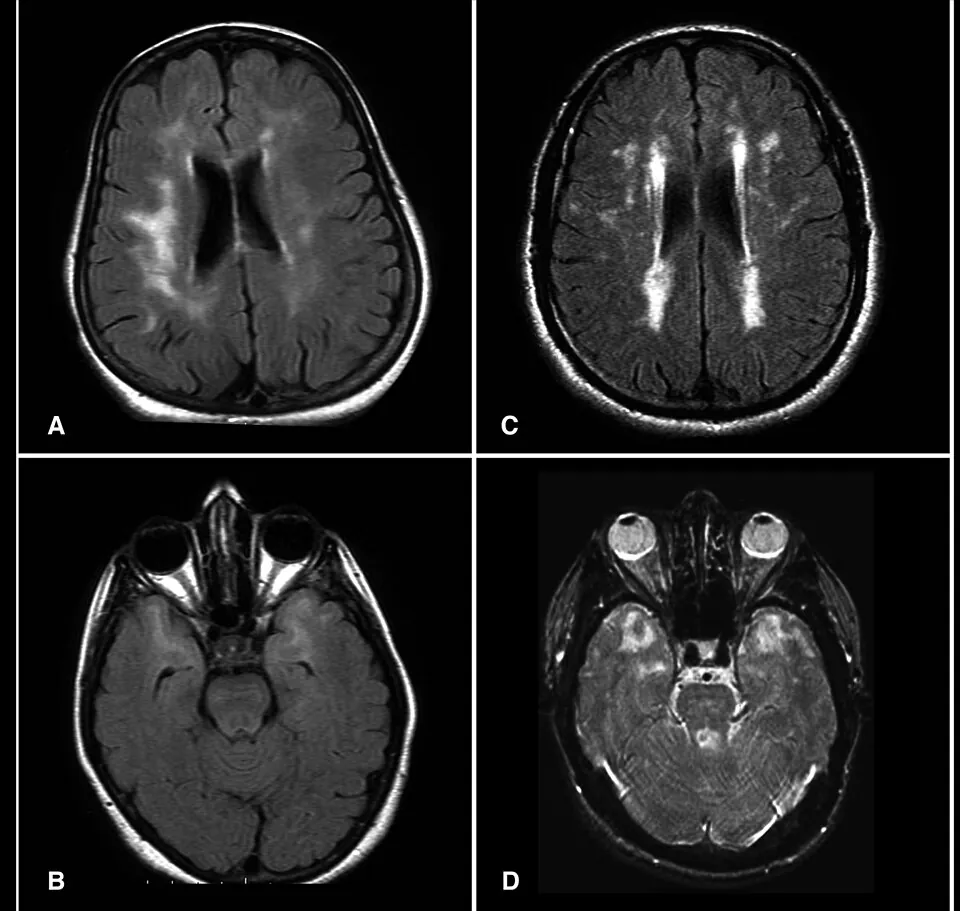
CADASIL (cerebral autosomal dominant arteriopathy with subcortical infarcts and leukoencephalopathy) is the commonest inherited cause of stroke and vascular dementia. It is caused by cysteine-altering mutations in the epidermal growth factor-like repeat domains of NOTCH3 on chromosome 19 that cause granular osmiophilic material to accumulate around degenerating smooth muscle cells of small penetrating arteries. Typical features appear in sequence: migraine with aura from the 20s–30s, recurrent lacunar strokes or TIAs from the 40s–50s, mood disturbance and apathy, and progressive subcortical cognitive decline with gait disorder. MRI shows extensive white matter hyperintensities that characteristically involve the anterior temporal poles and external capsules, with lacunes and microbleeds. Diagnosis is confirmed by NOTCH3 genetic testing, or by skin biopsy showing granular osmiophilic material. There is no disease-modifying therapy; management focuses on vascular risk control, antiplatelets after ischaemic events, symptomatic treatment and genetic counselling.
Patient case, mechanism, investigations, management, flashcards and exam-style questions.Open the lesson →
Key facts
- CADASIL is the most common monogenic cause of stroke; autosomal dominant inheritance of NOTCH3 mutations (chromosome 19p13)
- Mutations add or remove a cysteine in one of the 34 EGF-like repeats, causing NOTCH3 extracellular domain aggregation
- Pathological hallmark: granular osmiophilic material (GOM) next to smooth muscle cells of small arteries on electron microscopy (also seen in skin biopsy)
- Clinical sequence: migraine with aura (20s–30s) → lacunar strokes/TIAs (40s–50s) → mood disorder, apathy → subcortical dementia
- MRI: confluent white matter hyperintensities with anterior temporal pole and external capsule involvement, lacunes and microbleeds, often out of proportion to vascular risk factors
- Diagnosis: NOTCH3 sequencing (exons 2–24); skin biopsy for GOM if genetic result uncertain
- No disease-modifying treatment; control vascular risk factors and stop smoking; antiplatelets after ischaemic stroke; avoid unnecessary anticoagulation
- Cysteine-altering NOTCH3 variants are present in about 1 in 300–400 people in population databases, mostly with milder disease, showing a wide phenotypic spectrum
Differential diagnosis
| Condition | Clues | Key test |
|---|---|---|
| Sporadic hypertensive small vessel disease | Older, hypertension and diabetes, temporal poles spared | MRI pattern; NOTCH3 negative |
| Multiple sclerosis | Relapsing–remitting, ovoid periventricular and juxtacortical lesions, optic neuritis | MRI dissemination, CSF oligoclonal bands |
| Fabry disease | Posterior circulation strokes, neuropathic pain, angiokeratoma, renal and cardiac disease | Alpha-galactosidase A activity, GLA gene |
| MELAS | Stroke-like episodes not respecting vascular territories, seizures, lactic acidosis, short stature | Lactate, mitochondrial DNA testing (m.3243A>G) |
| CARASIL (HTRA1) | Autosomal recessive, early alopecia and spondylosis | HTRA1 testing |
| COL4A1/2 angiopathy | Porencephaly, haemorrhage, retinal arteriolar tortuosity, cataract | COL4A1/2 genes |
| Primary angiitis of the CNS | Headache, subacute encephalopathy, multifocal infarcts | CSF, angiography, biopsy |
Exam pearls
Guideline
EAN 2020 consensus recommendations on monogenic cerebral small vessel diseases (diagnosis and therapy); ESO 2023 small vessel disease guidance; AHA/ASA 2021 secondary prevention guideline
References
- Mancuso M, Arnold M, Bersano A, et al.. Monogenic cerebral small-vessel diseases: diagnosis and therapy. Consensus recommendations of the European Academy of Neurology. Eur J Neurol 2020.
- Wardlaw JM, Chabriat H, de Leeuw FE, et al.. European Stroke Organisation (ESO) guideline on cerebral small vessel disease, part 2, lacunar ischaemic stroke. Eur Stroke J 2023.
- Kleindorfer DO, Towfighi A, Chaturvedi S, et al.. 2021 Guideline for the Prevention of Stroke in Patients With Stroke and Transient Ischemic Attack. Stroke 2021.
- Joutel A, Corpechot C, Ducros A, et al.. Notch3 mutations in CADASIL, a hereditary adult-onset condition causing stroke and dementia. Nature 1996.
- Chabriat H, Joutel A, Dichgans M, Tournier-Lasserve E, Bousser MG. CADASIL. Lancet Neurol 2009.
- Rutten JW, Dauwerse HG, Gravesteijn G, et al.. Archetypal NOTCH3 mutations frequent in public exome: implications for CADASIL. Ann Clin Transl Neurol 2016.
Related topics
By Dr Khalid Seidi (B.Sc., M.D.) · MedEd World Clinical Knowledge library. Original teaching content checked against current guidelines (November 2026); confirm the latest local guidance before clinical use. Not a substitute for clinical judgement.