Clinical Knowledge › Neurology › Cerebrovascular disease
Transient ischaemic attack (TIA)
A transient ischaemic attack is a transient episode of neurological dysfunction caused by focal brain, spinal cord or retinal ischaemia without acute infarction. Most episodes last minutes and resolve within an hour. TIA is a medical emergency: the risk of stroke is highest in the first 48 hours, and urgent assessment and treatment reduce early recurrent stroke by about 80%. Typical symptoms are sudden negative focal deficits – unilateral weakness or numbness, speech disturbance, amaurosis fugax, homonymous hemianopia – whereas positive spreading symptoms, isolated dizziness, syncope or confusion suggest mimics. NICE NG128 advises aspirin 300 mg immediately and specialist assessment within 24 hours for everyone with a suspected TIA, without using ABCD2 scores to triage. Investigations include MRI DWI, carotid imaging and ECG monitoring. Short-term dual antiplatelet therapy (aspirin plus clopidogrel for 21 days) is recommended for high-risk TIA, followed by long-term secondary prevention: statin, BP control, anticoagulation for AF and carotid endarterectomy for symptomatic stenosis.
Patient case, mechanism, investigations, management, flashcards and exam-style questions.Open the lesson →
Key facts
- Tissue-based definition: transient focal deficit without infarction on imaging (most last <1 h)
- Stroke risk after TIA is highest in the first 48 hours; urgent treatment reduces early stroke by about 80% (EXPRESS)
- NICE NG128: aspirin 300 mg immediately (unless contraindicated) and specialist review within 24 hours of onset
- NICE does not recommend ABCD2 or other risk scores to triage TIA urgency
- DAPT: aspirin + clopidogrel for 21 days (then single antiplatelet) for high-risk TIA (ABCD2 ≥4) or minor stroke, started within 24 h (up to 72 h in atherosclerotic disease)
- MRI DWI is the preferred imaging; about a third of 'TIAs' show infarction (then reclassified as stroke)
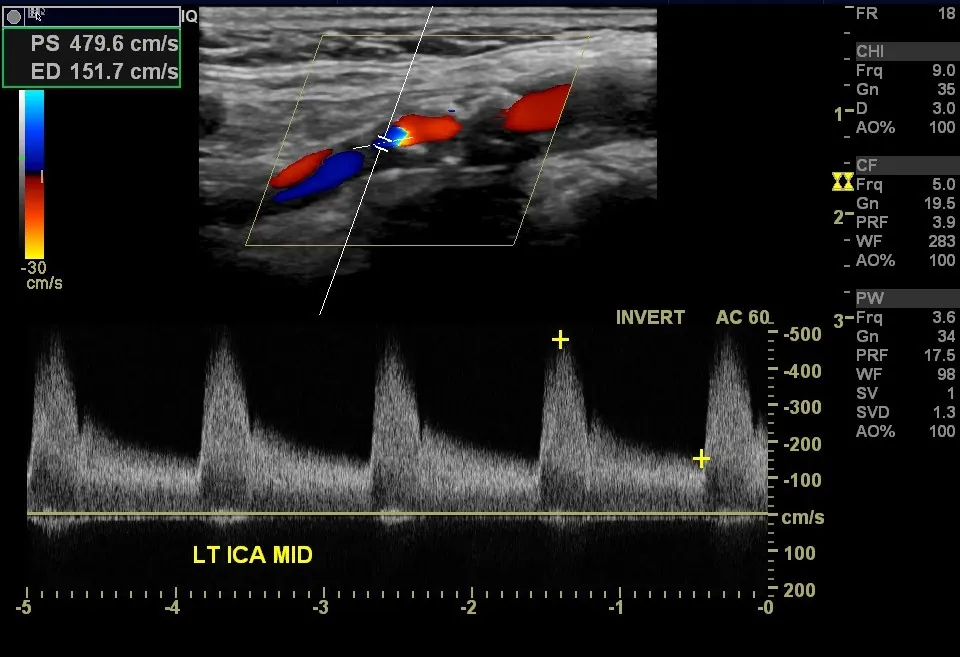
- Carotid imaging urgently; endarterectomy within 2 weeks for symptomatic 50–99% stenosis
- Driving (UK DVLA Group 1): no driving for 1 month after TIA; Group 2: 1 year
Differential diagnosis
| Condition | Clues | Key test |
|---|---|---|
| Migraine aura | Positive visual or sensory symptoms spreading over 5–60 min, followed by headache | Clinical history |
| Focal seizure | Positive jerking or tingling, march, post-ictal weakness | EEG, MRI |
| Hypoglycaemia | Diabetes on insulin or sulfonylurea; symptoms resolve with glucose | Capillary glucose |
| Syncope | Global loss of consciousness, prodrome, no focal deficit | ECG, lying/standing BP |
| Peripheral vestibular disorder | Isolated vertigo with positional triggers | Dix–Hallpike, HINTS |
| Transient global amnesia | Isolated anterograde amnesia for hours, no focal signs | Clinical |
| Functional neurological disorder | Non-anatomical symptoms, positive signs | Clinical |
Exam pearls
Guideline
NICE NG128 Stroke and TIA (2019, updated 2025), UK National Clinical Guideline for Stroke (2023), AHA/ASA 2021 secondary stroke prevention guideline and AHA/ASA 2009 TIA definition statement
References
- National Institute for Health and Care Excellence (NICE). Stroke and transient ischaemic attack in over 16s: diagnosis and initial management (NG128). NICE guideline 2019.
- Intercollegiate Stroke Working Party. National Clinical Guideline for Stroke for the UK and Ireland. Intercollegiate Stroke Working Party 2023.
- Kleindorfer DO, Towfighi A, Chaturvedi S, et al.. 2021 Guideline for the Prevention of Stroke in Patients With Stroke and Transient Ischemic Attack. Stroke 2021.
- Easton JD, Saver JL, Albers GW, et al.. Definition and evaluation of transient ischemic attack: a scientific statement for healthcare professionals from the American Heart Association/American Stroke Association Stroke Council. Stroke 2009.
- Rothwell PM, Giles MF, Chandratheva A, et al.. Effect of urgent treatment of transient ischaemic attack and minor stroke on early recurrent stroke (EXPRESS study): a prospective population-based sequential comparison. Lancet 2007.
- Wang Y, Wang Y, Zhao X, et al.. Clopidogrel with aspirin in acute minor stroke or transient ischemic attack. N Engl J Med 2013.
Related topics
By Dr Khalid Seidi (B.Sc., M.D.) · MedEd World Clinical Knowledge library. Original teaching content checked against current guidelines (November 2026); confirm the latest local guidance before clinical use. Not a substitute for clinical judgement.