Clinical Knowledge › Neurology › Cerebrovascular disease
Lacunar stroke syndromes
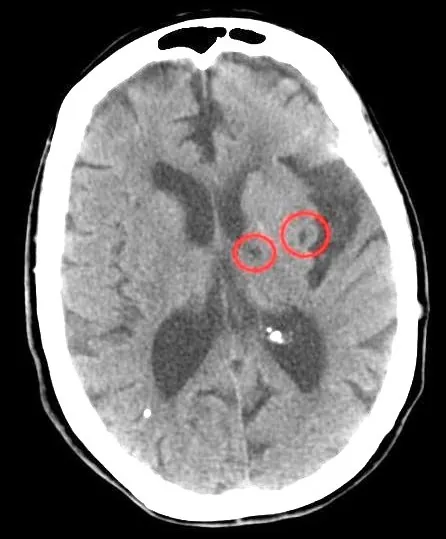
Lacunar strokes are small subcortical infarcts, typically under 15–20 mm, caused by occlusion of a single deep penetrating artery supplying the internal capsule, basal ganglia, thalamus, corona radiata or pons. They cause about a quarter of ischaemic strokes and reflect cerebral small vessel disease, driven mainly by hypertension, diabetes, smoking and age. Patients present with one of the classic lacunar syndromes – pure motor stroke, pure sensory stroke, sensorimotor stroke, ataxic hemiparesis or dysarthria–clumsy hand – without cortical signs such as aphasia, neglect, hemianopia, gaze deviation or reduced consciousness. CT is often normal; diffusion MRI confirms the infarct and shows other small vessel disease markers. Acute treatment is the same as for other ischaemic strokes, including thrombolysis within 4.5 hours, short-term dual antiplatelet therapy for minor stroke, then long-term single antiplatelet therapy, intensive blood pressure control and statins. Early survival is good, but recurrent lacunes lead to cognitive impairment, gait disorder and pseudobulbar palsy.
Patient case, mechanism, investigations, management, flashcards and exam-style questions.Open the lesson →
Key facts
- Lacunar infarct = small (under 15 mm; recent small subcortical infarct up to 20 mm on DWI) deep infarct from occlusion of one penetrating artery
- About 25% of ischaemic strokes; strongest risk factors are hypertension and diabetes
- Five classic syndromes: pure motor (commonest), pure sensory, sensorimotor, ataxic hemiparesis and dysarthria–clumsy hand
- Lacunar syndromes lack cortical signs: no aphasia, neglect, visual field defect, gaze deviation, seizures or depressed consciousness
- Oxfordshire (Bamford) classification: lacunar anterior circulation infarct (LACI) has the best prognosis of the four groups
- Thrombolysis benefits lacunar stroke within 4.5 hours just as in other ischaemic strokes
- Long-term dual antiplatelet therapy is harmful (SPS3): use 21 days of aspirin plus clopidogrel for minor stroke, then a single agent
- Small vessel disease markers on MRI include white matter hyperintensities, lacunes, microbleeds, enlarged perivascular spaces and atrophy
Differential diagnosis
| Condition | Clues | Key test |
|---|---|---|
| Small cortical infarct | Lacunar-like deficit with subtle cortical sign (e.g. mild dysphasia) | MRI DWI shows cortical lesion; embolic work-up |
| Small deep intracerebral haemorrhage | Identical syndrome, may have headache | Non-contrast CT |
| Large-artery or embolic striatocapsular infarct | Larger subcortical lesion, often with cortical signs | MRI size over 20 mm; CTA shows MCA stem disease |
| Hypoglycaemia | Focal weakness in a diabetic patient | Capillary glucose |
| Multiple sclerosis or tumour | Subacute progression, younger patient | MRI pattern and enhancement |
| Todd paresis or migraine aura | Preceding seizure or spreading positive symptoms | History, EEG, normal DWI |
Exam pearls
Guideline
ESO 2023 guideline on cerebral small vessel disease part 2 (lacunar ischaemic stroke); AHA/ASA 2026 acute ischaemic stroke guideline; AHA/ASA 2021 secondary prevention guideline; NICE NG128
References
- Wardlaw JM, Chabriat H, de Leeuw FE, et al.. European Stroke Organisation (ESO) guideline on cerebral small vessel disease, part 2, lacunar ischaemic stroke. Eur Stroke J 2023.
- Prabhakaran S, Gonzalez NR, Zachrison KS, et al.. 2026 Guideline for the Early Management of Patients With Acute Ischemic Stroke: a guideline from the American Heart Association/American Stroke Association. Stroke 2026.
- Kleindorfer DO, Towfighi A, Chaturvedi S, et al.. 2021 Guideline for the Prevention of Stroke in Patients With Stroke and Transient Ischemic Attack. Stroke 2021.
- National Institute for Health and Care Excellence. Stroke and transient ischaemic attack in over 16s: diagnosis and initial management (NG128). NICE (last updated 2022) 2019.
- SPS3 Investigators; Benavente OR, Hart RG, McClure LA, et al.. Effects of clopidogrel added to aspirin in patients with recent lacunar stroke (SPS3). N Engl J Med 2012.
- Wardlaw JM, Woodhouse LJ, Mhlanga II, et al.. Isosorbide mononitrate and cilostazol treatment in patients with symptomatic cerebral small vessel disease: the Lacunar Intervention Trial-2 (LACI-2). JAMA Neurol 2023.
Related topics
By Dr Khalid Seidi (B.Sc., M.D.) · MedEd World Clinical Knowledge library. Original teaching content checked against current guidelines (November 2026); confirm the latest local guidance before clinical use. Not a substitute for clinical judgement.